Shepard Tone: 12 Steps Up, and the Same Sound Comes Back
Tricks of Ear and Eye Published
Clip 1 climbs 12 semitone steps, and step 13 is the same sound as step 1. Each tone stacks components one octave apart under one fixed envelope, so raising every component a semitone 12 times rebuilds the starting stack. In experiments with tones built on this principle, listeners tended to report the direction of the shorter path between successive components (Chambers et al., 2017) [1]. For every step in clip 1, that shorter path is up.
 Illustration
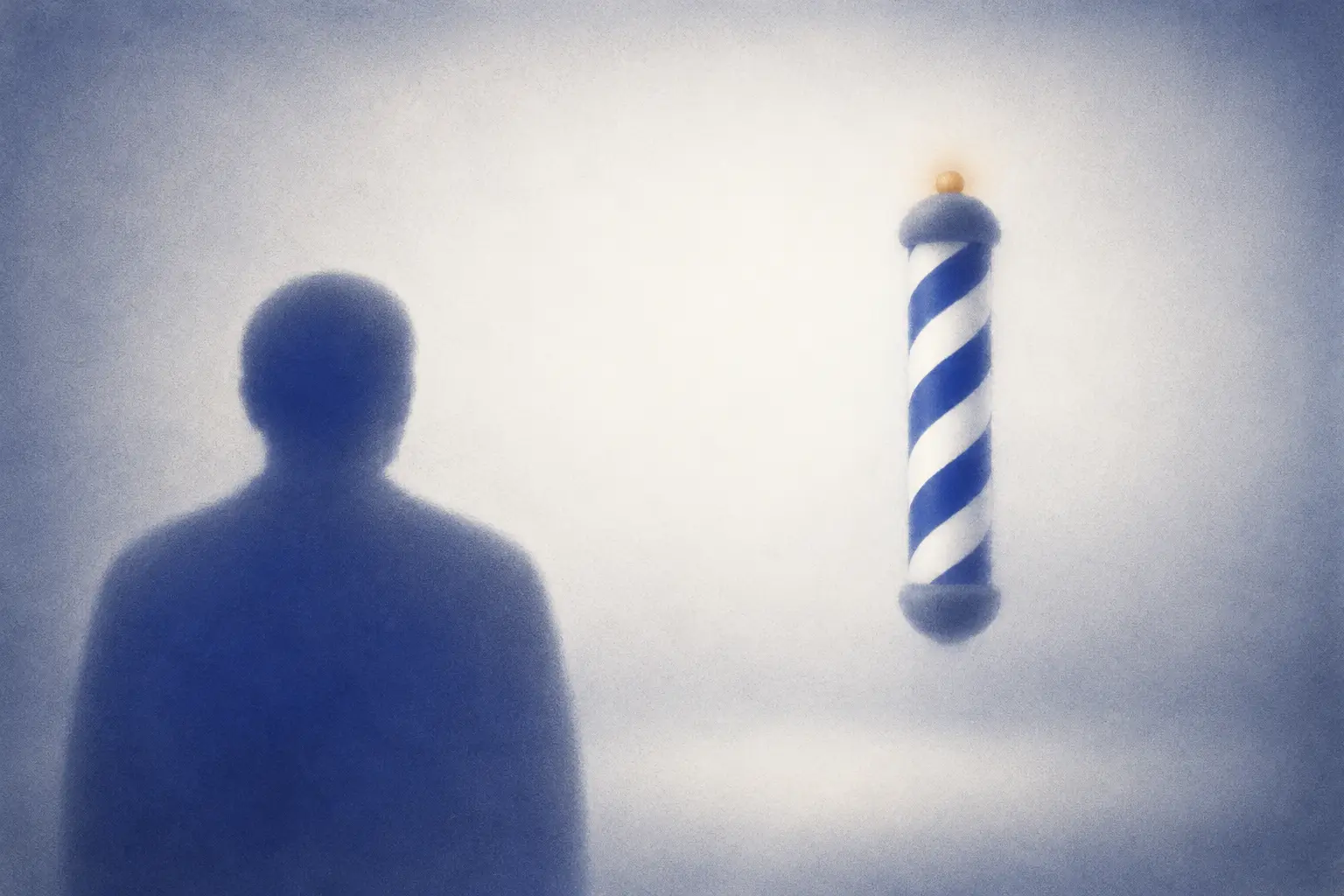
Figure 1. Illustration of a barber pole: its stripes wind around a cylinder.
Illustration: Tricks of Ear and Eye. Generated schematic image — not a photograph, specimen record or perceptual simulation. Reuse permitted with this credit line; provided as is.
Clip 1: one round of 12 steps
Turn your volume down before you press play.
Clip 1. Thirteen half-second tones, each a semitone above the last; tone 13 has the same components as tone 1.
13 tones of 0.5 s, each 1 semitone up; octave-spaced partials, envelope centred at 500 Hz; tone 13 equals tone 1
Length · MP3, starts only when you press play
- Download this clip (MP3)
- Synthesis parameters (JSON, shepard-tone-audio-13-steps.json) (where it comes from and its license, JSON)
- Spectrum check output (CSV, shepard-tone-audio-13-steps-verify.csv) (where it comes from and its license, JSON)
The spectrum check shows that the clip was synthesized with the parameters above. It does not show that any listener will hear the effect.
Sound: Tricks of Ear and Eye, CC BY 4.0
Full credit line to copy
"Shepard tone, clip 1: one round of 12 steps" by Tricks of Ear and Eye, https://tricksofearandeye.com/sound/shepard-tone/, licensed under CC BY 4.0, https://creativecommons.org/licenses/by/4.0/
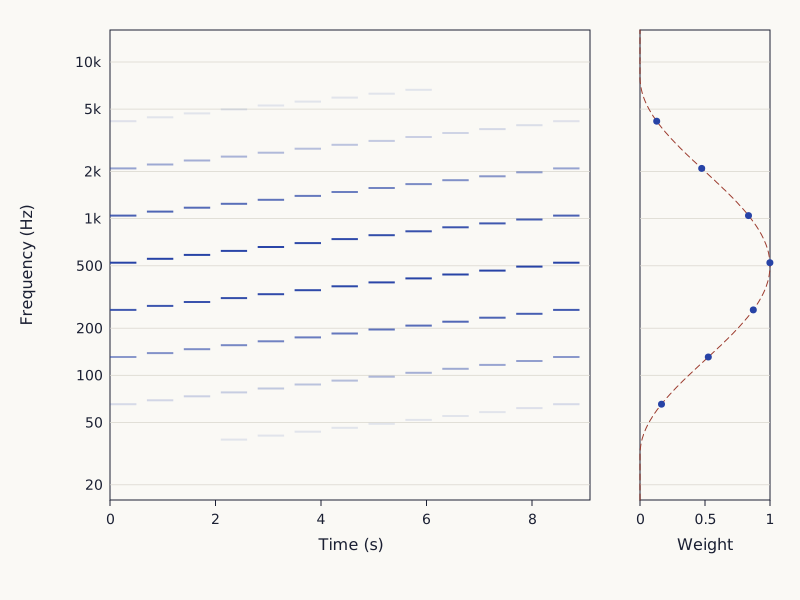
Play clip 1 once at a low volume. Its 13 tones last half a second each, with 0.2-second gaps, 9.1 seconds in all. Each tone has eight components with non-zero weight, an octave apart, between about 31 hertz and 8 kilohertz.
Wide drawing on a small screen: swipe sideways, or open it full size.
Figure 2. Clip 1 measured from the saved file: one dash per component of at least 1% weight, darker for more weight, with the envelope at right.
Chart: Tricks of Ear and Eye, CC BY 4.0
Full credit line to copy
"Shepard tone, clip 1: time-frequency plot" by Tricks of Ear and Eye, https://tricksofearandeye.com/sound/shepard-tone/, licensed under CC BY 4.0, https://creativecommons.org/licenses/by/4.0/
In Figure 2, every row of dashes climbs a little at each step. By tone 13 the pattern is back where it started.
The check behind Figure 2 found every step at 100 cents (one semitone), and tones 13 and 1 matching down to its floor of −240 decibels (clip 1 check (CSV) (where the data come from and its license, JSON)). That shows how the file was built, not what anyone hears. For a note started by a hammer instead, see the piano hammer entry.
Why is step 13 the same as step 1?
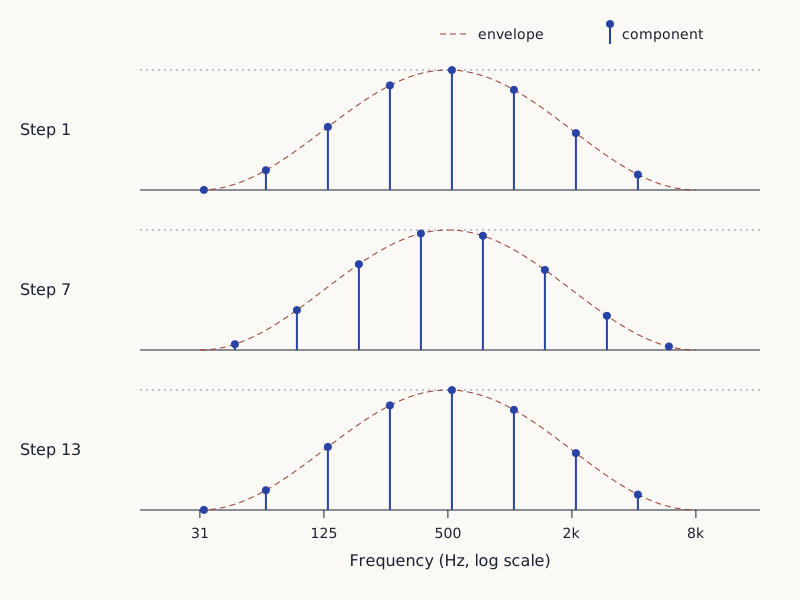
Figure 3 below draws steps 1, 7 and 13 on one frequency axis. The dashed envelope sets each component's weight by its place on a log-frequency scale. It never moves. Each step multiplies every frequency by 21/12, about 1.05946, so 12 steps multiply it by exactly 2 (computed for this page).
Wide drawing on a small screen: swipe sideways, or open it full size.
Figure 3. Steps 1, 7 and 13 of clip 1: components shift right under a fixed envelope, and step 13 lands on step 1.
Diagram: Tricks of Ear and Eye, CC BY 4.0
Full credit line to copy
"Shepard tone components under a fixed envelope, steps 1, 7 and 13" by Tricks of Ear and Eye, https://tricksofearandeye.com/sound/shepard-tone/, licensed under CC BY 4.0, https://creativecommons.org/licenses/by/4.0/
After 12 steps, each component stands where its upper neighbor stood at step 1. The top one has slid past 8 kilohertz, where its weight is zero, and a new one has faded in at the bottom. So step 13 repeats the eight frequencies and weights of step 1 (component table (CSV) (where the data come from and its license, JSON); drawing check (CSV) (where the data come from and its license, JSON)).
Siedenburg, Graves and Pressnitzer (2023) describe the same construction, in which a full octave shift is acoustically identical to no shift at all [2]. They trace these tones to Roger Shepard's 1964 paper, "Circularity in judgments of relative pitch" [3]. This site has only its bibliographic record. The clips' envelope numbers are this page's own.
The voice-in-gas entry splits a voice into two similar layers: a source and a filter over it. Figure 1's barber pole is only a visual comparison, its stripes winding around a cylinder as these steps wind around an octave.
Two rounds: clip 2
Turn your volume down before you press play.
Clip 2. Twenty-five half-second tones, each a semitone above the last: the 12-step cycle twice.
25 tones of 0.5 s, each 1 semitone up; octave-spaced partials, envelope centred at 500 Hz; tones 13 and 25 equal tone 1
Length · MP3, starts only when you press play
- Download this clip (MP3)
- Synthesis parameters (JSON, shepard-tone-audio-25-steps.json) (where it comes from and its license, JSON)
- Spectrum check output (CSV, shepard-tone-audio-25-steps-verify.csv) (where it comes from and its license, JSON)
The spectrum check shows that the clip was synthesized with the parameters above. It does not show that any listener will hear the effect.
Sound: Tricks of Ear and Eye, CC BY 4.0
Full credit line to copy
"Shepard tone, clip 2: two rounds of 12 steps" by Tricks of Ear and Eye, https://tricksofearandeye.com/sound/shepard-tone/, licensed under CC BY 4.0, https://creativecommons.org/licenses/by/4.0/
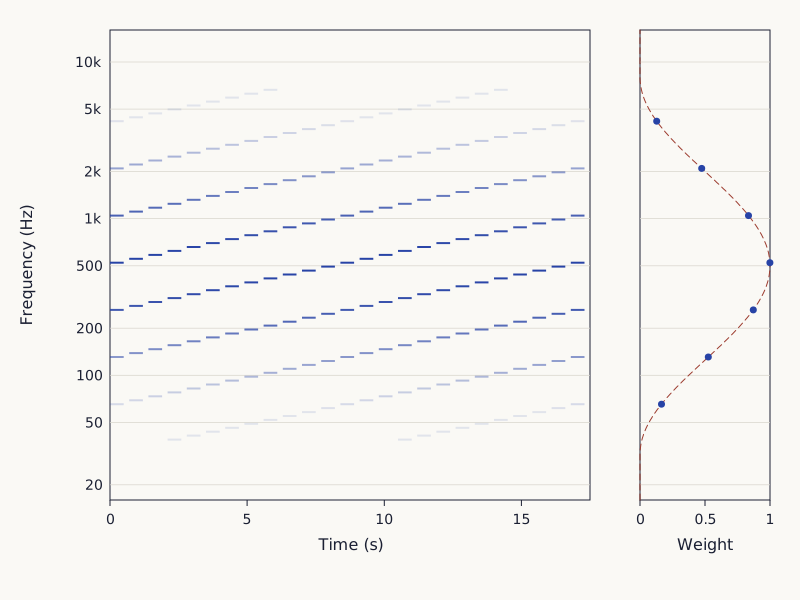
Clip 2 runs the cycle twice, 25 tones in 17.5 seconds. Tone 13 repeats tone 1 by construction, and the check found tone 25 matching tone 1 (clip 2 check (CSV) (where the data come from and its license, JSON)).
Wide drawing on a small screen: swipe sideways, or open it full size.
Figure 4. Clip 2 measured from the saved file: the staircase of Figure 2, run twice.
Chart: Tricks of Ear and Eye, CC BY 4.0
Full credit line to copy
"Shepard tone, clip 2: time-frequency plot" by Tricks of Ear and Eye, https://tricksofearandeye.com/sound/shepard-tone/, licensed under CC BY 4.0, https://creativecommons.org/licenses/by/4.0/
Siedenburg and colleagues describe such a run as the Shepard scale illusion: a sequence whose pitch seems to keep rising, or falling [2]. The Shepard tone is one stacked tone; the scale is the sequence.
Which way is up?
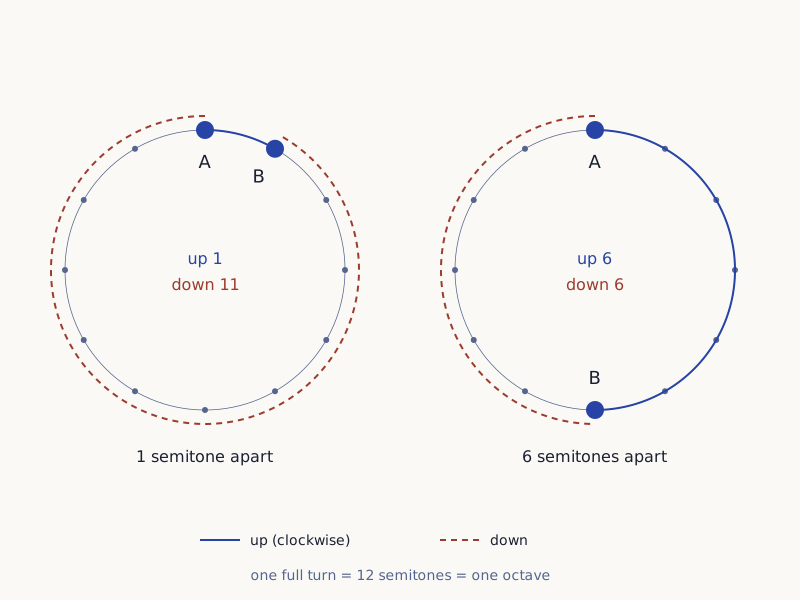
Figure 5 bends one octave into a circle of 12 semitones. Between two tones there are two ways around, one up and one down. They add up to 12.
Wide drawing on a small screen: swipe sideways, or open it full size.
Figure 5. One octave as a circle: a 1-semitone and a 6-semitone change, each counted both ways around.
Diagram: Tricks of Ear and Eye, CC BY 4.0
Full credit line to copy
"One octave as a circle: two tone changes counted both ways" by Tricks of Ear and Eye, https://tricksofearandeye.com/sound/shepard-tone/, licensed under CC BY 4.0, https://creativecommons.org/licenses/by/4.0/
Chambers and colleagues (2017) played pairs of Shepard tones to 11 listeners and asked which was higher. Unlike this page's clips, their envelope was centered at 960 hertz and each tone lasted 125 milliseconds [1]. Replicating earlier work, listeners tended to report the direction of the shorter log-frequency distance between successive components. At half an octave, where neither way is shorter, reports split evenly between up and down [1].
In this site's terms, hearing translates each step by its nearer reading, so a file that goes round in circles can come out as a climb. Without the metaphor: each step in clip 1 is one semitone up or 11 down, and listeners in these experiments tended to report the smaller change [1]. In Siedenburg and colleagues' first experiment, 12 listeners judging their own tones showed the same general trend [2].
It is a tendency, not a law. The cues behind "up" and "down" judgments were weighted differently by different listeners [2], and tones played just before an ambiguous pair almost fully decided its direction [1]. Your own report, on your own speakers, may differ.
According to the abstract of Deutsch (1992), two such tones a half-octave apart are heard as ascending by some listeners and descending by others, the tritone paradox, and how it is heard relates to the listener's speech, including dialect [4].
The Müller-Lyer illusion entry has a visual case of a similar split: two lines measured equal and judged unequal. For a frequency that changes smoothly instead of in steps, see the Doppler effect entry.
Sources
- Chambers, C., Akram, S., Adam, V., Pelofi, C., Sahani, M., Shamma, S., & Pressnitzer, D. (2017). Prior context in audition informs binding and shapes simple features. Nature Communications 8: 15027. Open the sourceRead: full textText license: CC BY 4.0
- Siedenburg, K., Graves, J., & Pressnitzer, D. (2023). A unitary model of auditory frequency change perception. PLoS Computational Biology 19(1): e1010307. Open the sourceRead: full textText license: CC BY 4.0
- Shepard, R. N. (1964). Circularity in judgments of relative pitch. The Journal of the Acoustical Society of America 36(12): 2346–2353. Open the sourceRead: bibliographic record only
- Deutsch, D. (1992). Some new pitch paradoxes and their implications. Philosophical Transactions of the Royal Society of London. Series B, Biological Sciences 336(1278): 391–397. Open the sourceRead: abstract only
Sense check:
One step, under a minute
Turn your volume down, play clip 2 once, and count the steps before you would say the scale has started over, if it ever does. Then find that step in Figure 4 and compare its components with those of tone 1. Next: Doppler effect · Müller-Lyer illusion
Related entries
 Illustration
Doppler Effect: Listeners Report a Rise the Frequency Lacks
Sound
Five synthesized passes, 20 to 300 km/h: at a steady speed in a straight line, the frequency only falls. Listeners in a 1996 study still reported a rise.
Image credit
Illustration: Tricks of Ear and Eye. Generated schematic image — not a photograph, specimen record or perceptual simulation. Reuse permitted with this credit line; provided as is.
Why Helium Changes Your Voice: Its Resonances Rise
Sound
In heliox, a voice's source frequency barely shifts while its resonances rise. Two synthetic clips share a 120 Hz source; one has resonances 1.85 times higher.
Image credit
"Early launch of radiosonde, Washington, D.C., 1936" by NOAA Photo Library — https://commons.wikimedia.org/wiki/File:Wea01108_-_Flickr_-_NOAA_Photo_Library.jpg — CC BY 2.0 (https://creativecommons.org/licenses/by/2.0/)
Cite this page
Tricks of Ear and Eye. "Shepard Tone: 12 Steps Up, and the Same Sound Comes Back." Tricks of Ear and Eye. Published 2026-10-30. https://tricksofearandeye.com/sound/shepard-tone/. Accessed on the date you read it.