Grand Piano Hammer: Normally, It Strikes in Free Flight
Tricks of Ear and Eye Published
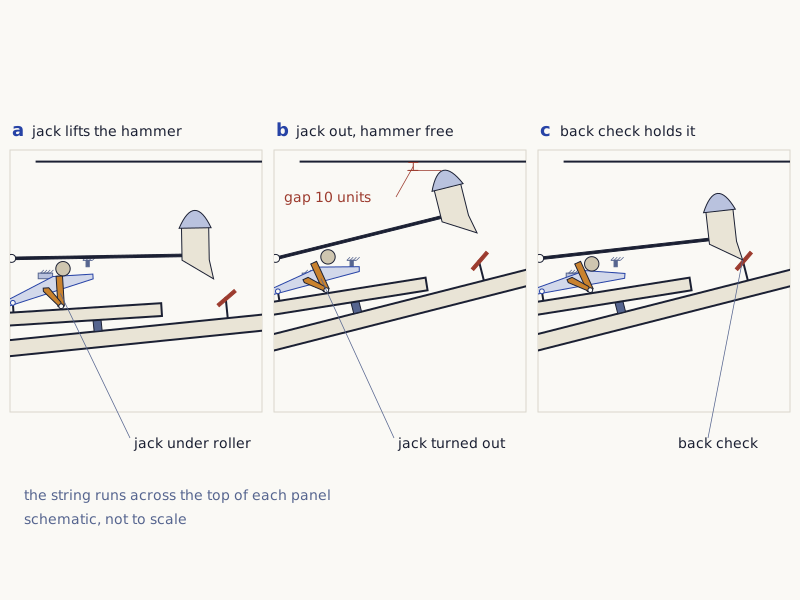
In Figure 3b, the jack has slipped out and the hammer is still short of the string. In a grand piano, the jack that lifts the hammer is tripped just before the strike. The hammer covers the last stretch on its own, hits the string and bounces back. Askenfelt and Jansson (1988) timed this on a grand piano: with normal regulation, the action always lost contact with the hammer before it reached the string [1].
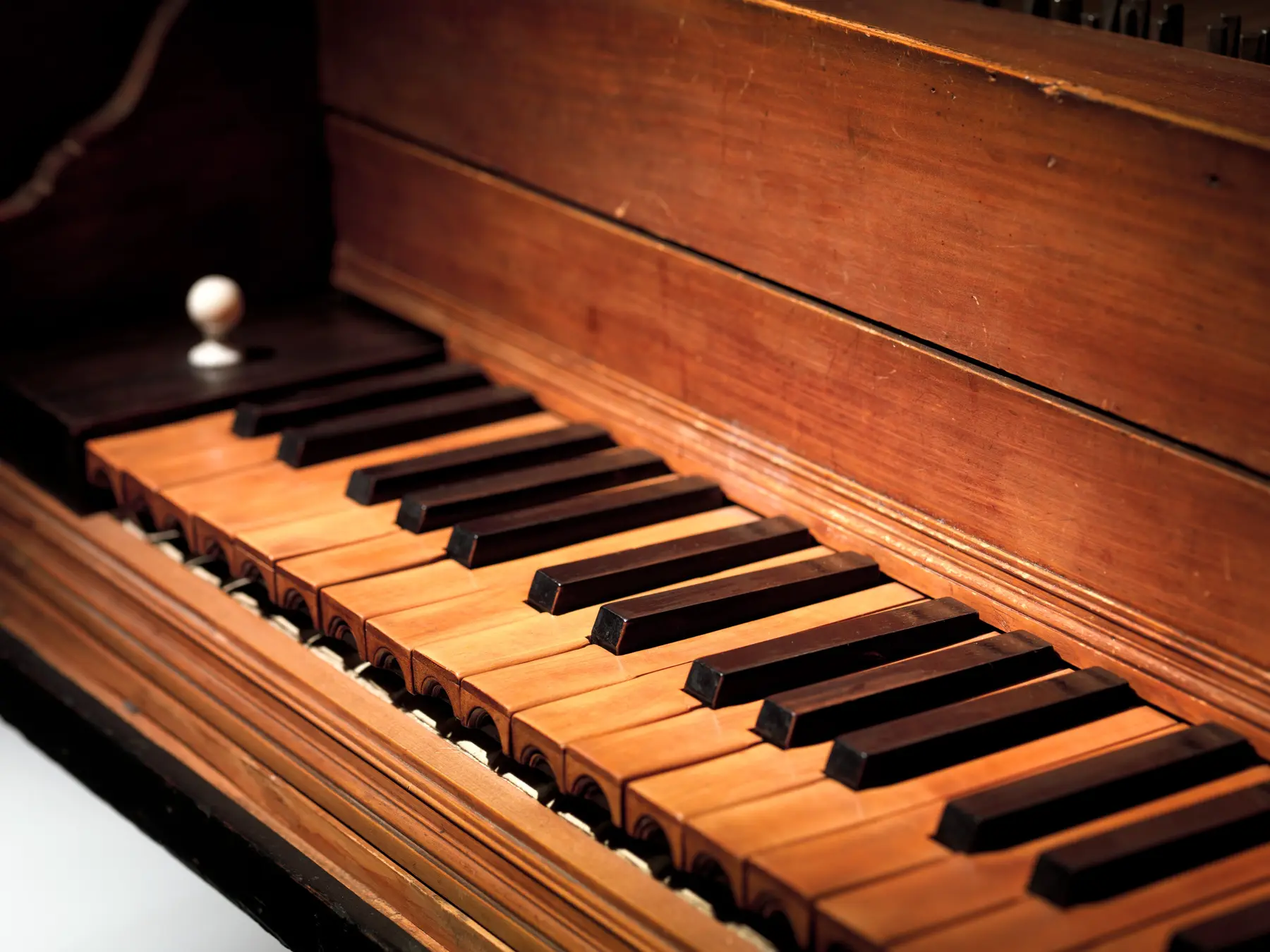
Figure 1. A grand piano made by Bartolomeo Cristofori in Florence in 1720, now in the Metropolitan Museum of Art (89.4.1219).
"Grand Piano, Bartolomeo Cristofori, Florence, 1720 (Metropolitan Museum of Art 89.4.1219)" by The Metropolitan Museum of Art — https://commons.wikimedia.org/wiki/File:Grand_Piano_MET_DP300910.jpg — CC0 1.0 (https://creativecommons.org/publicdomain/zero/1.0/)
From key to string
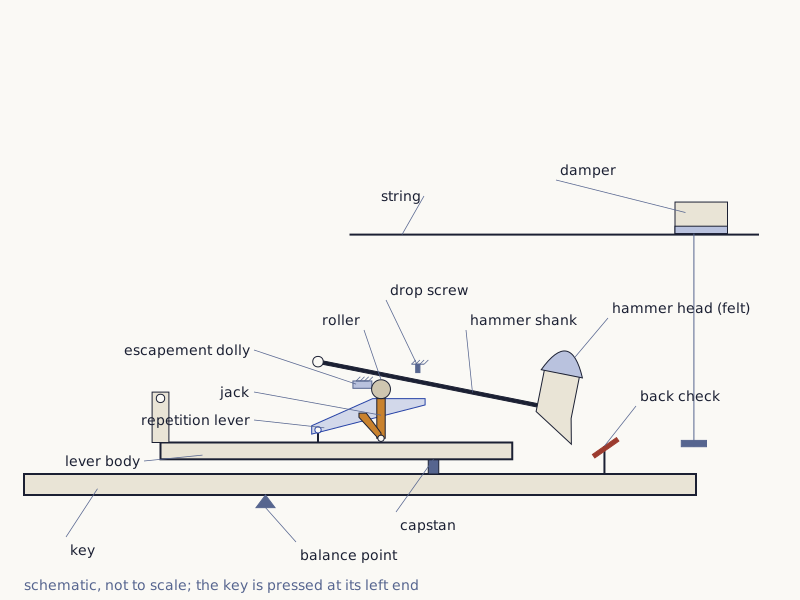
Figure 2 shows one key and its action at rest. You press the key at its left end; the key turns on its balance point, and the capstan on its far side lifts the lever body. The lever body carries the jack, a small upright piece whose top sits under the roller on the hammer shank. As the key goes down, the jack pushes the roller up, the shank turns on its pivot, and the felt-covered head swings toward the string [1].
Wide drawing on a small screen: swipe sideways, or open it full size.
Figure 2. One key and its action at rest, drawn for this page as a schematic, not to scale.
Diagram: Tricks of Ear and Eye, CC BY 4.0
Full credit line to copy
"Grand piano action at rest, schematic" by Tricks of Ear and Eye, https://tricksofearandeye.com/instruments/piano-hammer/, licensed under CC BY 4.0, https://creativecommons.org/licenses/by/4.0/
The parts in Figure 2 are sized so that each can be seen. Distances are in the drawing's own units. The geometry check (CSV) (where the data come from and its license, JSON) re-measures every contact and gap in this page's three action drawings (Figures 2, 3 and 6) from the model that drew them. It shows that the drawings are consistent, not that a real action has these proportions.
Askenfelt and Jansson (1988) divide the action of a modern grand into four main parts: the key, the lever body, the hammer and the damper [1]. The key lifts the damper off the string once the hammer is about halfway up, and lets it fall back when the key is released [1]. For the piano they measured, the maker's nominal distance from hammer to string was 47 mm, and the key moved 9.5 mm at the playing end [1]. The levers multiply the key's motion by slightly less than 5, so a full key stroke raises the hammer head about 45 mm [1].
How fast a struck string vibrates depends on its length and on the speed of waves along it. A pulse runs along the string and back, and one round trip, T = 2L/c, is one period [1]. The same length rule sets where a guitar's frets go (guitar fret spacing).
In equal temperament, one semitone is a frequency ratio of 21/12, about 1.05946. From G#3 at 208 Hz [2], four semitones up gives 208 × 1.059464, about 262 Hz, the figure given for C4 [1]. That semitone is the step this site's Shepard tone climbs.
What is let-off?
Figure 3a shows the jack still under the roller and pushing. In panel b, the jack's tail has reached the escapement dolly, a felt-covered stop fixed above it, and the jack has turned out from under the roller. The hammer is on its own, 10 units short of the string. In panel c, it has bounced back onto the back check, a pad on the far end of the key [1].
Wide drawing on a small screen: swipe sideways, or open it full size.
Figure 3. Three moments of one blow, drawn for this page as a schematic: the jack lifts the hammer (a), turns out so the hammer flies free (b), and the back check holds the hammer after the rebound (c).
Diagram: Tricks of Ear and Eye, CC BY 4.0
Full credit line to copy
"Three moments of one blow in a grand piano action, schematic" by Tricks of Ear and Eye, https://tricksofearandeye.com/instruments/piano-hammer/, licensed under CC BY 4.0, https://creativecommons.org/licenses/by/4.0/
| Panel of Figure 3 | Jack | Hammer |
|---|---|---|
| a, key going down | under the roller, pushing up | rising, 60 units below the string |
| b, key at the bottom | tail on the escapement dolly, top turned out from under the roller | traveling alone, 10 units below the string |
| c, key still held down | still turned out | bounced back; roller on the repetition lever, tail on the back check |
Askenfelt and Jansson (1988) call this release the let-off. The dolly stops the tail of the jack and the jack turns back; its top is withdrawn from the roller, and the free hammer goes on up, strikes the string and bounces back [1]. The let-off is set at the dolly by pressing the key slowly and checking the gap between string and hammer at the top of the hammer's travel [1]. For the grand piano in their experiments, the maker's nominal let-off was 1 to 3 mm [1], a gap that Figure 3 draws far larger.
Why can a very slow press miss the string?
That adjustment method explains why a very slow press can leave the string untouched. Pressed slowly, the hammer rises only to within that gap of the string. That is how the gap is checked. For the softest notes, the study says, the hammer should almost turn by itself at the string, and the force on the key must then be barely more than the static force needed to push the key down [1].
The free flight is short. With the let-off set to 1.8 mm, playing C4 at a soft piano level, the hammer swung free for about 2.5 ms before it reached the string [1]. A let-off of 3.8 mm almost doubled that time, and a let-off of 0 mm about halved it [1]. Louder playing shortened the free time, but with normal regulation the contact between action and hammer was always broken before the strike [1].
How fast does the hammer reach the string?
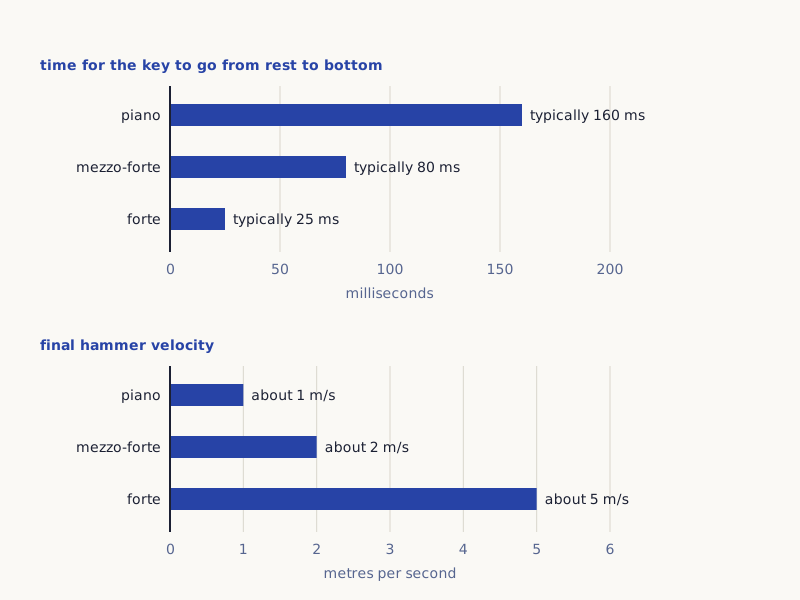
Askenfelt and Jansson tracked the key and the hammer with small lights fixed to them and a position sensor [1]. On the note C4, the key typically took 160 ms to reach the bottom at a piano level (Figure 4) [1]. It took 80 ms at mezzo-forte and 25 ms at forte [1]. Because of the levering, the hammer arrived much faster than the key: about 1, 2 and 5 meters per second, against final key speeds of 0.1, 0.4 and 0.6 m/s [1].
Wide drawing on a small screen: swipe sideways, or open it full size.
Figure 4. Key travel time and final hammer velocity at three dynamic levels on the note C4, from Askenfelt and Jansson (1988).
Chart: Tricks of Ear and Eye, CC BY 4.0
Full credit line to copy
"Key travel time and final hammer velocity at three dynamic levels" by Tricks of Ear and Eye, https://tricksofearandeye.com/instruments/piano-hammer/, licensed under CC BY 4.0, https://creativecommons.org/licenses/by/4.0/
Data: Values from Askenfelt & Jansson 1988, "From touch to string vibrations - the initial course of the piano tone", STL-QPSR 29(1): 31-109, KTH Royal Institute of Technology, p. 63
| Level, note C4 | Time from rest to key bottom | Final key velocity | Final hammer velocity |
|---|---|---|---|
| piano | typically 160 ms | 0.1 m/s | about 1 m/s |
| mezzo-forte | typically 80 ms | 0.4 m/s | about 2 m/s |
| forte | typically 25 ms | 0.6 m/s | about 5 m/s |
The key and the hammer do not finish together. At fortissimo, the key reached its bottom about 5 ms before the hammer struck the string; at mezzo-forte, at about the same moment; at pianissimo, up to 35 ms after [1]. After the strike, the back check caught the returning hammer about 8 ms later in forte and about 20 ms later in piano [1].
Each measured value from the two studies on this page is in the measurement table (CSV) (where the data come from and its license, JSON) Data: Values cited from Askenfelt & Jansson 1988, "From touch to string vibrations - the initial course of the piano tone", STL-QPSR 29(1): 31-109, KTH Royal Institute of Technology and Askenfelt 1991, "Measuring the motion of the piano hammer during string contact", STL-QPSR 32(4): 19-34, KTH Royal Institute of Technology; numbers only, with page references, one value per row, with its page and test conditions.
Does pressing harder change the sound?
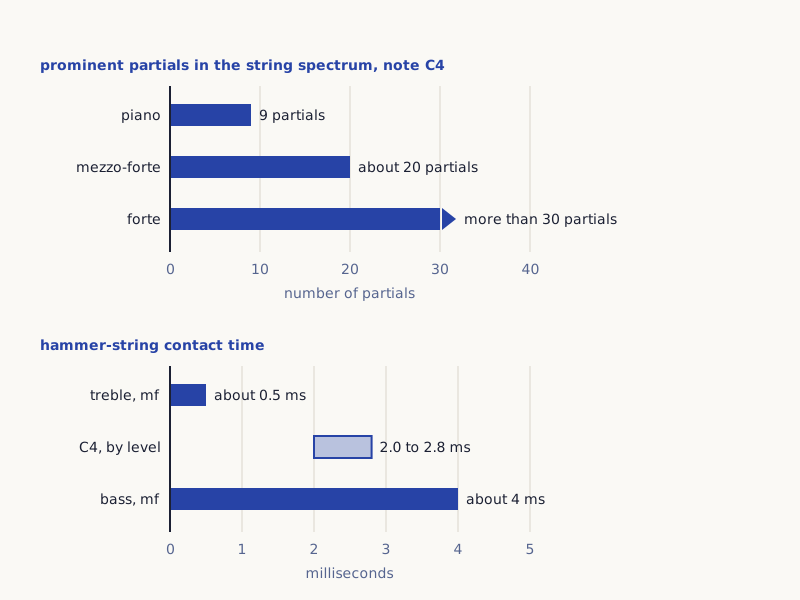
A harder blow does more than raise the level. The hammer felt behaves as a harder material when it is driven faster, so the strike gets shorter and the first pulse on the string gets higher and narrower [1]. For C4, the string spectrum had 9 prominent partials at piano, about 20 at mezzo-forte and more than 30 at forte (Figure 5) [1]. At 3 kHz, the level fell about 15 dB from forte to mezzo-forte and about 15 dB more at piano [1].
Wide drawing on a small screen: swipe sideways, or open it full size.
Figure 5. Prominent partials in the string spectrum of C4 at three dynamic levels, and hammer-string contact times, from Askenfelt and Jansson (1988).
Chart: Tricks of Ear and Eye, CC BY 4.0
Full credit line to copy
"Prominent partials and hammer-string contact times" by Tricks of Ear and Eye, https://tricksofearandeye.com/instruments/piano-hammer/, licensed under CC BY 4.0, https://creativecommons.org/licenses/by/4.0/
Data: Values from Askenfelt & Jansson 1988, "From touch to string vibrations - the initial course of the piano tone", STL-QPSR 29(1): 31-109, KTH Royal Institute of Technology, pp. 54 and 95
| Measure | Condition | Value |
|---|---|---|
| Prominent partials, note C4 | piano | 9 |
| Prominent partials, note C4 | mezzo-forte | about 20 |
| Prominent partials, note C4 | forte | more than 30 |
| Hammer-string contact time | treble, mezzo-forte | about 0.5 ms |
| Hammer-string contact time | note C4, depending on dynamic level | 2.0 to 2.8 ms |
| Hammer-string contact time | bass, mezzo-forte | about 4 ms |
How long does the hammer touch the string?
At mezzo-forte, the contact lasted from about 0.5 ms in the treble to about 4 ms in the bass [1]. Askenfelt (1991) tracked a point near the striking spot with an optical sensor. During contact, that point stayed almost fixed instead of sliding along the string, as if the hammer were "glued" to it [2].
The same study compared three ways of pressing one key (G#3) at nearly the same hammer speed: legato, staccato and a stiff-fingered strike. With a normal hammer shank, the string spectra differed by at most 4 dB [2]. Those differences sat around 6 to 8 kHz, in partials about 50 dB below the low partials [2]. The change from mezzo-forte to forte on the same note was larger: about 5 dB at the lowest partials, rising to 12 dB at 5 kHz [2].
These are measured differences in the string's motion. Neither study ran a formal listening test, and Askenfelt (1991) proposed a listening test of the smallest change in hammer speed that people can detect as a next step [2].
A second blow before the key comes up
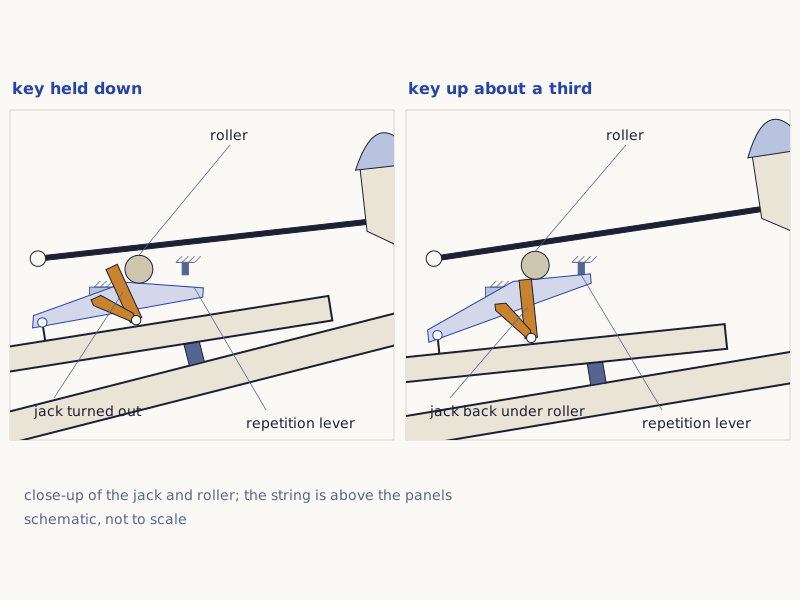
In the left panel of Figure 6, the key is held down after a blow: the jack is still turned out, and the roller rests on the repetition lever. In what Askenfelt and Jansson (1988) call the double-repetition mechanism, the key is let up only about a third of its travel, and the spring-supported repetition lever lifts the hammer slightly [1]. The spring-loaded jack can then slip back under the roller (Figure 6, right), and the action is set for a second blow [1]. The damper does not touch the string between the notes [1].
Wide drawing on a small screen: swipe sideways, or open it full size.
Figure 6. The jack and roller with the key held down after a blow (left) and with the key let up about a third (right), drawn for this page as a schematic.
Diagram: Tricks of Ear and Eye, CC BY 4.0
Full credit line to copy
"Repetition in a grand piano action, schematic" by Tricks of Ear and Eye, https://tricksofearandeye.com/instruments/piano-hammer/, licensed under CC BY 4.0, https://creativecommons.org/licenses/by/4.0/
The same study confirmed with measurements that this allows fast repetition on one key. A professional player repeated one key in the middle register at about 8 notes per second with two fingers, or 120 ms between note onsets [1]. With three fingers, the rate rose to about 16 per second [1].
Where the design came from
Askenfelt and Jansson (1988) trace the grand action to a hammer action invented in 1709 by Cristofori, an Italian harpsichord maker; in their account, the French piano maker Érard revised and improved it around 1820 [1]. Writing in 1988, they say its development settled before the turn of the century and that no major changes followed [1]. The piano in Figure 1, one of Cristofori's, is dated 1720 in the museum data on its file page [3].
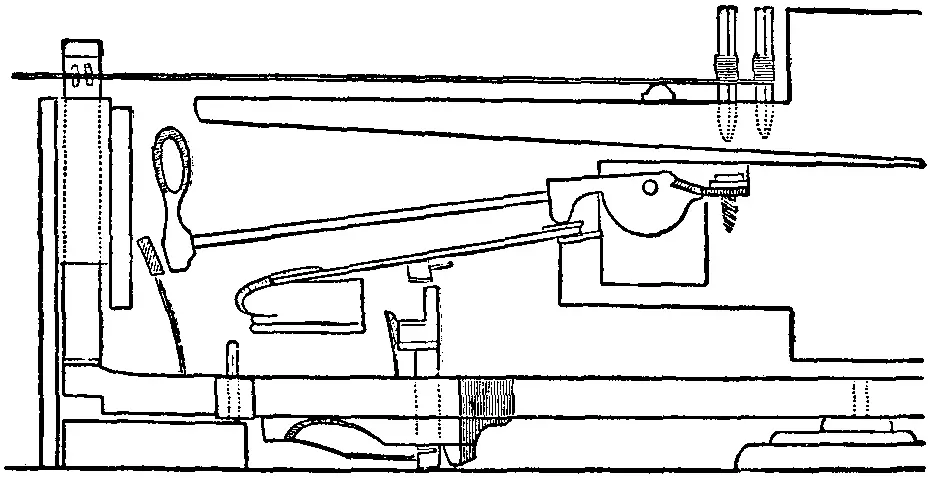
Figure 7. Cristofori's escapement action of 1720, as restored in 1875 by Cesare Ponsicchi, in a plate from the 11th edition of the Encyclopaedia Britannica (1911).
"Cristofori's Escapement Action, 1720 (Encyclopaedia Britannica, 11th edition, 1911)" by Encyclopaedia Britannica, 11th edition, Vol. 21, p. 565, public domain
Full credit line to copy
"Cristofori's Escapement Action, 1720 (Encyclopaedia Britannica, 11th edition, 1911)" by Encyclopaedia Britannica, 11th edition, Vol. 21, p. 565 — https://commons.wikimedia.org/wiki/File:Britannica_Pianoforte_Cristofori_Escapement_Action.png — Public domain (Unsigned plate in the Encyclopaedia Britannica, 11th edition (1911), Vol. 21, p. 565; public domain in the US (published before 1931) and in the EU (anonymous work published more than 70 years ago))
The plate's own caption gives the date and the restoration [4]. This page does not name a first inventor or a first design. The history above is the summary given in the sources read for it; the original documents behind it were not read. The clarinet entry follows the same path, from the player's action to the sound, in a wind instrument.
Sources
- Askenfelt, A., & Jansson, E. V. (1988). From touch to string vibrations: the initial course of the piano tone. STL-QPSR (Speech Transmission Laboratory, Quarterly Progress and Status Report, KTH Royal Institute of Technology) 29(1): 31–109. Open the sourceRead: full text; paraphrased, numbers cited with page references
- Askenfelt, A. (1991). Measuring the motion of the piano hammer during string contact. STL-QPSR (Speech Transmission Laboratory, Quarterly Progress and Status Report, KTH Royal Institute of Technology) 32(4): 19–34. Open the sourceRead: full text; paraphrased, numbers cited with page references
- Bartolomeo Cristofori, Grand Piano, Florence, 1720. The Metropolitan Museum of Art, 89.4.1219 (The Crosby Brown Collection of Musical Instruments, 1889). File description page "Grand Piano MET DP300910.jpg", Wikimedia Commons. Open the sourceRead: full text of the file description page; the museum's own record not read
- "Cristofori's Escapement Action, 1720. Restored in 1875 by Cesare Ponsicchi." Plate in Encyclopædia Britannica, 11th ed., Vol. 21, p. 565 (1911). File description page "Britannica Pianoforte Cristofori Escapement Action.png", Wikimedia Commons. Open the sourceRead: full text of the file description page, including the plate caption


Sense check:
One step, under a minute
Find the panel in Figure 3 where the jack has turned out from under the roller, and read how far the hammer still is from the string, in the figure's units. Then set that beside the piano in the study: a 1.8 mm let-off gap against a 47 mm distance from hammer to string. Next: Guitar fret spacing · Shepard tone
Related entries
 Illustration
Guitar Fret Spacing: Each Gap Is About 5.6% Narrower
Instruments
Fret positions for a 648 mm string: each gap is about 5.61% narrower than the last, and dividing by 18 leaves fret 12 of an ideal string about 12.5 cents flat.
Image credit
Illustration: Tricks of Ear and Eye. Generated schematic image — not a photograph, specimen record or perceptual simulation. Reuse permitted with this credit line; provided as is.
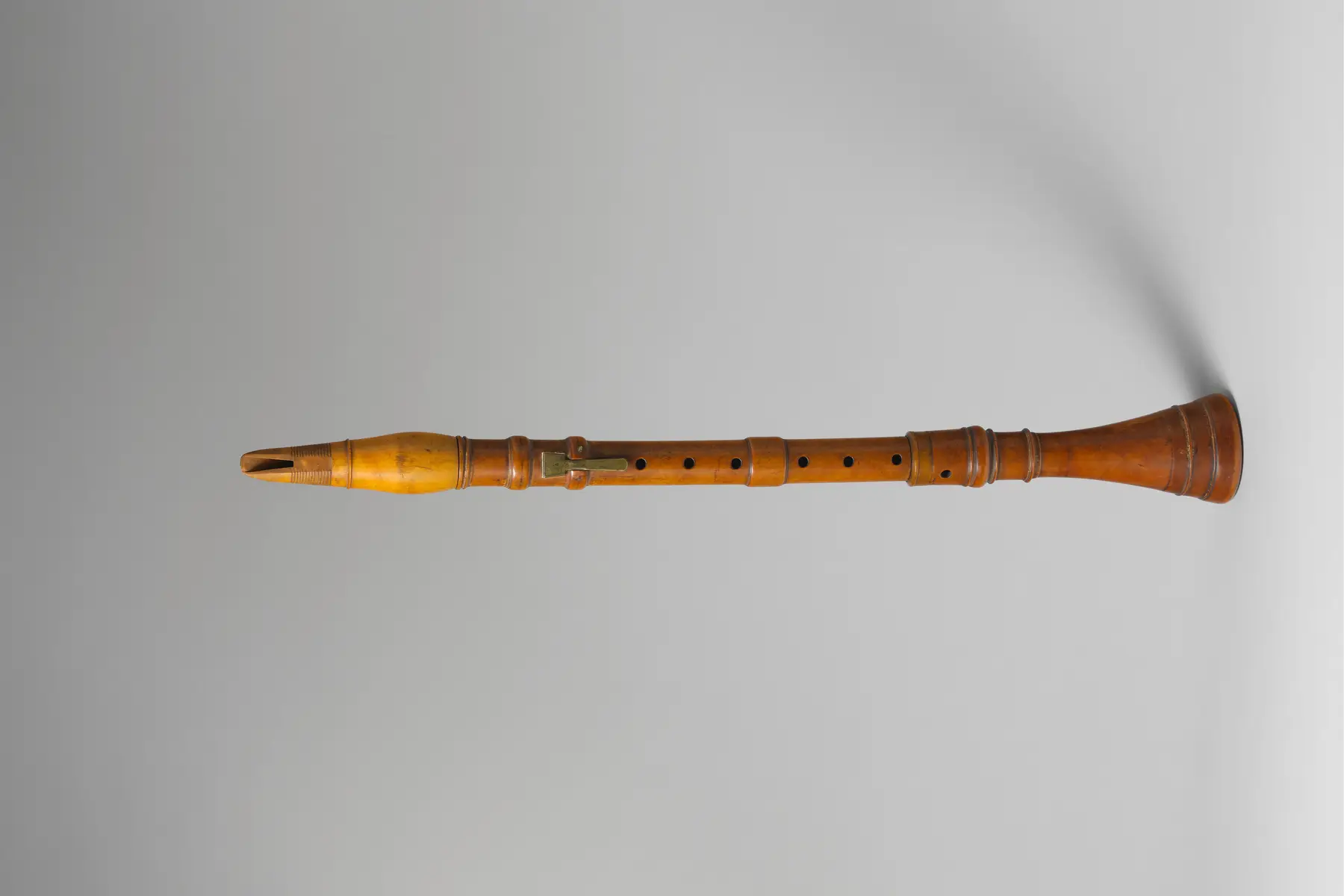
How a Clarinet Works: A Closed Tube Skips the Octave
Instruments
A tube closed at one end resonates at 1, 3 and 5 times its lowest frequency. A clarinet is close to one, so its next register is about a twelfth up.
Image credit
"Clarinet in D" by The Metropolitan Museum of Art — https://commons.wikimedia.org/wiki/File:Clarinet_in_D_MET_DP232753.jpg — CC0 1.0 (https://creativecommons.org/publicdomain/zero/1.0/); modified: rotated 90° counterclockwise and cropped to 3:2; colours not altered
Cite this page
Tricks of Ear and Eye. "Grand Piano Hammer: Normally, It Strikes in Free Flight." Tricks of Ear and Eye. Published 2026-10-30. https://tricksofearandeye.com/instruments/piano-hammer/. Accessed on the date you read it.