Guitar Fret Spacing: Each Gap Is About 5.6% Narrower
Tricks of Ear and Eye Published
On a 648-millimeter string, fret 1 sits 36.37 millimeters from the nut. Each fret leaves 2−1/12, about 94.39%, of the previous length, so fret 12 lands exactly halfway, at 324 millimeters, and each gap is about 5.61% narrower than the last. Dividing what remains by 18, a method Vincenzo Galilei linked to lute frets in 1581, puts fret 12 2.36 millimeters nearer the nut [1]. That leaves an ideal string about 12.5 cents flat, an eighth of a semitone low.
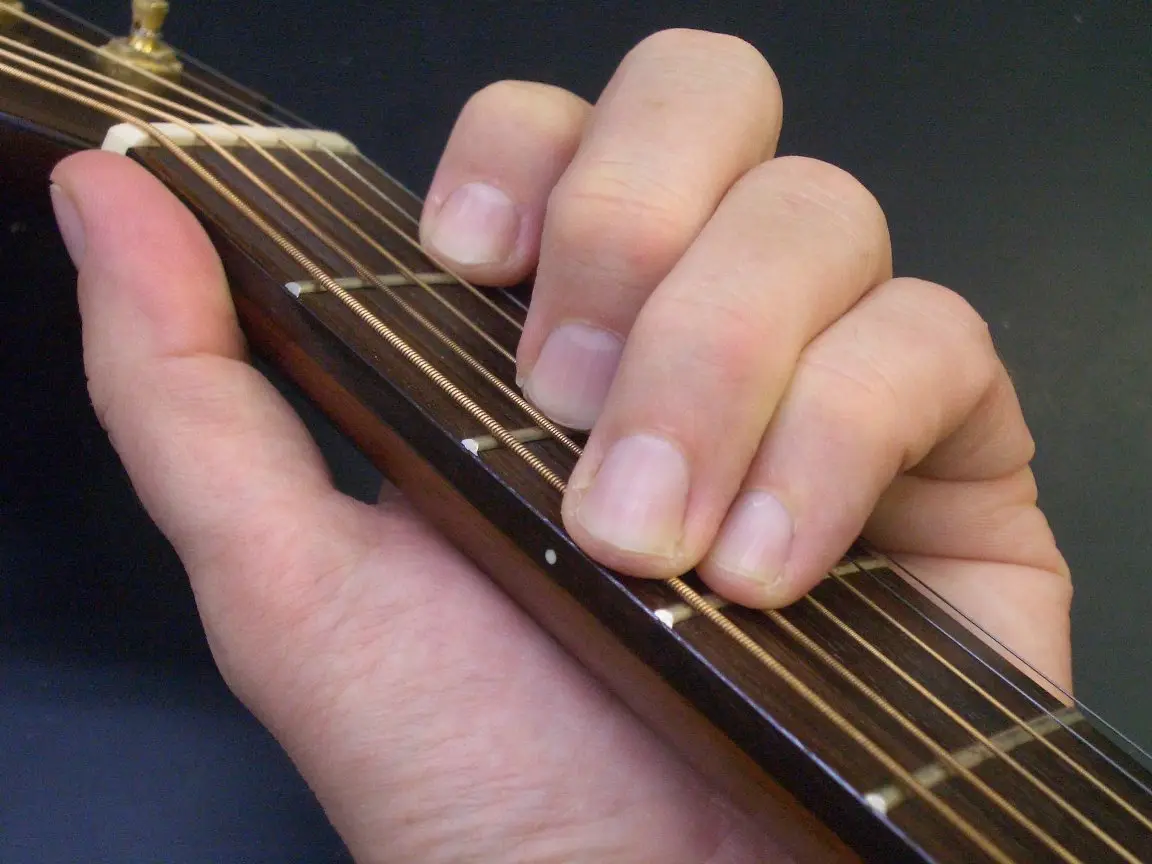
Figure 1. A hand holding a C/G chord on a guitar neck, with the frets running across the fingerboard.
"Frets, guitar neck, C-major chord" by Tomgally, public domain
Full credit line to copy
"Frets, guitar neck, C-major chord" by Tomgally — https://commons.wikimedia.org/wiki/File:Frets,_guitar_neck,_C-major_chord.jpg — Public domain (Released into the public domain worldwide by its author, Tomgally (Commons file page, PD-user); where that is not legally possible, the author grants anyone the right to use the work for any purpose without conditions)
How do you calculate fret positions?
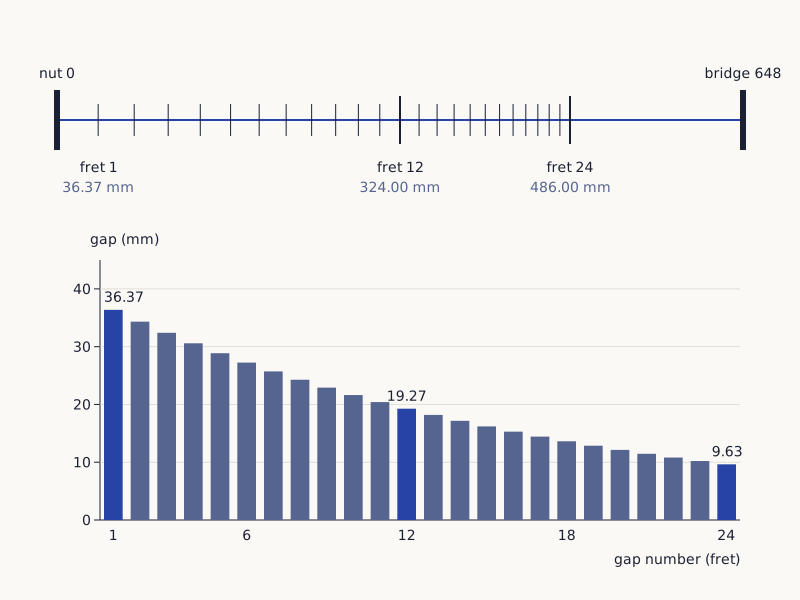
Call the string length from nut to bridge L. Fret n sits at L × (1 − 2−n/12) from the nut. For L = 648 millimeters, fret 1 is at 648 × (1 − 0.943874) = 36.37 millimeters, and fret 12 is at 648 × (1 − 1/2) = 324 millimeters (Figure 2).
The formula rests on an ideal string. John Tyndall's Sound states that "the number of vibrations is inversely proportional to the length of the string," and that a note an octave higher has double the number of vibrations [2]. Equal temperament splits each octave into 12 equal steps called semitones, each multiplying the frequency by 21/12, about 1.05946. So each fret must leave 2−1/12 of the length before it.
Twelve such steps double the frequency, so fret 12 always sits at exactly half the string; fret 24 leaves a quarter and sits at 486 millimeters on a 648-millimeter string.
Wide drawing on a small screen: swipe sideways, or open it full size.
Figure 2. The 24 equal-tempered fret positions on a 648-millimeter string, with the width of each gap below.
Chart: Tricks of Ear and Eye, CC BY 4.0
Full credit line to copy
"Fret positions and gaps on a 648 mm string" by Tricks of Ear and Eye, https://tricksofearandeye.com/instruments/guitar-fret-spacing/, licensed under CC BY 4.0, https://creativecommons.org/licenses/by/4.0/
The table covers two example lengths, 648 and 628 millimeters (25.51 and 24.72 inches); neither is claimed to be a standard. The fret position table (CSV) (where the data come from and its license, JSON) has a row for every fret on each length.
| Fret | 648 mm string: from nut (mm) | 648 mm string: gap (mm) | 628 mm string: from nut (mm) |
|---|---|---|---|
| 1 | 36.37 | 36.37 | 35.25 |
| 2 | 70.70 | 34.33 | 68.52 |
| 3 | 103.10 | 32.40 | 99.92 |
| 4 | 133.68 | 30.58 | 129.56 |
| 5 | 162.55 | 28.87 | 157.53 |
| 6 | 189.79 | 27.25 | 183.94 |
| 7 | 215.51 | 25.72 | 208.86 |
| 8 | 239.79 | 24.27 | 232.38 |
| 9 | 262.70 | 22.91 | 254.59 |
| 10 | 284.32 | 21.63 | 275.55 |
| 11 | 304.73 | 20.41 | 295.33 |
| 12 | 324.00 | 19.27 | 314.00 |
| 13 | 342.18 | 18.18 | 331.62 |
| 14 | 359.35 | 17.16 | 348.26 |
| 15 | 375.55 | 16.20 | 363.96 |
| 16 | 390.84 | 15.29 | 378.78 |
| 17 | 405.27 | 14.43 | 392.77 |
| 18 | 418.90 | 13.62 | 405.97 |
| 19 | 431.76 | 12.86 | 418.43 |
| 20 | 443.89 | 12.14 | 430.19 |
| 21 | 455.35 | 11.46 | 441.29 |
| 22 | 466.16 | 10.81 | 451.77 |
| 23 | 476.37 | 10.21 | 461.66 |
| 24 | 486.00 | 9.63 | 471.00 |
Why do the gaps shrink?
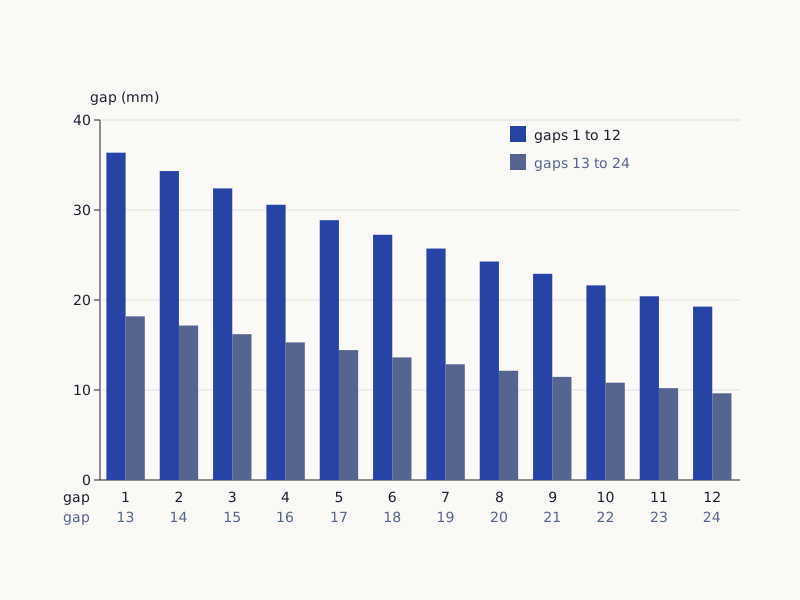
Look at the bars in Figure 2. Gap 1 is 36.37 millimeters, gap 13 is 18.18 and gap 24 is 9.63. Every fret takes the same share, about 5.61%, of the string still free to vibrate, and that length shrinks at every fret.
So each gap is 2−1/12 times the one before it. A list like this, where each number is the last one times the same factor, is called a geometric sequence. After 12 steps the factor reaches one half: gap 13 is half of gap 1, and gap 24 is half of gap 12.
Wide drawing on a small screen: swipe sideways, or open it full size.
Figure 3. Gaps 1 to 12 of a 648-millimeter string, each beside the gap 12 frets higher.
Chart: Tricks of Ear and Eye, CC BY 4.0
Full credit line to copy
"Each fret gap beside the gap 12 frets higher" by Tricks of Ear and Eye, https://tricksofearandeye.com/instruments/guitar-fret-spacing/, licensed under CC BY 4.0, https://creativecommons.org/licenses/by/4.0/
The Shepard tone entry climbs in this same step of 21/12, one semitone at a time. Other instruments set their notes without frets. On a piano, a hammer strikes the wire [2], and the piano hammer entry follows that hammer.
 Illustration
Figure 4. A seated player holding a string instrument, with the neck too blurred to show any fret spacing.
Illustration: Tricks of Ear and Eye. Generated schematic image — not a photograph, specimen record or perceptual simulation. Reuse permitted with this credit line; provided as is.
Tyndall describes the clarinet as a stopped tube whose tones follow the odd numbers 1, 3, 5, 7, with the notes in between supplied by opening holes in its side [2]. A jump from tone 1 to tone 3 is a frequency ratio of 3, about 19.02 semitones, and the clarinet entry follows that tube.
What changes if you divide by 18?
In his 1581 Dialogo della musica antica, et della moderna, Vincenzo Galilei sets out a way to divide a string that, he says, closely matches how the frets of the lute and the viol are placed [1]. Divide the whole string into 18 parts and put the first fret where the first part ends. Then divide what is left into 18 again for the second fret, and carry on to the twelfth. He writes that the twelfth fret lands where half the string ends, and that the lowest octave comes out as twelve equal semitones [1].
This page read that passage on page 49 of a scanned copy of the 1581 printing, for verification only. Galilei wrote about the lute and the viol, not the guitar, so this page claims only that the method is at least that old.
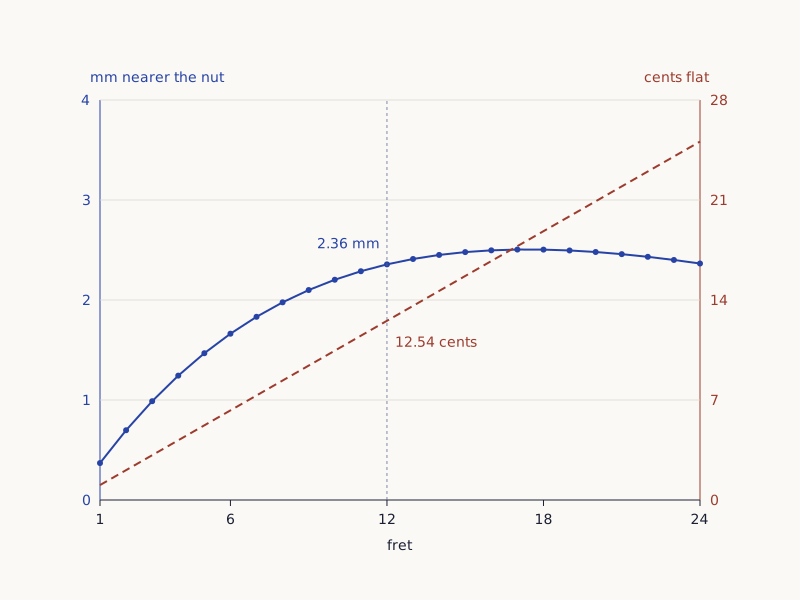
Each divide-by-18 step leaves 17/18 of the string, about 94.44%, where equal temperament leaves about 94.39%. That costs 1.05 cents (hundredths of a semitone) per fret. It adds up. At fret 12 the divide-by-18 fret sits 2.36 millimeters nearer the nut, leaving an ideal string 12.54 cents flat; at fret 24 it is 25.09 cents flat (Figure 5).
Wide drawing on a small screen: swipe sideways, or open it full size.
Figure 5. How far each divide-by-18 fret sits from the equal-tempered one on a 648-millimeter string, in millimeters and in cents.
Chart: Tricks of Ear and Eye, CC BY 4.0
Full credit line to copy
"Divide-by-18 frets compared with equal temperament" by Tricks of Ear and Eye, https://tricksofearandeye.com/instruments/guitar-fret-spacing/, licensed under CC BY 4.0, https://creativecommons.org/licenses/by/4.0/
| Fret | Equal-tempered, from nut (mm) | Divide by 18, from nut (mm) | Divide by 18 nearer the nut by (mm) | Divide by 18 flat by (cents) |
|---|---|---|---|---|
| 1 | 36.37 | 36.00 | 0.37 | 1.05 |
| 2 | 70.70 | 70.00 | 0.70 | 2.09 |
| 5 | 162.55 | 161.08 | 1.47 | 5.23 |
| 7 | 215.51 | 213.68 | 1.83 | 7.32 |
| 12 | 324.00 | 321.64 | 2.36 | 12.54 |
| 17 | 405.27 | 402.77 | 2.50 | 17.77 |
| 24 | 486.00 | 483.64 | 2.36 | 25.09 |
The millimeter gap stops growing near fret 17, at about 2.50 millimeters, while the cents keep climbing. The cents depend only on the fret count, so a 628-millimeter string is also 12.54 cents flat at fret 12, though its fret sits only 2.28 millimeters off.
Why 18 and not 17 or 19?
Galilei gives his reason in the same passage. A divisor of 17 would give fewer frets than needed, and 16 or 15 fewer still; 19 would give more, and 20 or 21 more still. So 18 is the most suitable [1].
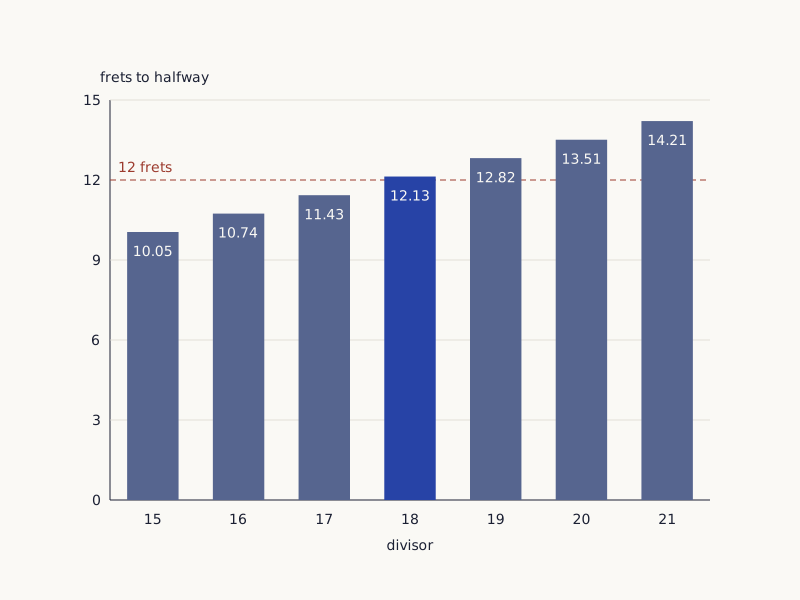
The numbers line up with that. With a divisor k, each fret leaves (k − 1)/k of the string, and the string is halved after log(1/2) ÷ log((k − 1)/k) frets. Dividing by 18 gets there after 12.13 frets, closer to 12 than any other whole-number divisor (Figure 6). The exact divisor for equal temperament is 1 ÷ (1 − 2−1/12), about 17.82.
Wide drawing on a small screen: swipe sideways, or open it full size.
Figure 6. How many frets each divisor needs before the string is halved; a line marks 12 frets.
Chart: Tricks of Ear and Eye, CC BY 4.0
Full credit line to copy
"Frets needed to reach the halfway point, by divisor" by Tricks of Ear and Eye, https://tricksofearandeye.com/instruments/guitar-fret-spacing/, licensed under CC BY 4.0, https://creativecommons.org/licenses/by/4.0/
| Divisor | Frets to reach halfway | Fret 12 compared with halfway, on 648 mm (mm) | Fret 12 compared with the octave (cents) | Galilei (1581) |
|---|---|---|---|---|
| 15 | 10.05 | 40.85 past | 233.31 sharp | fewer frets than needed |
| 16 | 10.74 | 25.30 past | 140.78 sharp | fewer frets than needed |
| 17 | 11.43 | 10.94 past | 59.46 sharp | fewer frets than needed |
| 18 | 12.13 | 2.36 short | 12.54 flat | the most suitable |
| 19 | 12.82 | 14.69 short | 76.76 flat | more frets than needed |
| 20 | 13.51 | 26.15 short | 134.39 flat | more frets than needed |
| 21 | 14.21 | 36.83 short | 186.39 flat | more frets than needed |
| 17.82 (equal temperament) | 12.00 | 0.00 | 0.00 | not discussed |
Galilei adds a caution: as with a compass stepped six times around a circle, a small mismatch remains, and he asks the careful maker to correct it [1]. On a 648-millimeter string, that mismatch at fret 12 is the 2.36 millimeters above. Download the full divisor table (CSV) (where the data come from and its license, JSON) Data: Verdict on each divisor from Vincenzo Galilei, Dialogo della musica antica, et della moderna (Florence, 1581), p. 49; public domain.
How many cents is a millimeter?
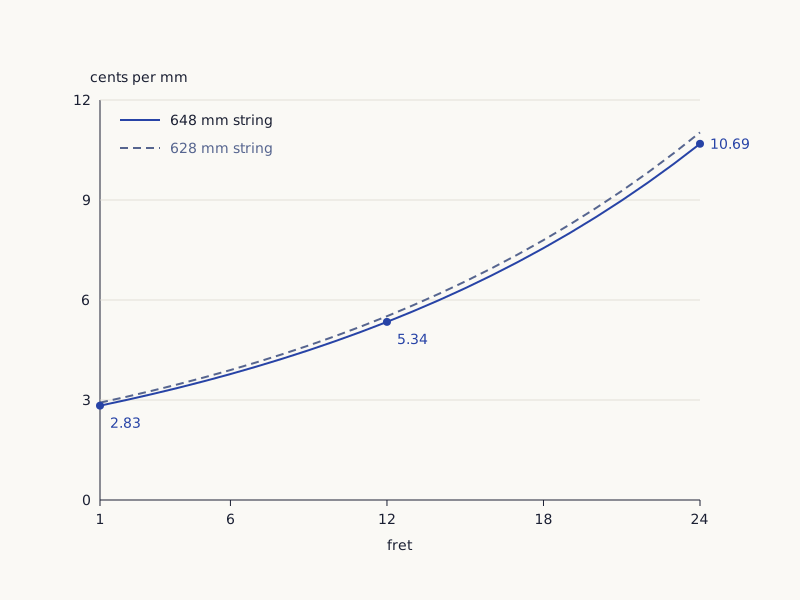
Read Figure 7 at fret 1, then at fret 12. On a 648-millimeter string, moving fret 1 by one millimeter changes an ideal string's pitch by about 2.83 cents. At fret 12 the same millimeter is worth 5.34 cents; at fret 24, 10.69.
The rule is cents per millimeter = 1200 ÷ (ln 2 × the length still vibrating). That length halves by fret 12, so each millimeter there is worth about twice as much as near the nut. Unlike the divide-by-18 shortfall in cents, this depends on string length: at fret 12 of a 628-millimeter string, it is 5.51.
Wide drawing on a small screen: swipe sideways, or open it full size.
Figure 7. Cents per millimeter of fret position at each fret, for a 648-millimeter and a 628-millimeter string.
Chart: Tricks of Ear and Eye, CC BY 4.0
Full credit line to copy
"Cents per millimeter at each fret" by Tricks of Ear and Eye, https://tricksofearandeye.com/instruments/guitar-fret-spacing/, licensed under CC BY 4.0, https://creativecommons.org/licenses/by/4.0/
| Fret | 648 mm string (cents per mm) | 628 mm string (cents per mm) |
|---|---|---|
| 1 | 2.83 | 2.92 |
| 5 | 3.57 | 3.68 |
| 12 | 5.34 | 5.51 |
| 17 | 7.13 | 7.36 |
| 24 | 10.69 | 11.03 |
All of these numbers are for an ideal string. Tyndall's laws also say the vibration rate grows with the square root of the stretching weight and falls as the string gets thicker [2]. This page holds tension, thickness and material fixed, so anything that changes them when a string is pressed to a fret is left out.
The 12.54 cents at fret 12 is a computed difference between two positions. Neither source read for this page tested whether listeners hear it on a guitar, and this page does not claim that they can.
Sources
- Galilei, V. (1581). Dialogo di Vincentio Galilei nobile fiorentino della musica antica, et della moderna. Florence: Giorgio Marescotti. Page 49. Open the sourceRead: scanned copy, read for verification
- Tyndall, J. Sound. New York: P. F. Collier & Son, 1902 printing, with the preface to the third edition dated June 1875. Project Gutenberg eBook #54969. Open the sourceRead: full text
Sense check:
One step, under a minute
Work out 648 × (1 − 2−7/12) on a calculator and find the result in the fret table above. To see how other instruments set their notes, read about the piano hammer or listen to the Shepard tone.
Related entries
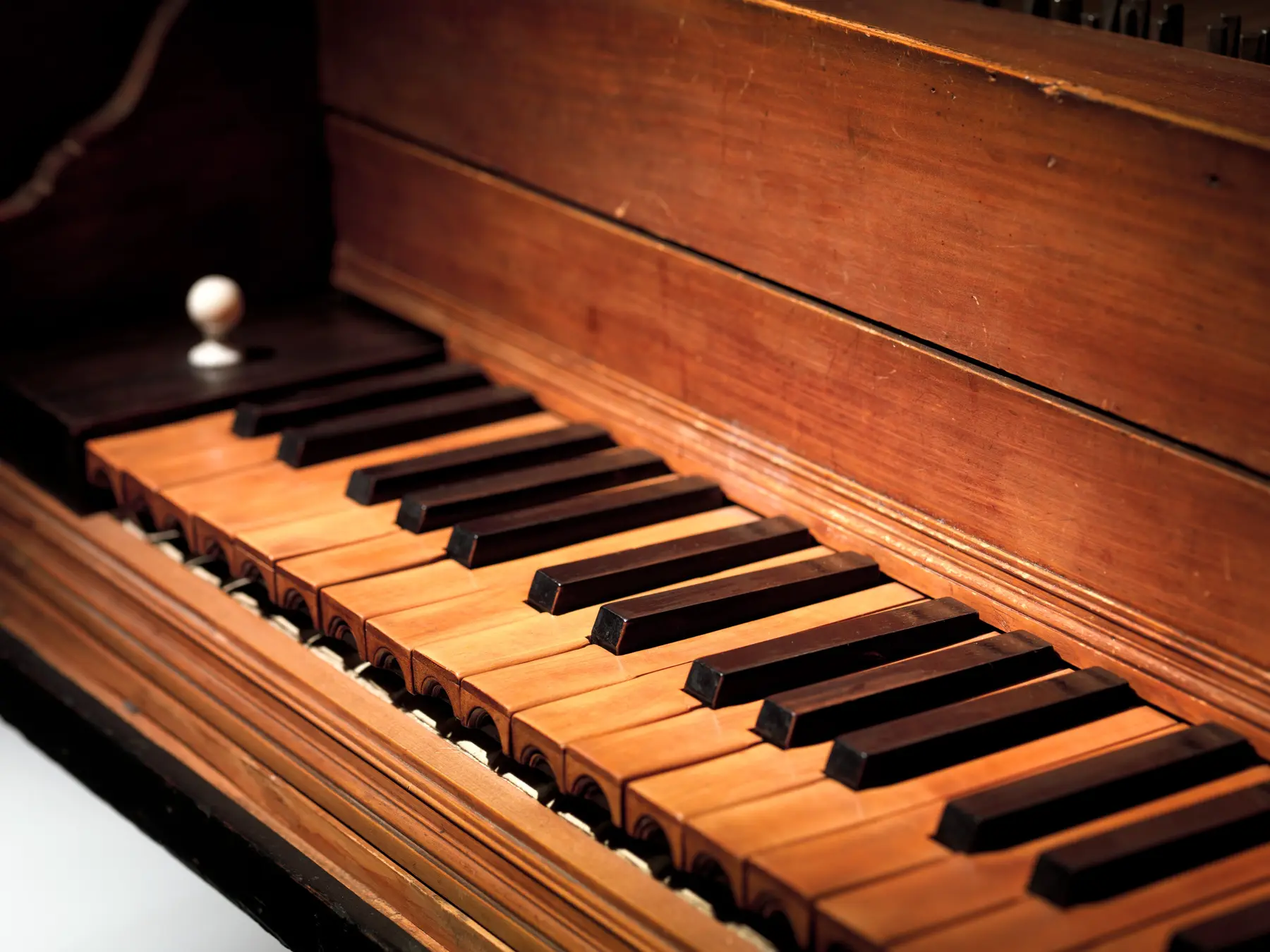
Grand Piano Hammer: Normally, It Strikes in Free Flight
Instruments
In a grand piano action, the jack lets go of the hammer just before the strike. Measurements on a grand show the hammer covering the last stretch on its own.
Image credit
"Grand Piano, Bartolomeo Cristofori, Florence, 1720 (Metropolitan Museum of Art 89.4.1219)" by The Metropolitan Museum of Art — https://commons.wikimedia.org/wiki/File:Grand_Piano_MET_DP300910.jpg — CC0 1.0 (https://creativecommons.org/publicdomain/zero/1.0/)
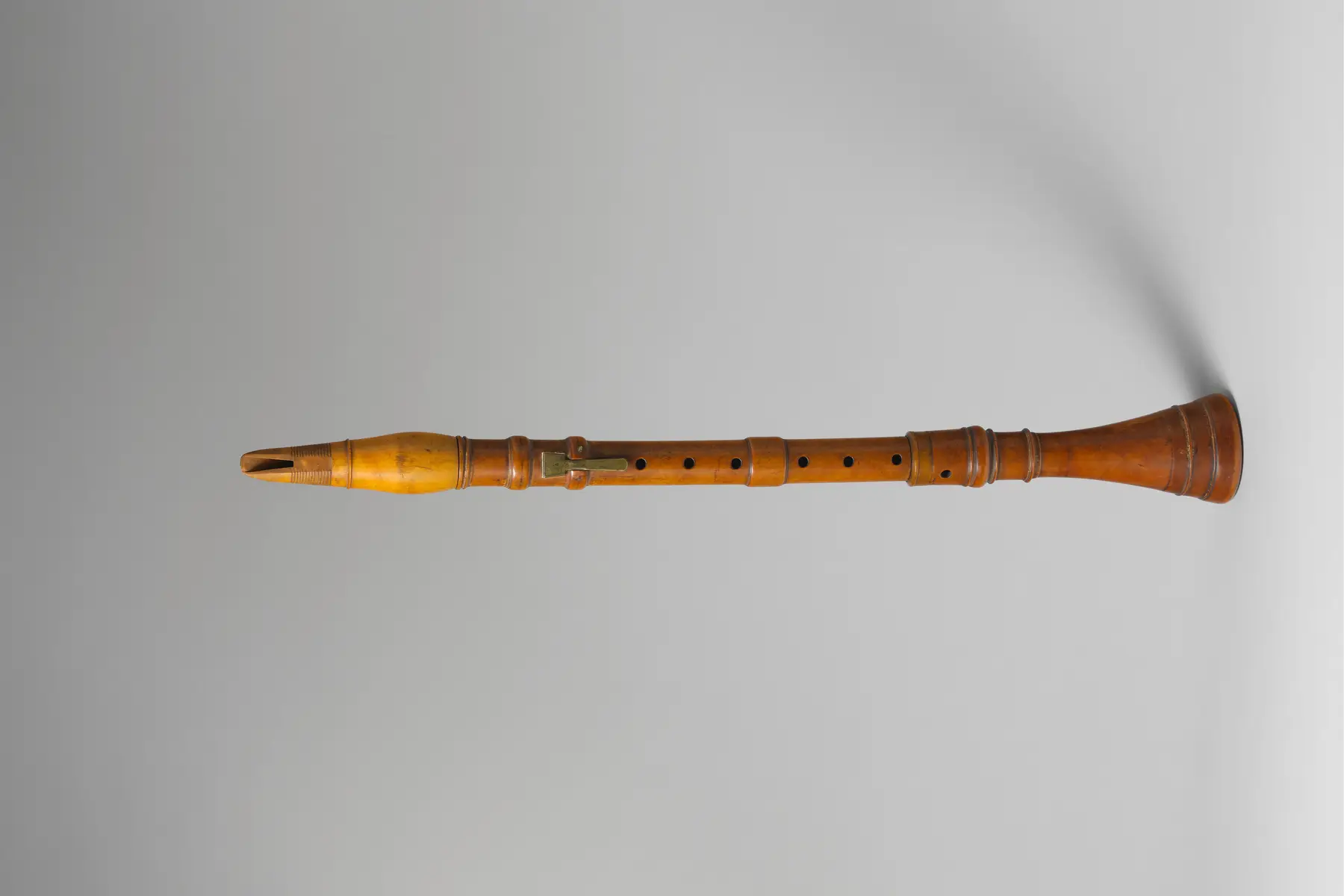
How a Clarinet Works: A Closed Tube Skips the Octave
Instruments
A tube closed at one end resonates at 1, 3 and 5 times its lowest frequency. A clarinet is close to one, so its next register is about a twelfth up.
Image credit
"Clarinet in D" by The Metropolitan Museum of Art — https://commons.wikimedia.org/wiki/File:Clarinet_in_D_MET_DP232753.jpg — CC0 1.0 (https://creativecommons.org/publicdomain/zero/1.0/); modified: rotated 90° counterclockwise and cropped to 3:2; colours not altered
Cite this page
Tricks of Ear and Eye. "Guitar Fret Spacing: Each Gap Is About 5.6% Narrower." Tricks of Ear and Eye. Published 2026-10-30. https://tricksofearandeye.com/instruments/guitar-fret-spacing/. Accessed on the date you read it.