How a Clarinet Works: A Closed Tube Skips the Octave
Tricks of Ear and Eye Published
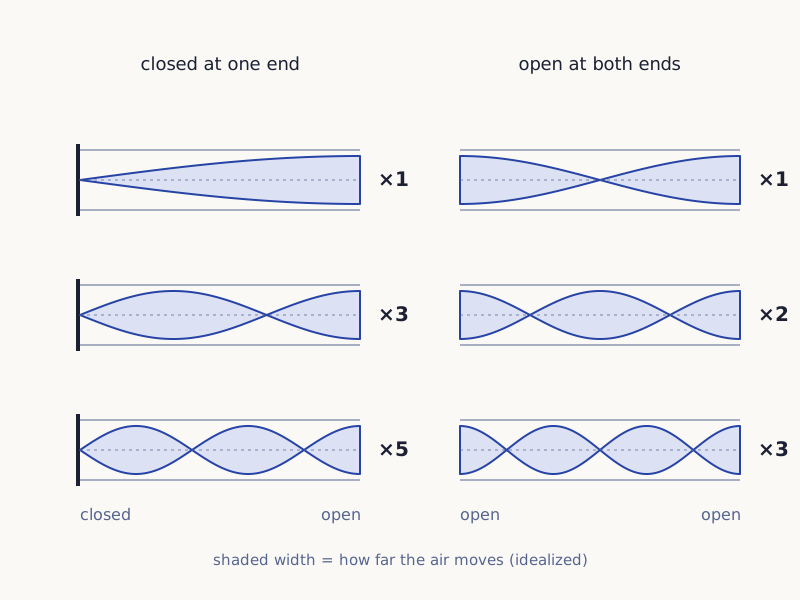
In Figure 1 below, a tube closed at one end resonates at 1, 3 and 5 times its lowest frequency. A clarinet behaves close to such a tube, closed at the reed end [1]. Its next register sits about three times higher, an octave plus a fifth that musicians call a twelfth, and players reach it with the register key [2][3]. A flute acts as a tube open at both ends, so its next step up is an octave [1].
Wide drawing on a small screen: swipe sideways, or open it full size.
Figure 1. The first three resonances of an ideal tube closed at one end and of one open at both ends, drawn for this page.
Diagram: Tricks of Ear and Eye, CC BY 4.0
Full credit line to copy
"Standing waves in a tube closed at one end and in a tube open at both ends" by Tricks of Ear and Eye, https://tricksofearandeye.com/instruments/clarinet/, licensed under CC BY 4.0, https://creativecommons.org/licenses/by/4.0/
Why does a closed tube skip the octave?
Compare the two columns of Figure 1: on the left, each shaded band shrinks to nothing at the closed end, where the air cannot move, and is widest at the open end. One quarter of a wave fits that pattern, then three quarters, then five, so the resonances climb as 1, 3 and 5 times the lowest frequency.
On the right, both ends are open, and the patterns hold two, four and six quarters, so the steps go 1, 2 and 3 times. John Tyndall's lectures on sound give the same rule in older words: a stopped pipe is a quarter of its sound wave long, and its notes run 1, 3, 5, 7, while an open pipe takes every whole number [1].
His example is easy to check. If a stopped pipe's lowest note vibrates 100 times a second, the next is 300 and then 500, and the pipe cannot sound 200 or 400 [1].
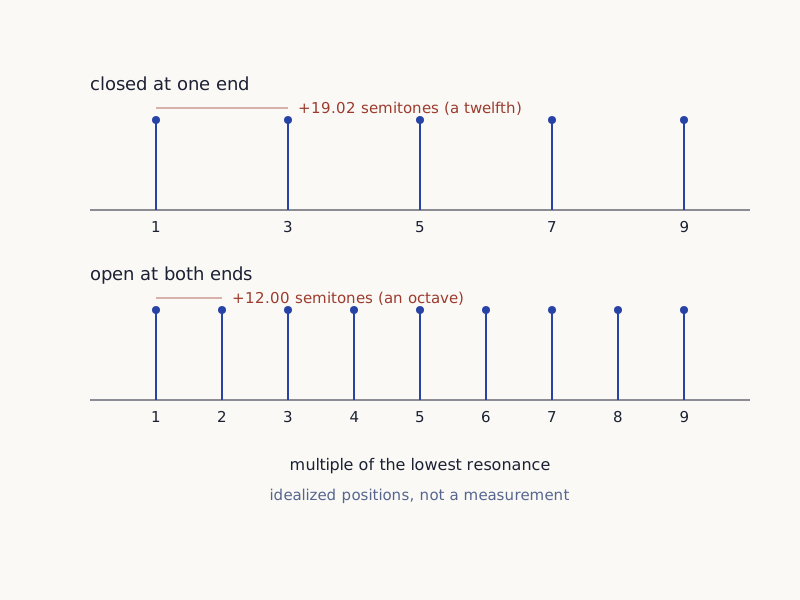
Musicians count these steps in semitones, the steps between neighboring keys on a piano. A factor of 2 is 12 semitones, an octave, and a factor of 3 is 12 × log2 3, about 19.02 semitones, or an octave plus a fifth (computed for this page). Figure 2 marks the 12-semitone first step of the open tube and the 19.02-semitone first step of the closed one.
Wide drawing on a small screen: swipe sideways, or open it full size.
Figure 2. Ideal resonances of the two tube models as multiples of the lowest, with the first step up in semitones; positions only, not a measurement.
Chart: Tricks of Ear and Eye, CC BY 4.0
Full credit line to copy
"Ideal resonances of closed and open tubes as multiples of the lowest" by Tricks of Ear and Eye, https://tricksofearandeye.com/instruments/clarinet/, licensed under CC BY 4.0, https://creativecommons.org/licenses/by/4.0/
To put numbers on it, take an example tube 0.60 m long, with sound moving at 343.2 m/s, its speed in air at 20 °C [5]. A closed tube gives f = (2n − 1) × c ÷ 4L, and an open tube gives f = n × c ÷ 2L, where n counts the resonances 1, 2, 3 and so on.
| Resonance | Closed at one end | Open at both ends |
|---|---|---|
| 1st | 143.0 Hz (×1) | 286.0 Hz (×1) |
| 2nd | 429.0 Hz (×3, +19.02 semitones) | 572.0 Hz (×2, +12.00 semitones) |
| 3rd | 715.0 Hz (×5, +27.86 semitones) | 858.0 Hz (×3, +19.02 semitones) |
| 4th | 1,001.0 Hz (×7) | 1,144.0 Hz (×4) |
| 5th | 1,287.0 Hz (×9) | 1,430.0 Hz (×5) |
These values were computed for this page and describe the ideal tube, not any instrument. The open tube's marks in Figure 2 go on at 6, 7, 8 and 9 times, and the resonance table (CSV) (where the data come from and its license, JSON) Data: Speed of sound in air at 20 °C (34,321 cm/s) from Kim, K., & Kim, Y. (2015), Monaural Sound Localization Based on Structure-Induced Acoustic Resonance, Sensors 15(2): 3872–3895, CC BY 3.0 lists all 14 values, each row with its formula, tube length and speed of sound.
What does the register key do?
Pàmies-Vilà and colleagues (2020) recorded 11 players of the B-flat clarinet and divide its range into three registers [3]. In the lowest, the chalumeau, the clarinet plays at the frequency set by the tube length, while the upper registers use a register key [3].
| Register of a B-flat clarinet | Written notes | Sounding frequency |
|---|---|---|
| Chalumeau (low) | E3 to B-flat 4 | 147–415 Hz |
| Clarion (middle) | B4 to C6 | 440–932 Hz |
| Altissimo (high) | from C-sharp 6 | about 988–1,760 Hz |
Divide the bottom of the clarion range by the bottom of the chalumeau: 440 ÷ 147 ≈ 2.99 (computed for this page), close to the factor of 3 that a closed tube predicts. The two figures are note frequencies as the paper lists them, not measurements of one instrument. The written notes E3 and B4 are 19 semitones apart, which is a twelfth.
Older accounts agree. Hermann von Helmholtz, in the 1895 English edition of his book on musical tone, called the clarinet's tube cylindrical and wrote that its resonances match the 3rd, 5th and 7th partials of its lowest note, and that a change in the way of blowing takes a player from the lowest note to the twelfth [2]. His translator, Alexander Ellis, adds D. J. Blaikley's view that only the twelfth can start a new set of notes, because the higher resonances sit too far from whole multiples [2].
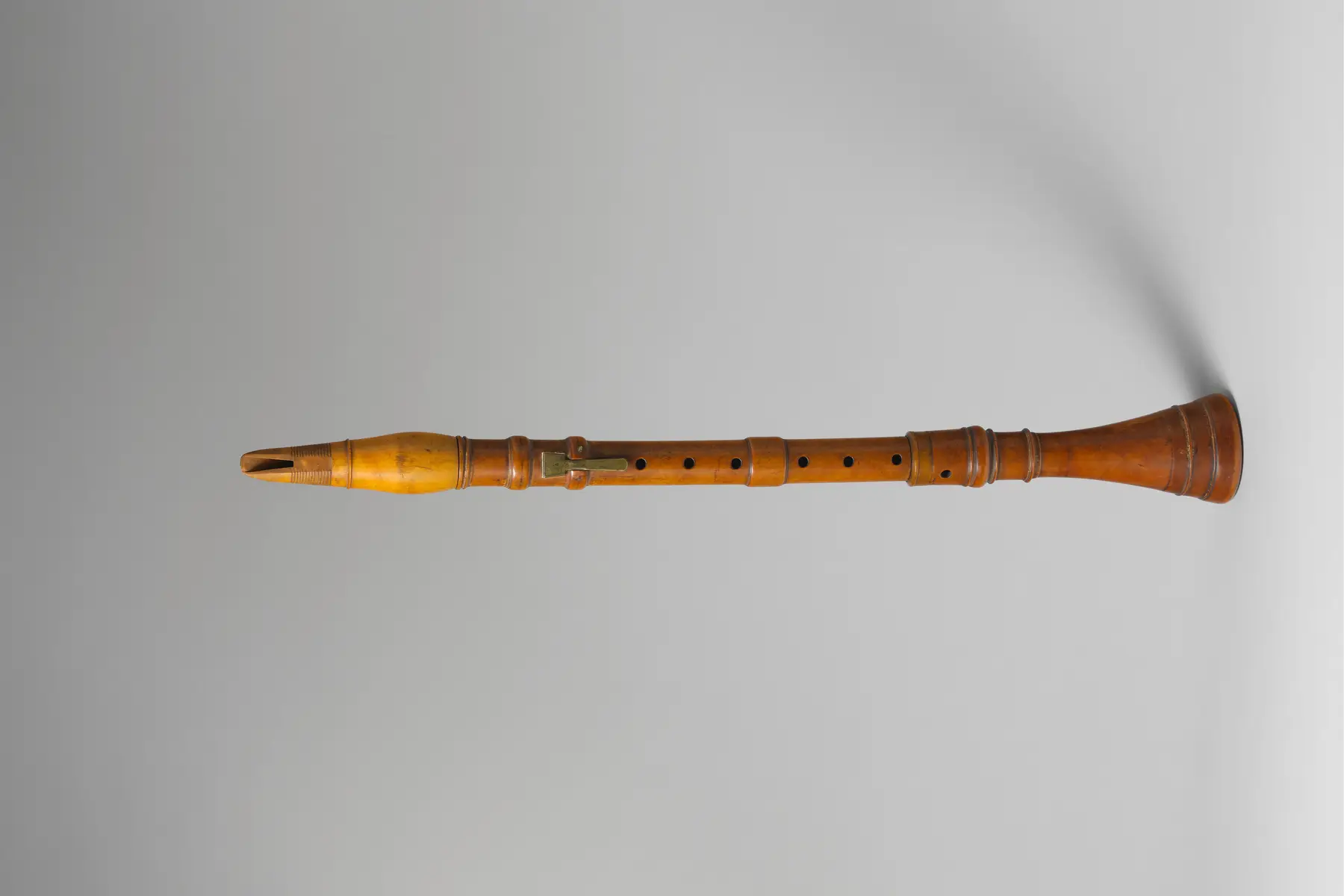
Figure 3. Clarinet in D, German, 1750–70, boxwood and brass, 53.3 cm long; Metropolitan Museum of Art, 2010.185.
"Clarinet in D" by The Metropolitan Museum of Art — https://commons.wikimedia.org/wiki/File:Clarinet_in_D_MET_DP232753.jpg — CC0 1.0 (https://creativecommons.org/publicdomain/zero/1.0/); modified: rotated 90° counterclockwise and cropped to 3:2; colours not altered
Why opening one hole is enough is still being studied. According to their abstract, Szwarcberg and colleagues (2024) drilled holes in a cylindrical tube at the places where a B-flat clarinet has its register hole and thumb hole. Clarinetists played it, and opening a hole could make the note jump to the second register [4].
In their simulations, the abstract adds, a model without extra losses at the hole never made that jump. A second model with such losses, which do not grow in step with the sound, came close to the players for the holes nearer the reed but never made the jump for those farther down [4].
What does a real clarinet add to the ideal tube?
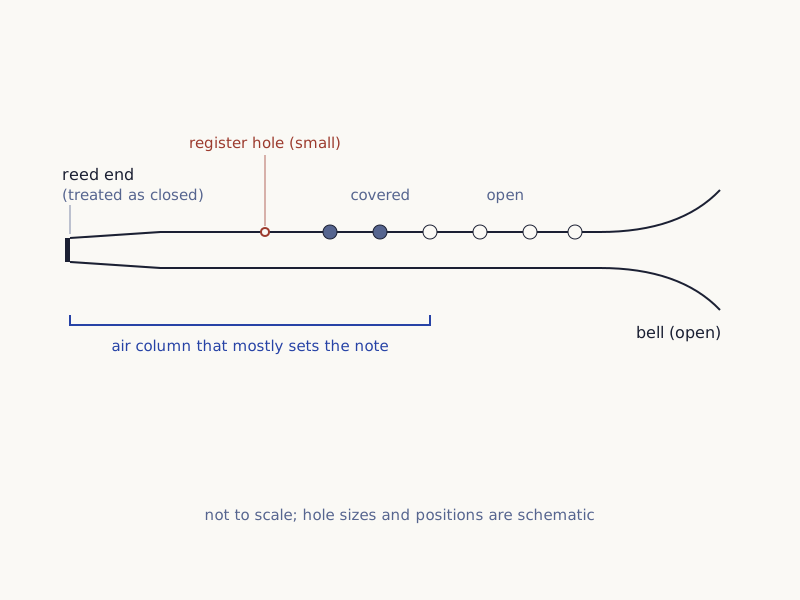
Figure 4 marks what the ideal tube leaves out. Tyndall describes a single reed fitted to a long cylindrical tube, with the reed end acting as the closed end [1], and the notes in between come from opening side holes [1]. With a side hole open, Helmholtz adds, the vibrating air is mostly the column from the mouthpiece to the highest open hole [2].
Wide drawing on a small screen: swipe sideways, or open it full size.
Figure 4. A clarinet bore as a schematic, not to scale: reed end, register hole, tone holes and bell, with the air column up to the first open hole.
Diagram: Tricks of Ear and Eye, CC BY 4.0
Full credit line to copy
"Clarinet bore schematic, not to scale" by Tricks of Ear and Eye, https://tricksofearandeye.com/instruments/clarinet/, licensed under CC BY 4.0, https://creativecommons.org/licenses/by/4.0/
The holes do for the tube what a shorter length does for a string. Tyndall's first law of strings says the rate of vibration is inversely proportional to the length [1]. The guitar fret entry builds on that rule. In a tube, a shorter working column sets a higher note.
The reed also works differently from a piano hammer, which strikes the string [1], while a clarinet reed is set moving by the player's breath. Tyndall showed the pairing with a reed cut into a wheat straw: as he shortened the straw from eight inches to two, the pitch rose [1]. The reed, he wrote, had to adapt itself to the column of air [1].
The ideal tube has resonances only at odd multiples. On real clarinets, two 19th-century reports differ. Helmholtz wrote that by trial he found only odd-numbered partials, distinct up to the seventh [2]. Ellis's note, based on tests he watched Blaikley run in 1884, says the instrument is narrowed at the mouthpiece and widened at the bell, and that with the bell fitted, the 2nd, 4th and 6th partials showed up with tuned resonators and tuning forks [2].
Both reports are listening checks, and this site has not read a modern measurement of a clarinet's spectrum. The odd-only pattern belongs to the model, not to any instrument.
The figure checks (CSV) (where the data come from and its license, JSON) re-read the saved drawings and table and confirm the geometry and arithmetic. They do not show what any listener hears.
How is a clarinet different from a flute?
Figure 5 shows a French transverse flute, 65.8 cm long. Tyndall calls the flute an open pipe and the clarinet a stopped one [1]. The flute's notes follow 1, 2, 3, 4 and the clarinet's follow 1, 3, 5, 7, a difference he credits Charles Wheatstone with first pointing out [1].
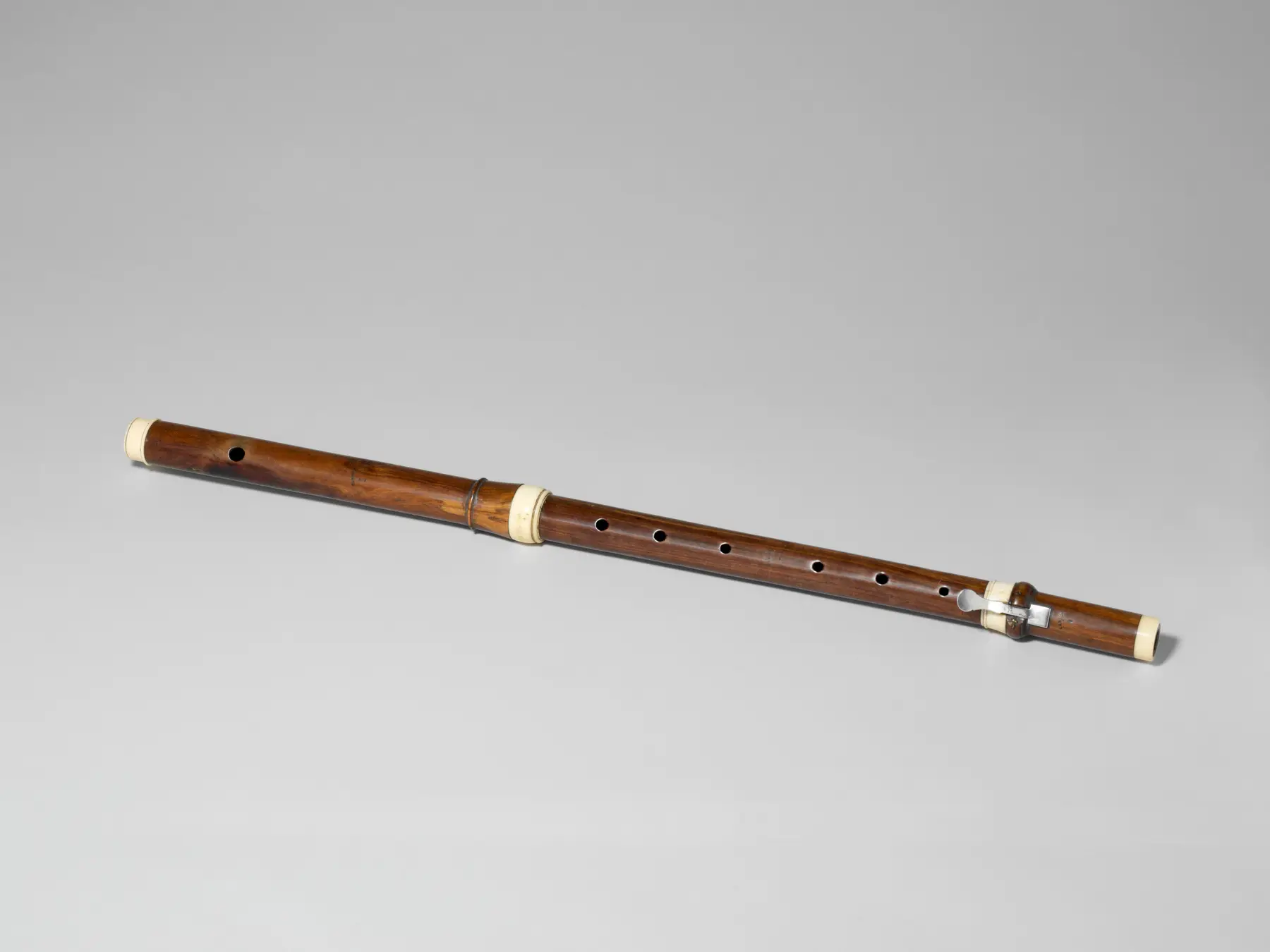
Figure 5. Transverse flute by Garion, French, rosewood, ivory and silver, 65.8 cm long; Metropolitan Museum of Art, 2005.365.
"Transverse Flute" by The Metropolitan Museum of Art — https://commons.wikimedia.org/wiki/File:Transverse_Flute_MET_DP168857.jpg — CC0 1.0 (https://creativecommons.org/publicdomain/zero/1.0/)
An open pipe also sounds an octave above a stopped pipe of the same length [1]; in the example table, that is 286.0 Hz against 143.0 Hz.
| Comparison | Clarinet, modeled as closed at one end | Flute, modeled as open at both ends |
|---|---|---|
| Resonances, as multiples of the lowest | 1, 3, 5, 7 | 1, 2, 3, 4 |
| First step up | ×3, a twelfth (19.02 semitones) | ×2, an octave (12.00 semitones) |
| Lowest resonance, same tube length | an octave lower | an octave higher |
| Example: 0.60 m tube, 20 °C | 143.0 Hz | 286.0 Hz |
The oboe and bassoon sit on the flute's side of this table. Helmholtz wrote that their tubes are conical, with the resonances of open tubes, so overblowing them gives the octave first [2]. The closed-tube rule comes back in the entry on why a voice changes in a lighter gas, which uses a 17 cm tube closed at one end as a simple model of the vocal tract.
Sources
- Tyndall, J. Sound. New York: P. F. Collier & Son, 1902 printing, with the preface to the third edition dated June 1875. Project Gutenberg eBook #54969. Open the sourceRead: full text
- Helmholtz, H. L. F. (1895). On the Sensations of Tone as a Physiological Basis for the Theory of Music, 3rd ed., translated by A. J. Ellis. London: Longmans, Green, and Co. Open the sourceRead: scanned copy, read for verification
- Pàmies-Vilà, M., Hofmann, A., & Chatziioannou, V. (2020). The influence of the vocal tract on the attack transients in clarinet playing. Journal of New Music Research 49(2): 126–135. Open the sourceRead: full textText license: CC BY 4.0
- Szwarcberg, N., Colinot, T., Vergez, C., & Jousserand, M. (2024). Second register production on the clarinet: Nonlinear losses in the register hole as a decisive physical phenomenon. Journal of the Acoustical Society of America 156(2): 726–739. Open the sourceRead: abstract only
- Kim, K., & Kim, Y. (2015). Monaural sound localization based on structure-induced acoustic resonance. Sensors 15(2): 3872–3895. Open the sourceRead: full textText license: CC BY 3.0
Sense check:
One step, under a minute
Work out 12 × log(3) ÷ log(2) on a calculator. The answer, about 19.02, is the number of semitones in a factor of 3, the clarinet's twelfth. Put 2 in place of 3 and you get the flute's octave of 12. Next: Piano hammer · Voice in a lighter gas
Related entries
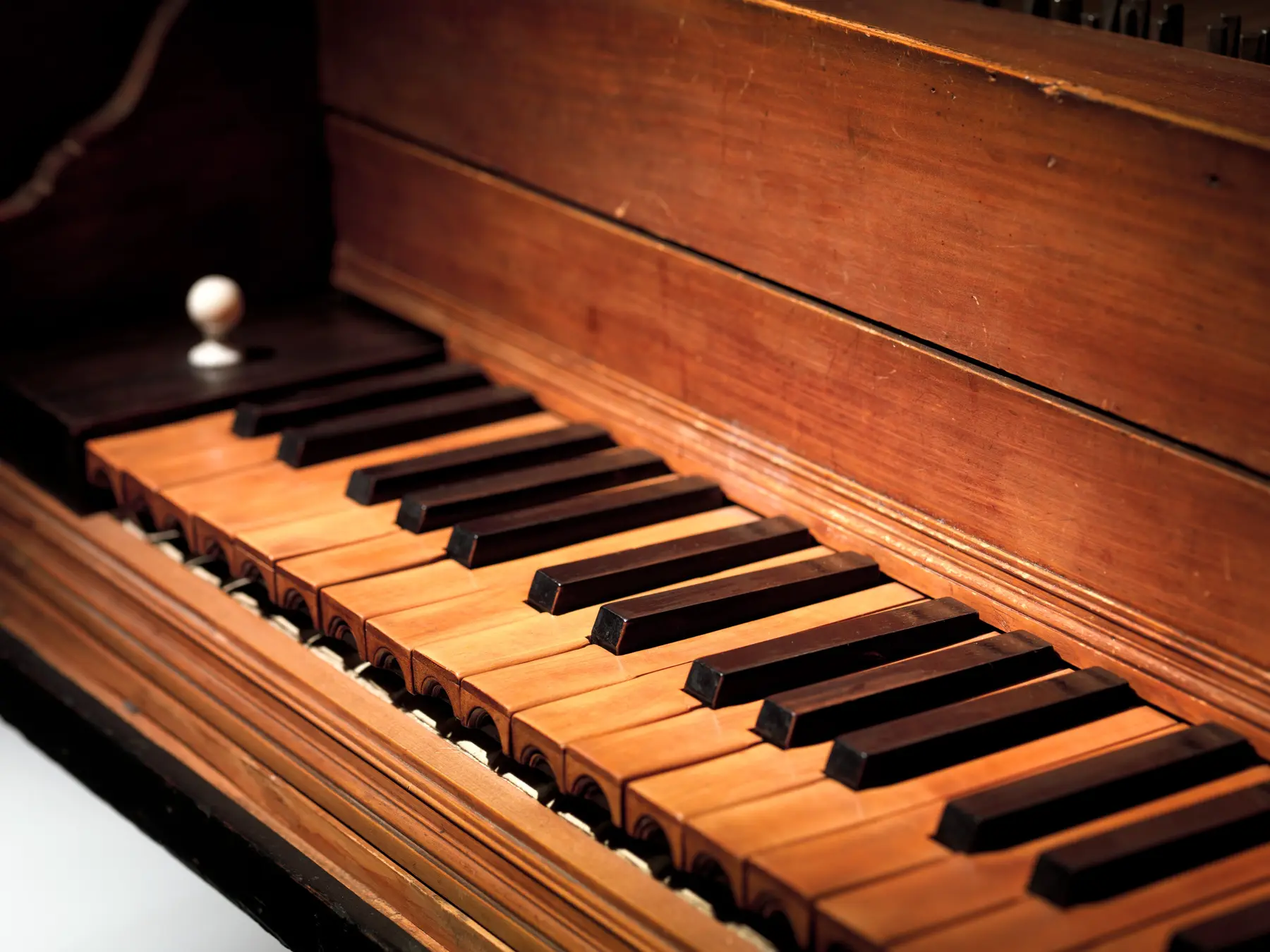
Grand Piano Hammer: Normally, It Strikes in Free Flight
Instruments
In a grand piano action, the jack lets go of the hammer just before the strike. Measurements on a grand show the hammer covering the last stretch on its own.
Image credit
"Grand Piano, Bartolomeo Cristofori, Florence, 1720 (Metropolitan Museum of Art 89.4.1219)" by The Metropolitan Museum of Art — https://commons.wikimedia.org/wiki/File:Grand_Piano_MET_DP300910.jpg — CC0 1.0 (https://creativecommons.org/publicdomain/zero/1.0/)
 Illustration
Guitar Fret Spacing: Each Gap Is About 5.6% Narrower
Instruments
Fret positions for a 648 mm string: each gap is about 5.61% narrower than the last, and dividing by 18 leaves fret 12 of an ideal string about 12.5 cents flat.
Image credit
Illustration: Tricks of Ear and Eye. Generated schematic image — not a photograph, specimen record or perceptual simulation. Reuse permitted with this credit line; provided as is.
Cite this page
Tricks of Ear and Eye. "How a Clarinet Works: A Closed Tube Skips the Octave." Tricks of Ear and Eye. Published 2026-10-30. https://tricksofearandeye.com/instruments/clarinet/. Accessed on the date you read it.