Why Helium Changes Your Voice: Its Resonances Rise
Tricks of Ear and Eye Published
Both clips below share one 120-hertz source; only the resonances move. Sound travels faster in heliox, a mix of helium and oxygen, so the resonances of the air in the throat and mouth rise while the vocal folds keep about the same rate. For human voices, Reber and colleagues (2015), citing Beil (1962), write that the source frequency does not shift appreciably in heliox [1]. Fitch and colleagues (2025) say the formants, those resonances, rise while the source stays unchanged [2].
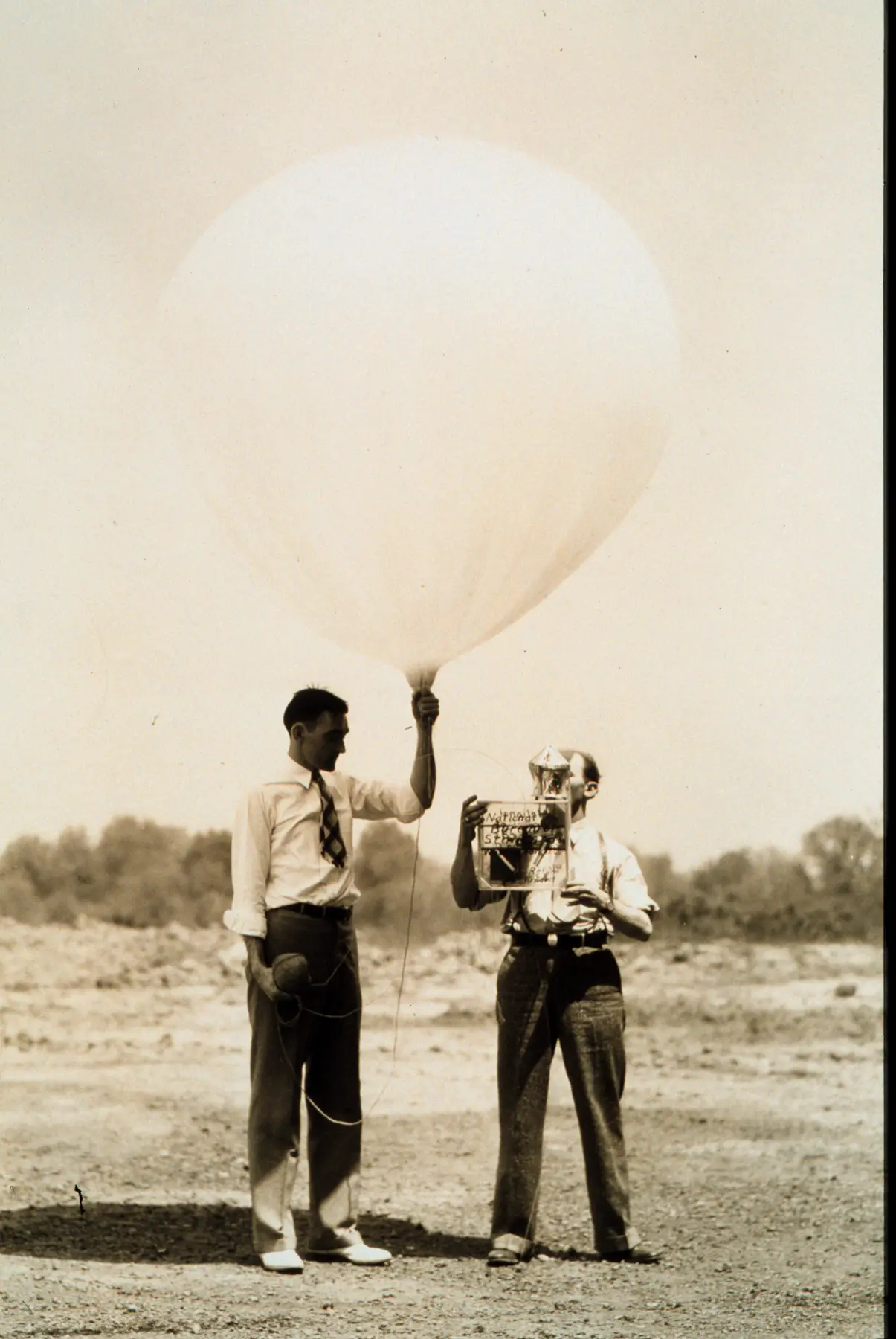
Figure 1. Launch preparations for an early radiosonde developed by the US Bureau of Standards, Washington Airport, 7 May 1936.
"Early launch of radiosonde, Washington, D.C., 1936" by NOAA Photo Library — https://commons.wikimedia.org/wiki/File:Wea01108_-_Flickr_-_NOAA_Photo_Library.jpg — CC BY 2.0 (https://creativecommons.org/licenses/by/2.0/)
Two clips, one source
Helium displaces oxygen, and inhaling it can cause asphyxiation and death. Newcastle City Council's trading standards page relays a safety announcement from the UK Office for Product Safety and Standards. It reports children and teenagers in the UK, Ireland and the US who died after inhaling helium from balloons [3]. This page uses synthesized sound and arithmetic only, with no way to breathe any gas.
Play clip 1, then clip 2. Both start from the same source: a train of pulses 120 times a second, with energy at 120, 240, 360 hertz and each further multiple of 120 up to 10,000 hertz. Only the filter that shapes those harmonics differs.
Turn your volume down before you press play.
Clip 1. Air model: a 120 Hz pulse source through three resonances near 505, 1514 and 2524 Hz.
Synthetic vowel-like tone, 2 s: 120 Hz pulse source, resonances near 505, 1514 and 2524 Hz.
Length · MP3, starts only when you press play
- Download this clip (MP3)
- Synthesis parameters (JSON, helium-voice-audio-air.json) (where it comes from and its license, JSON)
- Spectrum check output (CSV, helium-voice-audio-air-verify.csv) (where it comes from and its license, JSON)
The spectrum check shows that the clip was synthesized with the parameters above. It does not show that any listener will hear the effect.
Sound: Tricks of Ear and Eye, CC BY 4.0
Full credit line to copy
"Helium voice, clip 1: air model" by Tricks of Ear and Eye, https://tricksofearandeye.com/sound/helium-voice/, licensed under CC BY 4.0, https://creativecommons.org/licenses/by/4.0/
Wide drawing on a small screen: swipe sideways, or open it full size.
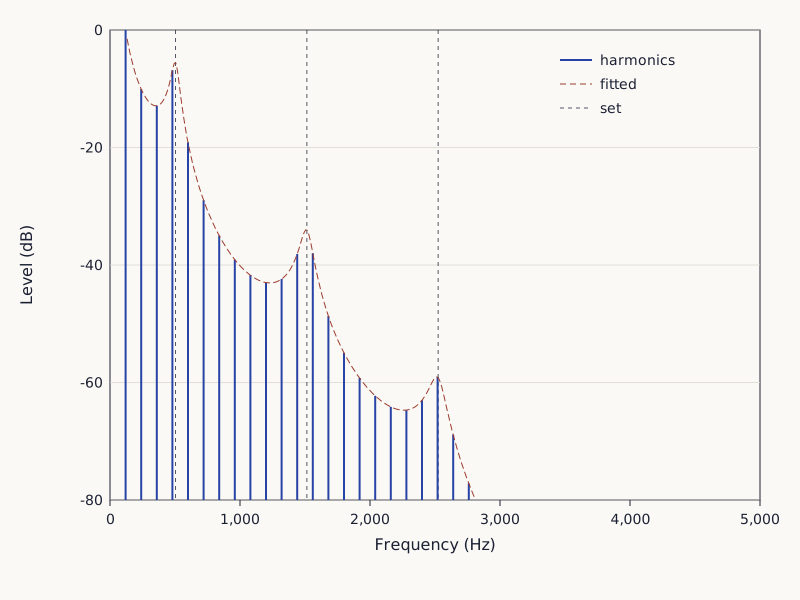
Figure 2. Spectrum of clip 1: harmonics every 120 Hz, shaped by resonances near 505, 1514 and 2524 Hz.
Chart: Tricks of Ear and Eye, CC BY 4.0
Full credit line to copy
"Spectrum of the air model clip" by Tricks of Ear and Eye, https://tricksofearandeye.com/sound/helium-voice/, licensed under CC BY 4.0, https://creativecommons.org/licenses/by/4.0/
Turn your volume down before you press play.
Clip 2. Heliox model: the same 120 Hz source, with every resonance 1.85 times higher.
Synthetic vowel-like tone, 2 s: 120 Hz pulse source, resonances near 934, 2801 and 4669 Hz.
Length · MP3, starts only when you press play
- Download this clip (MP3)
- Synthesis parameters (JSON, helium-voice-audio-heliox.json) (where it comes from and its license, JSON)
- Spectrum check output (CSV, helium-voice-audio-heliox-verify.csv) (where it comes from and its license, JSON)
The spectrum check shows that the clip was synthesized with the parameters above. It does not show that any listener will hear the effect.
Sound: Tricks of Ear and Eye, CC BY 4.0
Full credit line to copy
"Helium voice, clip 2: heliox model" by Tricks of Ear and Eye, https://tricksofearandeye.com/sound/helium-voice/, licensed under CC BY 4.0, https://creativecommons.org/licenses/by/4.0/
Wide drawing on a small screen: swipe sideways, or open it full size.
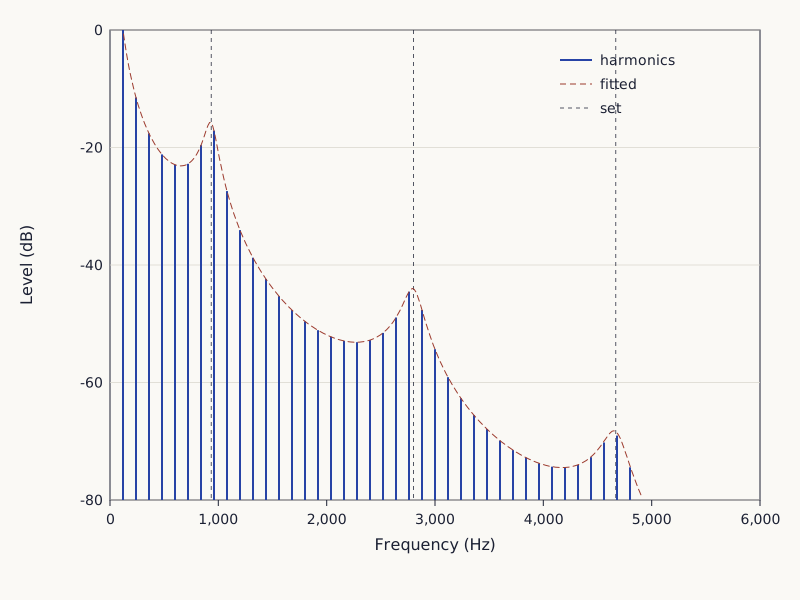
Figure 3. Spectrum of clip 2: the same harmonics every 120 Hz, shaped by resonances near 934, 2801 and 4669 Hz.
Chart: Tricks of Ear and Eye, CC BY 4.0
Full credit line to copy
"Spectrum of the heliox model clip" by Tricks of Ear and Eye, https://tricksofearandeye.com/sound/helium-voice/, licensed under CC BY 4.0, https://creativecommons.org/licenses/by/4.0/
Compare Figure 2 with Figure 3. The harmonic lines sit at the same frequencies in both. The humps of the curve above them, the resonances, have slid to the right. A spectrum check of the two files measures a pulse rate of 120 hertz in both, and puts each resonance in clip 2 at 1.85 times its value in clip 1, within the 2 percent the check allows (spectrum check for clip 2 (CSV) (where the data come from and its license, JSON)).
That check is about the files, not about ears. Whether listeners hear clip 2 as higher, thinner or something else is a question for listening experiments, and no such experiment was read for this page.
Why do the resonances move but not the pitch?
Source-filter theory splits a voice into two parts (Fitch et al., 2025) [2]. The source is the vocal folds, which vibrate at a rate called the fundamental frequency, the main basis of pitch [2]. The filter is the air between the vocal folds and the lips. Its resonances, called formants, favor some of the source's harmonics over others.
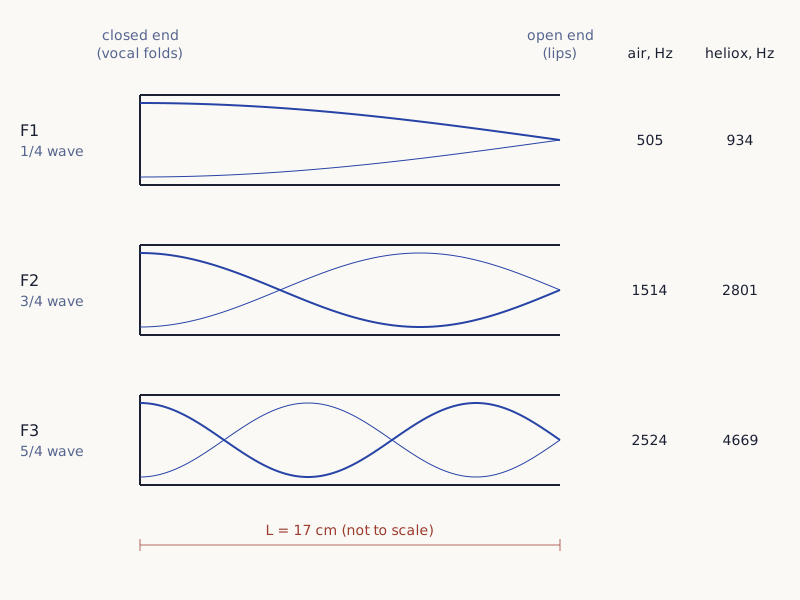
A simple model treats that air column as a uniform tube, closed at the vocal folds and open at the mouth. Its resonances fall at odd multiples of a quarter wavelength [2]. The formula is F = n × c ÷ (4 × L), where c is the speed of sound, L is the tube length and n is 1, 3, 5 and so on. Fitch and colleagues stress that a real vocal tract is rarely uniform, so the formula is only a rough guide [2].
Figure 4 shows the first three resonances for a 17-centimeter tube, a round length chosen for this page's model.
Wide drawing on a small screen: swipe sideways, or open it full size.
Figure 4. A quarter, three quarters and five quarters of a wavelength in a 17-centimeter tube closed at one end, with the resulting resonances in air and in heliox 80/20.
Diagram: Tricks of Ear and Eye, CC BY 4.0
Full credit line to copy
"First three resonances of a tube closed at one end" by Tricks of Ear and Eye, https://tricksofearandeye.com/sound/helium-voice/, licensed under CC BY 4.0, https://creativecommons.org/licenses/by/4.0/
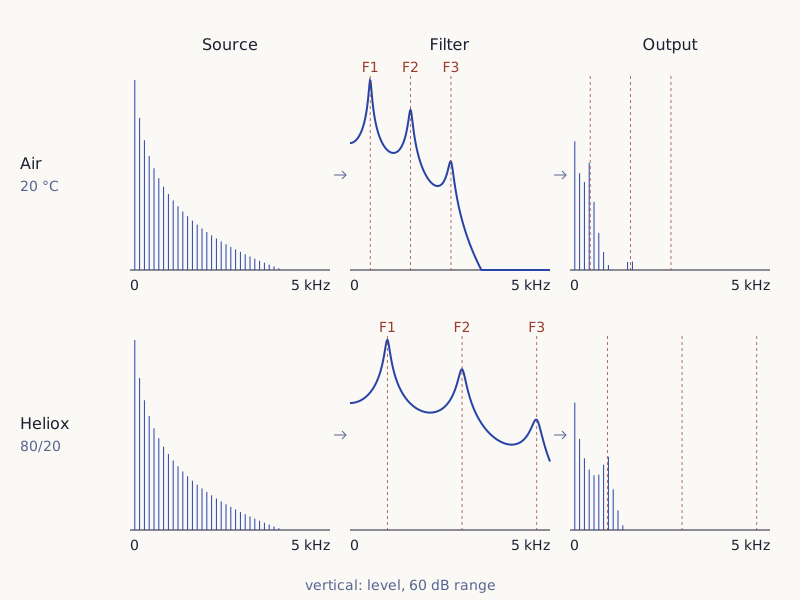
In Figure 5, the same 120-hertz source passes through that tube twice: once with the air values, once with the heliox values.
Wide drawing on a small screen: swipe sideways, or open it full size.
Figure 5. Source, filter and output in this page's air and heliox models; the source panels are identical, the filter peaks move.
Diagram: Tricks of Ear and Eye, CC BY 4.0
Full credit line to copy
"Source and filter in the air and heliox models" by Tricks of Ear and Eye, https://tricksofearandeye.com/sound/helium-voice/, licensed under CC BY 4.0, https://creativecommons.org/licenses/by/4.0/
The formula has c in it, and nothing about the tissue. Helium, Fitch and colleagues note, is "less dense than air and conveys sound more rapidly." When source and filter are uncoupled, filling the airway with it shifts the formants "uniformly upwards while leaving tissue-based source frequencies" unchanged [2]. The Shepard tone entry pulls the same two layers apart the other way round: its components climb while a fixed envelope over them stays put.
How heliox became a lab test
Fitch and colleagues (2025) write that heliox voices were first used to show this independence in humans in the early 1960s. Helium chambers have since been used with songbirds, frogs, alligators, bats, dolphins and nonhuman primates [2]. Reber and colleagues (2015) put a Chinese alligator in one. The source components of its bellows stayed constant while high-energy bands moved up, so the authors identified those bands as formants [1].
This page has not read the 1962 human study that both papers cite, by R. G. Beil. What it says about human voices rests on how those two papers report it.
When the pitch does move
The source does not always hold still. Fitch and colleagues (2025) note that source and filter can interact. Examples are falsetto singing, when the fundamental comes close to a formant, and voice breaks, though they call these secondary effects in the human voice [2].
Some animal sounds break the rule outright. In rodent whistles the source is coupled to the vocal tract resonances, so in heliox their fundamental frequency shifts [2].
What people notice is a different matter. Fitch and colleagues describe heliox voices as sounding "uncannily high in timbre," timbre meaning a sound's tone color [2]. That is the authors' description, not the result of a listening test.
The numbers: air, heliox and pure helium
In an ideal gas, the speed of sound is c = √(γRT/M). Here γ is the gas's heat-capacity ratio, R is the gas constant, T is the temperature in kelvin and M is the molar mass [4][5]. Helium is light: 4.0026 grams per mole, against 28.96 for dry air [5][6]. As a gas of single atoms, it also has γ = 5/3, against about 1.4 for air [4][5].
This page computed the speeds at 20 °C with R = 8.314471 J/(mol·K) [4]. For the mixes, it averaged heat capacities by mole fraction, a rule of the kind Yue and colleagues apply to moist air [5]. It gave oxygen the same γ as dry air, an assumption of this page. The heliox rows use two mixes from the sources: helium with 20% oxygen, which Fitch and colleagues name for living subjects [2], and the 88/12 mix in Reber's alligator chamber [1].
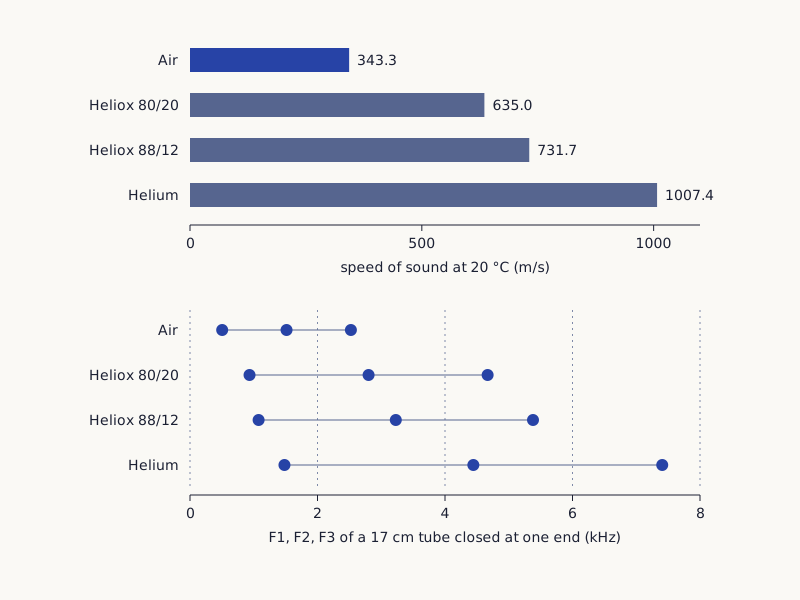
| Gas at 20 °C | Speed of sound | Ratio to air | F1 | F2 | F3 |
|---|---|---|---|---|---|
| Dry air | 343.3 m/s | 1.000 | 504.8 Hz | 1514.4 Hz | 2524.0 Hz |
| Heliox, 80% helium, 20% oxygen | 635.0 m/s | 1.850 | 933.8 Hz | 2801.3 Hz | 4668.8 Hz |
| Heliox, 88% helium, 12% oxygen | 731.7 m/s | 2.132 | 1076.1 Hz | 3228.2 Hz | 5380.4 Hz |
| Pure helium (no oxygen) | 1007.4 m/s | 2.935 | 1481.5 Hz | 4444.6 Hz | 7407.6 Hz |
Wide drawing on a small screen: swipe sideways, or open it full size.
Figure 6. Speed of sound and the first three resonances of a 17-centimeter tube closed at one end, for four gases at 20 °C.
Chart: Tricks of Ear and Eye, CC BY 4.0
Full credit line to copy
"Speed of sound and tube resonances, four gases" by Tricks of Ear and Eye, https://tricksofearandeye.com/sound/helium-voice/, licensed under CC BY 4.0, https://creativecommons.org/licenses/by/4.0/
Data: Rows of the Tricks of Ear and Eye table of speed of sound and tube resonances, constants cited row by row
The conversion table (CSV) (where the data come from and its license, JSON) Data: Constants from Moldover et al. 1988 (public domain), Yue, Dong & Qi 2025 (CC BY 4.0) and Al-Raeei & El-Daher 2020 (CC BY 4.0); heliox mixes and stated values from Fitch et al. 2025 (CC BY 4.0) and Reber et al. 2015 (CC BY 3.0) has a row for each gas with its constants and sources; clip 2 uses the 80/20 row. The Doppler effect entry also works with about 343 m/s for dry air at 20 °C. Inside a speaking person the air is warmer and moister. Fitch and colleagues use about 350 m/s for warm humid air [2], which would raise every air resonance by about 2 percent.
Two figures for one heliox mix
Reber and colleagues expected 345 m/s in air and 712 m/s in their heliox at about 23 °C, "about twice the velocity in ambient air" [1]. At 23 °C, this page's formula gives 345.0 and 735.5 m/s. The passage does not show how 712 was worked out, so the table file lists both.
Heliox, helium and deeper voices
Heliox has uses outside the lab. Berganza and Zhang (2013) note that deep-sea divers breathe it, because helium dissolves less readily than nitrogen [7]. Barach, they add, proposed it as a therapeutic gas in 1934 [7].
The pure-helium row is physics only. It contains no oxygen, and heliox for living subjects includes oxygen to allow normal breathing (Fitch et al., 2025) [2]. Run the formula the other way and a gas in which sound travels more slowly than in air would pull the resonances down. This page names no such gas and describes no way to try one.
Sources
- Reber, S. A., Nishimura, T., Janisch, J., Robertson, M., & Fitch, W. T. (2015). A Chinese alligator in heliox: formant frequencies in a crocodilian. Journal of Experimental Biology 218(15): 2442–2447. Open the sourceRead: full textText license: CC BY 3.0
- Fitch, W. T., Anikin, A., Pisanski, K., Valente, D., & Reby, D. (2025). Formant analysis of vertebrate vocalizations: achievements, pitfalls, and promises. BMC Biology 23: 92. Open the sourceRead: full textText license: CC BY 4.0
- Newcastle City Council, Trading Standards. Product safety: Helium balloons (relaying a safety announcement from the UK Office for Product Safety and Standards). Open the sourceRead: page section on helium balloons; paraphrased
- Moldover, M. R., Trusler, J. P. M., Edwards, T. J., Mehl, J. B., & Davis, R. S. (1988). Measurement of the universal gas constant R using a spherical acoustic resonator. Journal of Research of the National Bureau of Standards 93(2): 85–144. Open the sourceRead: full text
- Yue, Y., Dong, Z., & Qi, Z.-m. (2025). Acoustic Fabry–Perot resonance detector for passive acoustic thermometry and sound source localization. Sensors 25(8): 2445. Open the sourceRead: full textText license: CC BY 4.0
- Al-Raeei, M., & El-Daher, M. S. (2020). Formula of compressibility and using it for air, noble gases, some hydrocarbons gases, some diatomic simple gases and some other fluids. BMC Chemistry 14: 47. Open the sourceRead: full textText license: CC BY 4.0
- Berganza, C. J., & Zhang, J. H. (2013). The role of helium gas in medicine. Medical Gas Research 3: 18. Open the sourceRead: full textText license: CC BY 2.0
Sense check:
One step, under a minute
Work out 343 ÷ (4 × 0.17), the lowest resonance in hertz of a 17-centimeter tube closed at one end, then compare it with F1 in the air row of the table above. The same speed of sound sets the frequency drop in the Doppler effect, and the same closed-tube formula reappears in how a clarinet works.
Related entries
 Illustration
Doppler Effect: Listeners Report a Rise the Frequency Lacks
Sound
Five synthesized passes, 20 to 300 km/h: at a steady speed in a straight line, the frequency only falls. Listeners in a 1996 study still reported a rise.
Image credit
Illustration: Tricks of Ear and Eye. Generated schematic image — not a photograph, specimen record or perceptual simulation. Reuse permitted with this credit line; provided as is.
 Illustration
Shepard Tone: 12 Steps Up, and the Same Sound Comes Back
Sound
Clip 1 lifts each component of a Shepard tone a semitone 12 times, and tone 13 matches tone 1. Listeners in experiments tended to report the shorter way around.
Image credit
Illustration: Tricks of Ear and Eye. Generated schematic image — not a photograph, specimen record or perceptual simulation. Reuse permitted with this credit line; provided as is.
Cite this page
Tricks of Ear and Eye. "Why Helium Changes Your Voice: Its Resonances Rise." Tricks of Ear and Eye. Published 2026-10-30. https://tricksofearandeye.com/sound/helium-voice/. Accessed on the date you read it.