Prussian Blue: The Accident Story Rests on a 1731 Account
Tricks of Ear and Eye Published
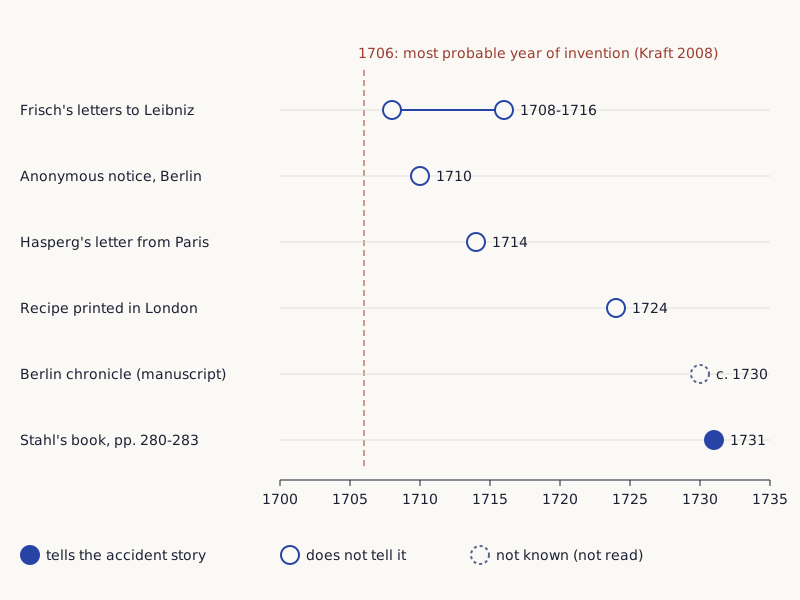
The oldest source in Figure 1 below that tells the accident story dates from 1731. Prussian blue, an iron compound used as a pigment, was announced in Berlin in 1710 with no method. A recipe was printed in London in 1724. The tale of a color maker who was making a red and got a blue comes from Georg Ernst Stahl's book of 1731, as Alexander Kraft (2008) traces the sources [1].
Wide drawing on a small screen: swipe sideways, or open it full size.
Figure 1. Early sources on Prussian blue by year: filled circles tell the accident story, open circles do not, a dashed circle is not known.
Chart: Tricks of Ear and Eye, CC BY 4.0
Full credit line to copy
"Early sources on Prussian blue, by year" by Tricks of Ear and Eye, https://tricksofearandeye.com/color/prussian-blue/, licensed under CC BY 4.0, https://creativecommons.org/licenses/by/4.0/
Data: Rows of the Tricks of Ear and Eye table of early Prussian blue sources, each citing its source; based mainly on Kraft 2008
Where does the accident story come from?
Stahl, a physician and chemist, set the discovery in Johann Konrad Dippel's Berlin laboratory, with no date. In his telling, a color maker named Diesbach was making Florentine lake, a red pigment from cochineal insects. He borrowed potash that Dippel had used to make an animal oil, and the pigment came out blue instead of red [1]. This page tells the story as history only, with no steps for making the pigment.
A scan of the 1731 edition shows Stahl's Latin on pages 280 to 283. He calls it a chance experiment ("experimento fortuito") from perhaps twenty years earlier [2]. Dippel lived in Berlin from autumn 1704 until early 1707, and Kraft judges 1706 the most probable year [1].
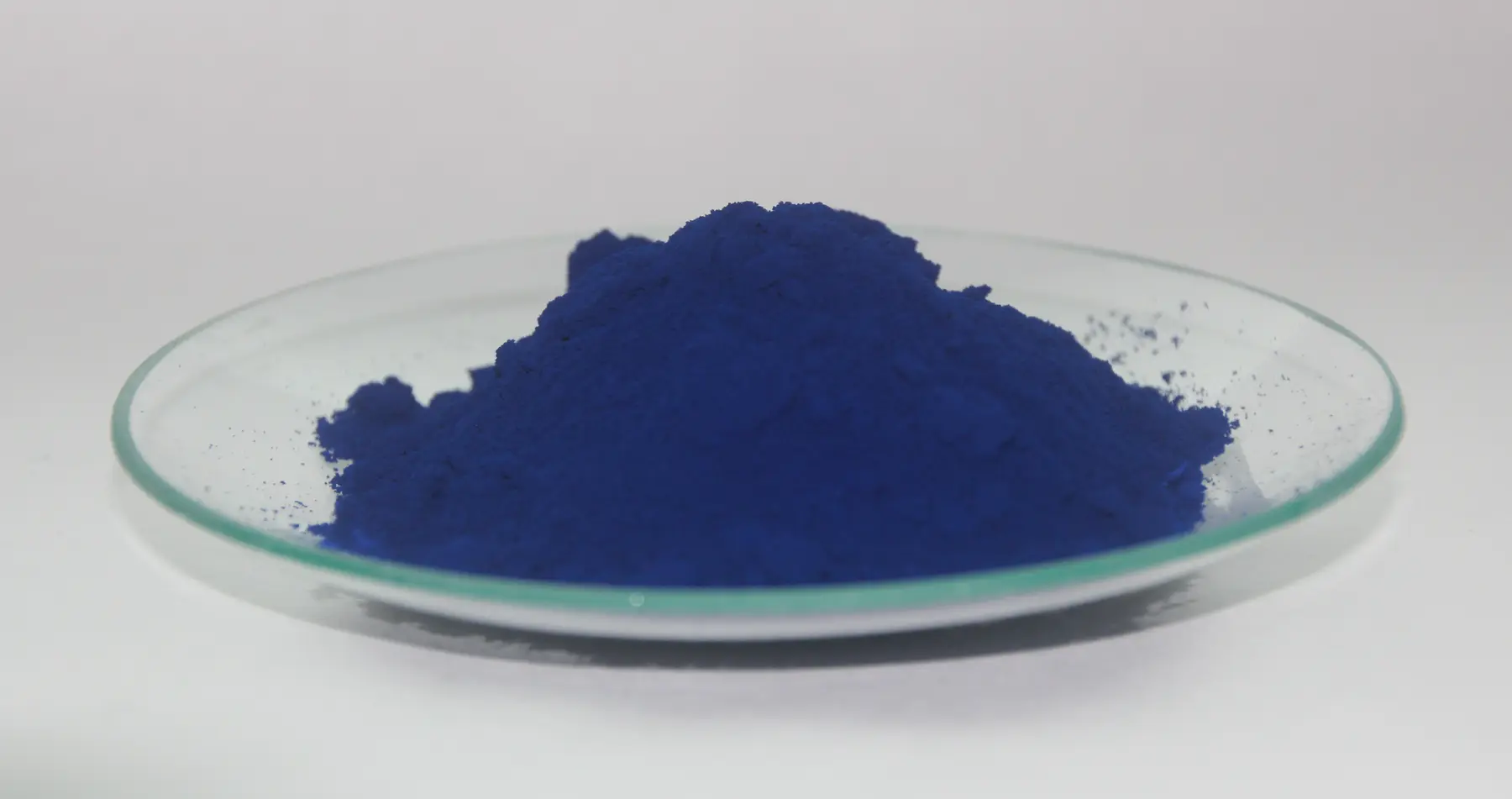
Figure 2. Prussian blue pigment powder in a photograph from 2012; colors on a screen only approximate the pigment.
"Pigment Berliner Blau" by Saalebaer — https://commons.wikimedia.org/wiki/File:Pigment_Berliner_Blau.JPG — CC0 1.0 (https://creativecommons.org/publicdomain/zero/1.0/)
Kraft notes that two sources have been treated as the only ones on the pigment's first years: the anonymous 1710 notice and Stahl's book. The notice said almost nothing about how the pigment was found. Kraft adds 13 letters that Johann Leonhard Frisch wrote to Gottfried Wilhelm Leibniz from 1708 to 1716; they mention the new blue but not how it was invented [1]. This site has not read the letters or the notice.
In 1714 a writer in Paris told Leibniz he did not know who the inventor was. A Berlin chronicle from about 1730 credits the invention to a Swiss named Diesbach, under the year 1706 [1]. Kraft cites it for that alone, so whether it tells the story is not known. That leaves Stahl's book as the oldest account of an accident in Figure 1.
| Year | Source | On the discovery | Tells the accident story? |
|---|---|---|---|
| 1708–1716 | 13 letters, Frisch to Leibniz | Mention the blue | No |
| 1710 | Anonymous notice, Berlin | Almost nothing; no method | No |
| 1714 | Letter from Paris | Inventor unknown to the writer | No |
| 1724 | Recipe printed in London | A recipe with quantities | No |
| About 1730 | Berlin chronicle, manuscript | Names Diesbach under 1706 | Not known |
| 1731 | Stahl's book, pp. 280–283 | A red that came out blue | Yes |
The source table (CSV) (where the data come from and its license, JSON) Data: Claims summarized row by row from Kraft 2008 (Bulletin for the History of Chemistry 33(2): 61-67, read in full, paraphrased), from scanned copies of Stahl 1731 and Woodward 1724 read for verification, and from Seymour et al. 2020 and Gargano et al. 2022 (CC BY) behind Figures 1 and 4 lists one claim per row, with how much of each source this site read.
What is Prussian blue made of?
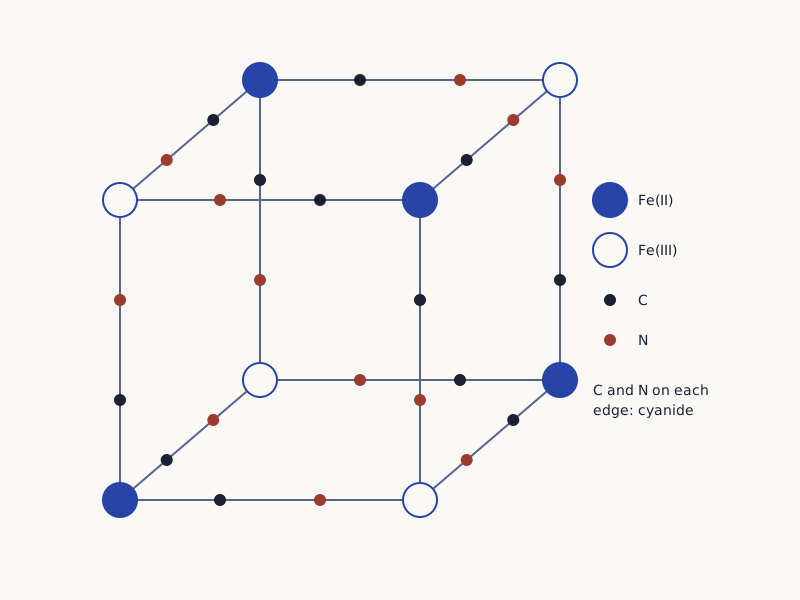
Figure 3 shows one small cube of its structure. Iron ions sit at the corners, alternating between iron(II) and iron(III). Each edge holds a cyanide group, a carbon atom bound to a nitrogen atom, with the carbon on the iron(II) side [3]. The small cubes repeat to build a solid lattice, so the pigment is not a single molecule.
Wide drawing on a small screen: swipe sideways, or open it full size.
Figure 3. One small cube of the lattice, simplified and not to scale; water, potassium ions and gaps in the real solid are left out.
Diagram: Tricks of Ear and Eye, CC BY 4.0
Full credit line to copy
"One small cube of the Prussian blue lattice, simplified" by Tricks of Ear and Eye, https://tricksofearandeye.com/color/prussian-blue/, licensed under CC BY 4.0, https://creativecommons.org/licenses/by/4.0/
Kraft gives the composition confirmed by a structure study of the 1970s as Fe4[Fe(CN)6]3·xH2O, with x from 14 to 16 [1]. The blue comes from intervalence charge transfer: absorbed light moves an electron between iron(II) and iron(III) across the cyanide bridge [3]. Because the pigment contains cyanide groups, this page covers its history and chemistry only, with no steps for making or handling it.
No color swatch appears here. No source read for this page gives color measurements, and a screen value would only approximate the pigment. Identical pixel values judged differently are the subject of the checker-shadow entry.
Kraft calls Prussian blue the first purely synthetic pigment [1]. Seymour and colleagues (2020) write that Egyptian blue is credited as the first synthetic pigment, with its earliest known use dated to 3300–3200 BCE [4].
When was the recipe published, and why two names?
The method stayed secret for only about 20 years, Kraft writes. In 1715 Frisch told Leibniz that in Berlin only he and Diesbach knew how to make it. He claimed in 1716 that two ultramarine factories in Paris had closed because of the Prussian blue he delivered [1].
Ultramarine, the blue it competed with, got a synthetic version over a century later. A French prize for a process went to Guimet in 1828, as Hamerton and colleagues (2013) recount [5].
In early 1724 the Royal Society in London printed a Latin recipe sent from Germany to John Woodward, without naming its author [1]. The scanned issue shows it on pages 15 to 17, with quantities; this page does not reproduce it [6]. Étienne-François Geoffroy passed the method to French chemists in 1725 [1].
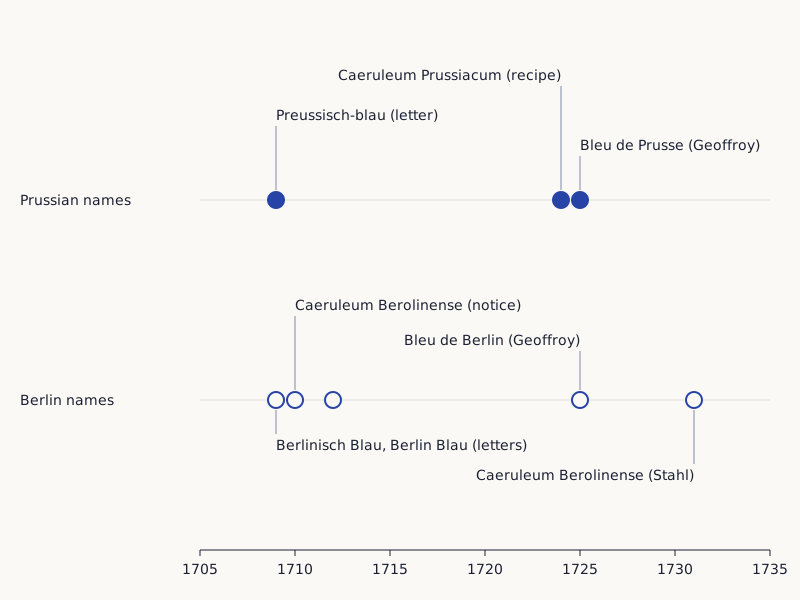
Both place names were in use by 1709. The pigment came from Berlin, then in the Kingdom of Prussia. The 1710 notice appeared in a publication of the Royal Prussian Society of Sciences [1].
Frisch's letters say "Preussisch-blau" and "Berlinisch Blau" from 1709. The notice and Stahl use the Latin name "Caeruleum Berolinense," and the 1724 recipe uses "Caeruleum Prussiacum" [1][6]. Geoffroy's 1725 title uses both: "Bleu de Prusse ou Bleu de Berlin" [1].
Wide drawing on a small screen: swipe sideways, or open it full size.
Figure 4. Names for the pigment in the early sources by year, Prussian names above and Berlin names below.
Chart: Tricks of Ear and Eye, CC BY 4.0
Full credit line to copy
"Names for Prussian blue in the early sources" by Tricks of Ear and Eye, https://tricksofearandeye.com/color/prussian-blue/, licensed under CC BY 4.0, https://creativecommons.org/licenses/by/4.0/
Data: Rows of the Tricks of Ear and Eye table of early Prussian blue sources, each citing its source; based mainly on Kraft 2008
The earliest painting in which Bartoll and colleagues found the pigment is a 1709 work by Pieter van der Werff, as Kraft reports [1]. This site has not read a pigment analysis of Hokusai's Great Wave. Gargano and colleagues (2022) studied six Japanese woodblock prints by Utagawa Kunisada, dated 1859 to 1862. Raman spectroscopy, a laser-based test, found Prussian blue in most of their blue areas [7].
Sources
- Kraft, A. (2008). On the discovery and history of Prussian blue. Bulletin for the History of Chemistry 33(2): 61–67. Open the sourceRead: full text; paraphrased
- Stahl, G. E. (1731). Experimenta, observationes, animadversiones CCC numero chymicae et physicae. Berlin: Ambrosius Haude, pp. 280–283. Open the sourceRead: scanned copy (Wellcome Library), read for verification
- Sonoda, A., Nihei, M., Shinkawa, N., Kakizaki, E., & Yukawa, N. (2025). Perls' Prussian blue staining and chemistry of Prussian blue and Turnbull blue. Forensic Science International: Synergy 11: 100627. Open the sourceRead: full text
- Seymour, L. M., Nicola, M., Kessler, M. I., Yost, C. L., Bazzacco, A., Marello, A., Ferraris, E., Gobetto, R., & Masic, A. (2020). On the production of ancient Egyptian blue: Multi-modal characterization and micron-scale luminescence mapping. PLoS ONE 15(11): e0242549. Open the sourceRead: full textText license: CC BY 4.0
- Hamerton, I., Tedaldi, L., & Eastaugh, N. (2013). A systematic examination of colour development in synthetic ultramarine according to historical methods. PLoS ONE 8(2): e50364. Open the sourceRead: full text; its history of the 1824 prize is retold from a 1993 magazine articleText license: CC BY 4.0
- Woodward, J. (1724). Praeparatio caerulei Prussiaci ex Germania missa ad Johannem Woodward. Philosophical Transactions of the Royal Society of London 33: 15–17. Open the sourceRead: scanned copy (Natural History Museum Library), read for verification
- Gargano, M., Longoni, M., Pesce, V., Palandri, M. C., Canepari, A., Ludwig, N., & Bruni, S. (2022). From materials to technique: A complete non-invasive investigation of a group of six ukiyo-e Japanese woodblock prints of the Oriental Art Museum E. Chiossone (Genoa, Italy). Sensors 22(22): 8772. Open the sourceRead: full text
Sense check:
One step, under a minute
Count the years in Figure 1 from the 1710 notice to the recipe printed in London. Kraft wrote in 2008 that it was not clear who sent that recipe from Germany, so the sources on this page do not say who ended the secret. Next: Ultramarine · Checker-shadow illusion
Related entries

Ultramarine Blue: Its Color Comes Mostly From Caged Sulfur
Color & Pigment
Ultramarine's blue comes mainly from three sulfur atoms trapped in a mineral cage. How lapis lazuli fits in, and what 1828 reports say of the synthetic.
Image credit
"The Virgin in Prayer" by Giovanni Battista Salvi da Sassoferrato — https://commons.wikimedia.org/wiki/File:Sassoferrato_-_Jungfrun_i_b%C3%B6n.jpg — Public domain (Giovanni Battista Salvi da Sassoferrato died 1685; public domain in the US (published before 1931) and in the EU (author died more than 70 years ago); PD-Art faithful reproduction (photograph from the Web Gallery of Art; National Gallery, London, NG200, as recorded on the Commons file page))
Egyptian Blue: Under Red Light, It Glows in Infrared
Color & Pigment
Egyptian blue, a copper silicate with an earliest known use of 3300–3200 BCE, emits near-infrared light reported near 910 nm, past the CIE curve's 830 nm end.
Image credit
"Shabti of Yuya" by The Metropolitan Museum of Art — https://commons.wikimedia.org/wiki/File:Shabti_of_Yuya_MET_DT541.jpg — CC0 1.0 (https://creativecommons.org/publicdomain/zero/1.0/)
Cite this page
Tricks of Ear and Eye. "Prussian Blue: The Accident Story Rests on a 1731 Account." Tricks of Ear and Eye. Published 2026-10-30. https://tricksofearandeye.com/color/prussian-blue/. Accessed on the date you read it.