Egyptian Blue: Under Red Light, It Glows in Infrared
Tricks of Ear and Eye Published
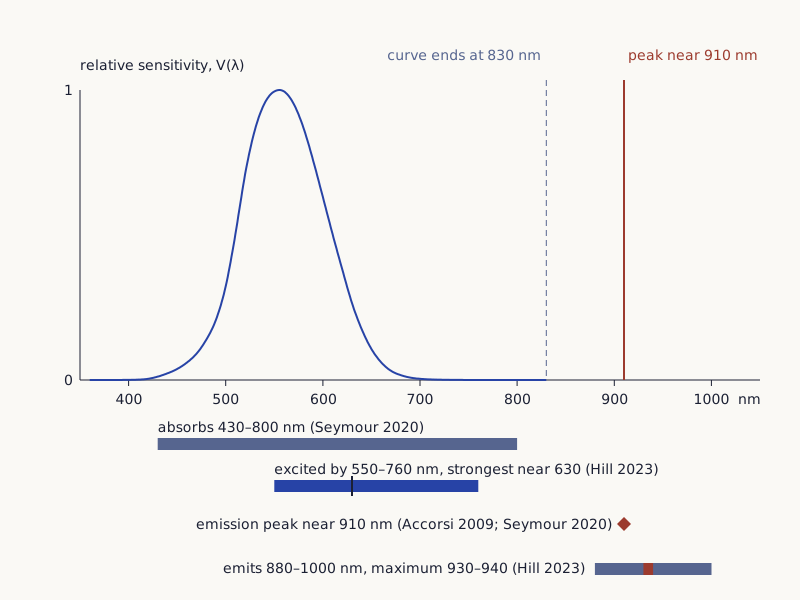
In Figure 1, Egyptian blue's emission peak sits past the end of the human sensitivity curve. This calcium copper silicate absorbs visible light and emits near-infrared light; the abstract of Accorsi and colleagues (2009) puts the peak at 910 nanometers [1] [2]. The CIE daylight curve stops at 830 nanometers [3], and a modified camera records the glow [1]. Seymour and colleagues (2020) note that Egyptian blue is credited as the first synthetic pigment, with its earliest known use dated to 3300–3200 BCE [1].
Wide drawing on a small screen: swipe sideways, or open it full size.
Figure 1. The CIE daylight sensitivity curve, with the ranges and peaks reported for Egyptian blue below the axis.
Chart: Tricks of Ear and Eye, CC BY-SA 4.0
Full credit line to copy
"Egyptian blue absorption and emission ranges beside the CIE daylight sensitivity curve" by Tricks of Ear and Eye, https://tricksofearandeye.com/color/egyptian-blue/, licensed under CC BY-SA 4.0, https://creativecommons.org/licenses/by-sa/4.0/
Data: CIE 2019, CIE spectral luminous efficiency for photopic vision, International Commission on Illumination (CIE), Vienna, AT, DOI: 10.25039/CIE.DS.dktna2s3, licensed under CC BY-SA 4.0
What is Egyptian blue made of?
Egyptian blue is not a single molecule. Its main part is the crystal CaCuSi4O10, matching the rare mineral cuprorivaite [1]. Calcium ions loosely hold its stacked silicate sheets together, with copper ions (Cu2+) set in the sheets [5]. Hill and colleagues (2023) name the copper ions as the reason for how it handles light [5].
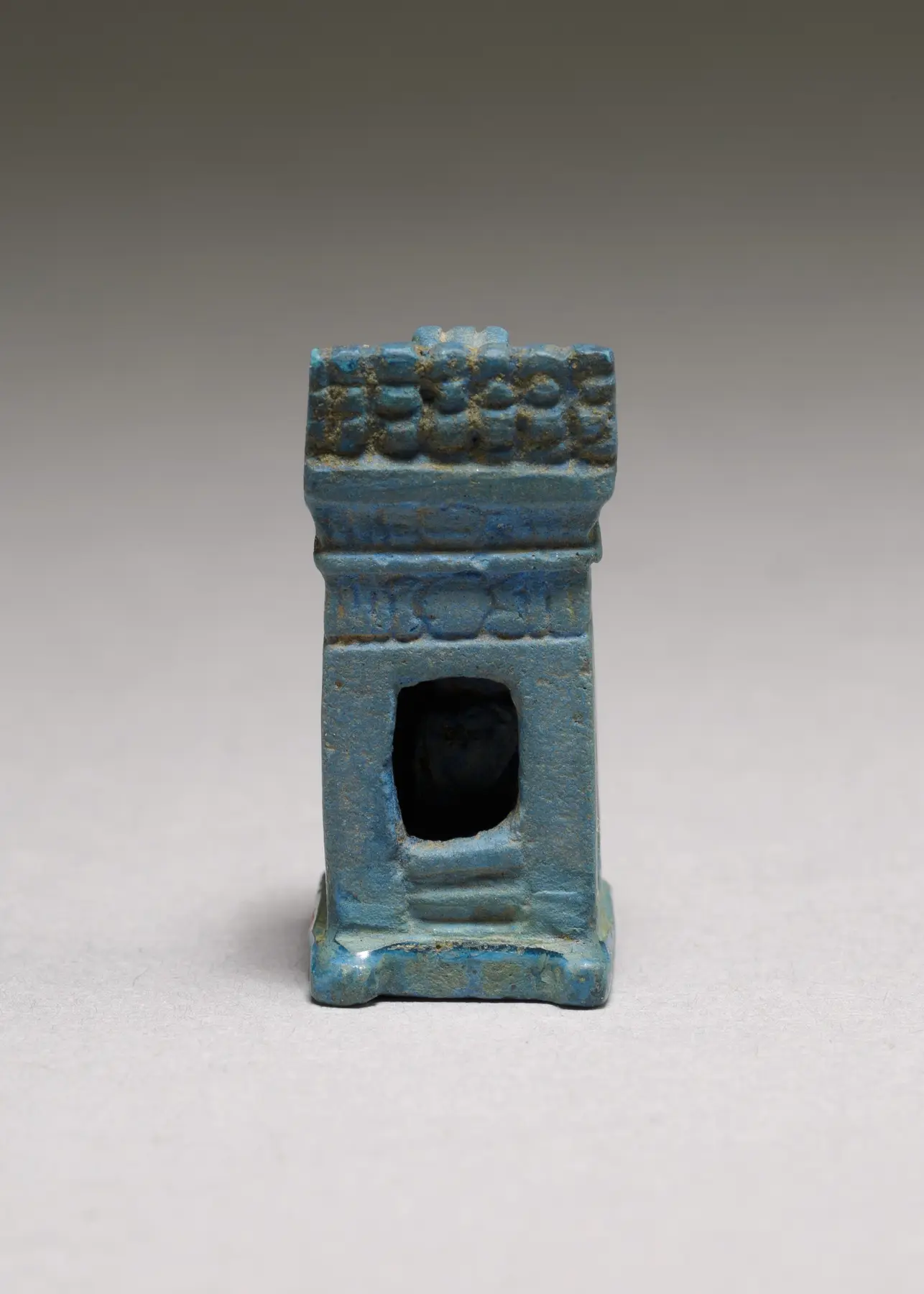
Figure 2. Khonsu shrine amulet, 664–332 BCE, 2.5 cm tall; the museum lists its medium as Egyptian blue.
"Khonsu shrine amulet" by The Metropolitan Museum of Art — https://commons.wikimedia.org/wiki/File:Khonsu_shrine_amulet_MET_1984.177_EGDP019181.jpg — CC0 1.0 (https://creativecommons.org/publicdomain/zero/1.0/)
Look at the amulet in Figure 2, though a screen cannot show a pigment's real color. This page gives no swatch, because no measured color data was read for it. Old samples can also be mixtures. In shabti figures from Deir el-Medina in Egypt, Seymour and colleagues (2020) found grains that were not pure cuprorivaite, with glowing and non-glowing parts side by side [1].
Why does Egyptian blue glow in the infrared?
Read the rows under Figure 1's axis. Summing up earlier studies, Seymour and colleagues (2020) describe a broad band of absorbed light from 430 to 800 nm [1] and a narrow near-infrared band of emitted light near 910 nm [1]. Accorsi and colleagues' 2009 abstract puts the peak at 910 nm, with 10.5% of the absorbed photons (particles of light) coming back as glow [2].
Hill and colleagues (2023) measured ground Egyptian blue themselves. Green to red light, from 550 to 760 nm, set off the glow, most strongly near 630 nm [5]. The glow ran from 880 to 1000 nm and peaked at 930–940 nm [5]. The sources read here do not explain the gap, so this page lists both peaks (facts table (CSV) (where the data come from and its license, JSON)).
Citing earlier work, Seymour and colleagues tie the glow to the copper ion: visible light lifts it to a higher energy state, and the glow comes out as it drops back through its lowest energy step [1]. They call this the most commonly accepted account but add that the exact process is still unclear [1].
Can you see the glow?
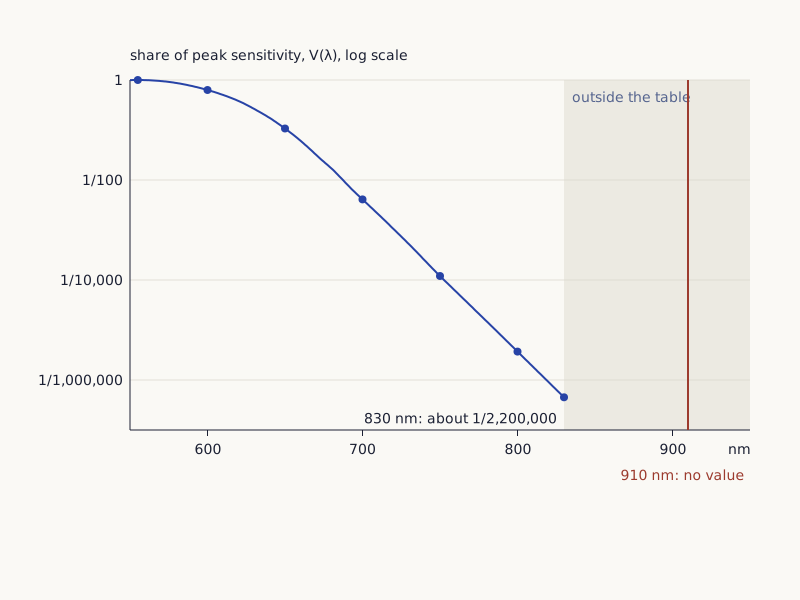
Figure 3 zooms in on the red end of the CIE photopic curve, the standard model of how sensitive daylight vision is to each wavelength [3]. Its table runs from 360 to 830 nm. At 830 nm, the last row, the value is about 1/2,200,000 of the peak at 555 nm (computed for this page). At 910 nm there is no value (red-end values (CSV) (where the data come from and its license, JSON) Data: CIE 2019, CIE spectral luminous efficiency for photopic vision, International Commission on Illumination (CIE), Vienna, AT, DOI: 10.25039/CIE.DS.dktna2s3, licensed under CC BY-SA 4.0).
Wide drawing on a small screen: swipe sideways, or open it full size.
Figure 3. The red end of the CIE photopic curve on a log scale; each gridline is 100 times lower than the one above.
Chart: Tricks of Ear and Eye, CC BY-SA 4.0
Full credit line to copy
"Red end of the CIE photopic sensitivity curve on a logarithmic scale" by Tricks of Ear and Eye, https://tricksofearandeye.com/color/egyptian-blue/, licensed under CC BY-SA 4.0, https://creativecommons.org/licenses/by-sa/4.0/
Data: CIE 2019, CIE spectral luminous efficiency for photopic vision, International Commission on Illumination (CIE), Vienna, AT, DOI: 10.25039/CIE.DS.dktna2s3, licensed under CC BY-SA 4.0
A standard curve does not measure any one person's eyes. Still, it gives the glow no weight, and the studies read here record it with cameras [1] [4]. Citing earlier work, Seymour and colleagues (2020) note that the camera method finds pigment traces invisible to the human eye [1]. The mantis shrimp entry puts an animal's color receptors on the same nanometer scale.
How is Egyptian blue found on old objects?
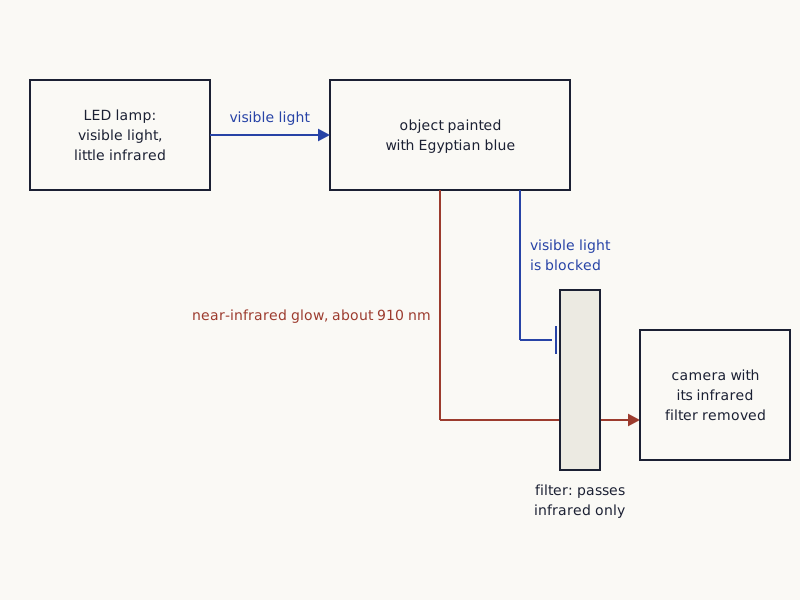
Follow the two light paths in Figure 4, drawn for this page from the methods below.
Wide drawing on a small screen: swipe sideways, or open it full size.
Figure 4. Visible-induced luminescence imaging, schematic, not to scale.
Diagram: Tricks of Ear and Eye, CC BY 4.0
Full credit line to copy
"Visible-induced luminescence imaging, schematic" by Tricks of Ear and Eye, https://tricksofearandeye.com/color/egyptian-blue/, licensed under CC BY 4.0, https://creativecommons.org/licenses/by/4.0/
The method is called visible-induced luminescence imaging. The object is lit with visible light, and a camera records the infrared it gives back [1]. In the abstract, Verri (2009) describes a modified digital camera with glass filters, and calls LEDs, which give off no stray infrared, an excellent light source [4]. In the setup of Seymour and colleagues (2020), the camera's own infrared filter was removed, and a front filter blocked visible light [1].
Citing earlier work, Seymour and colleagues say this can pick out grains on the order of 100 micrometers across, a tenth of a millimeter [1]. They mapped the pigment on shabti figures from Deir el-Medina, dated to about 1550–1077 BCE and now in the Egyptian Museum in Turin [1].
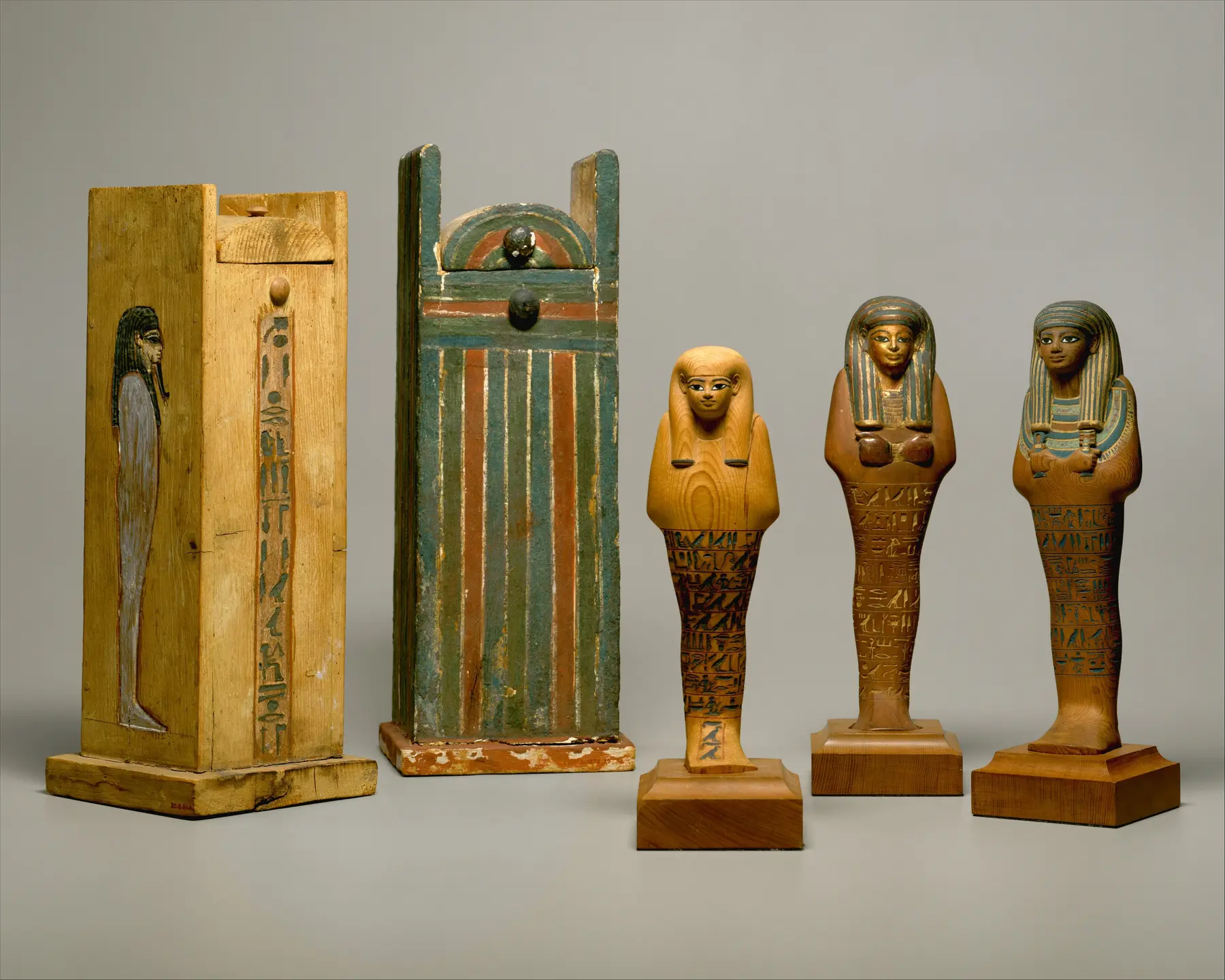
Figure 5. Shabtis and shabti boxes made for Yuya, Dynasty 18, photographed together; for the shabti catalogued as 30.8.57, the museum lists the medium as cedar, paint, Egyptian blue.
"Shabti of Yuya" by The Metropolitan Museum of Art — https://commons.wikimedia.org/wiki/File:Shabti_of_Yuya_MET_DT541.jpg — CC0 1.0 (https://creativecommons.org/publicdomain/zero/1.0/)
The shabtis in Figure 5 are in New York, not Turin; no luminescence image of it was read for this page.
Is Egyptian blue the oldest synthetic pigment?
Seymour and colleagues (2020) write that Egyptian blue is credited as the first synthetic pigment, with the earliest known use dated to 3300–3200 BCE [1]. That date is for the earliest known use, not for every object. Hill and colleagues (2023) give a later date: use as early as 2500 BC [5]. Seymour and colleagues add that it was made in Roman times, until about the fifth century CE [1].
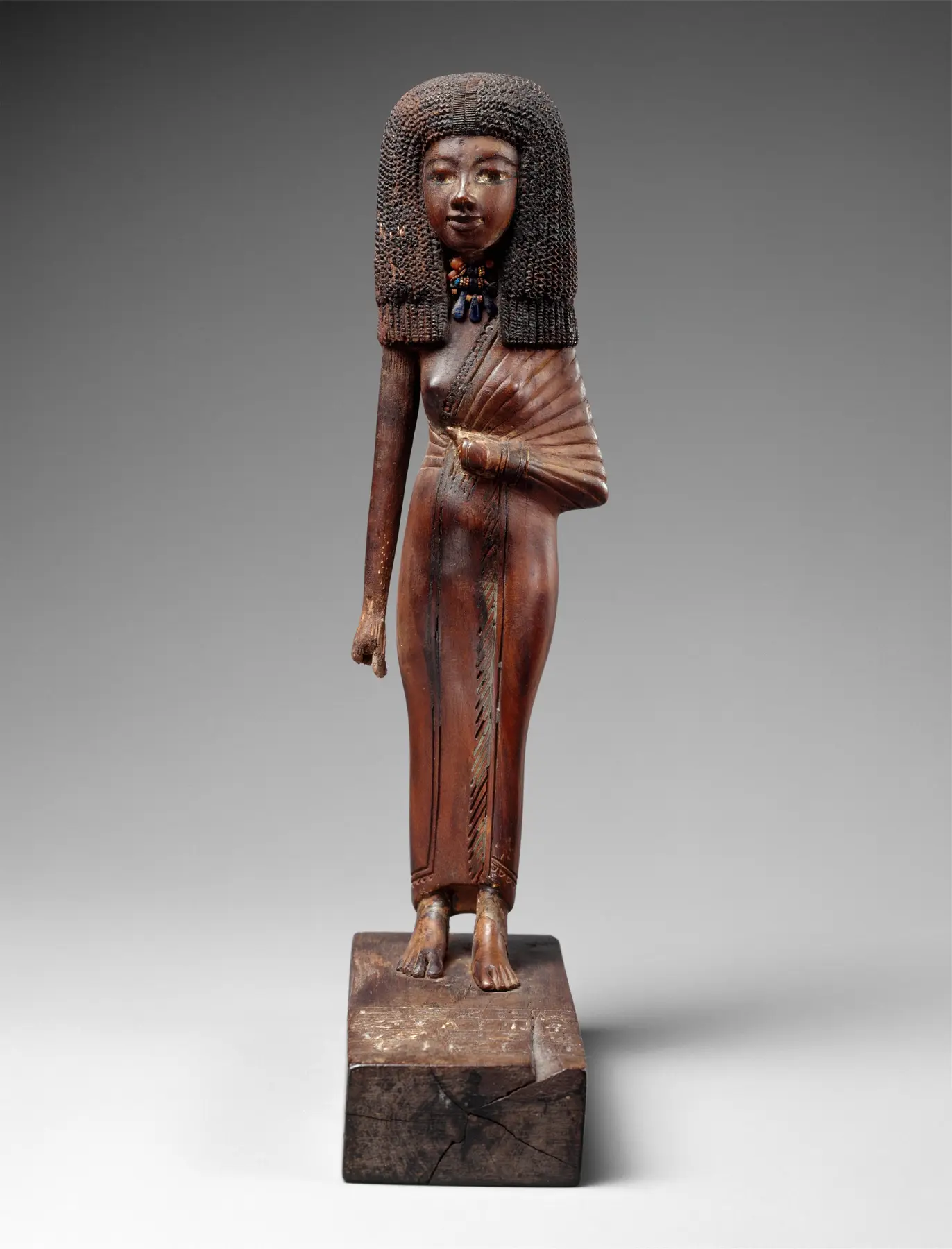
Figure 6. Statuette of the lady Tiye, Dynasty 18; the museum lists Egyptian blue among its materials.
"Statuette of the lady Tiye" by The Metropolitan Museum of Art — https://commons.wikimedia.org/wiki/File:Statuette_of_the_lady_Tiye_MET_DT221869.jpg — CC0 1.0 (https://creativecommons.org/publicdomain/zero/1.0/)
Dariz and Schmid (2021) call it "the first artificial pigment of mankind." They note the Greek and Roman writers Theophrastus, Vitruvius and Pliny the Elder said it was invented in Egypt [6]. They found it in a church wall painting from the fifth or sixth century AD in South Tyrol, Italy [6]. A 2026 lab study calls it "the earliest known synthetic pigment," according to its abstract [7].
Prussian blue was first mentioned in a Berlin science journal in 1710 [8]. Kraft (2008) calls Prussian blue the first purely synthetic pigment, so the "first" label depends on the source [8]. For synthetic ultramarine, the subject of the ultramarine entry, Hamerton and colleagues (2013) recount a French prize given in 1828 [9]. That is about 5,000 years after Egyptian blue's earliest known use (computed for this page).
Sources
- Seymour, L. M., Nicola, M., Kessler, M. I., Yost, C. L., Bazzacco, A., Marello, A., Ferraris, E., Gobetto, R., & Masic, A. (2020). On the production of ancient Egyptian blue: Multi-modal characterization and micron-scale luminescence mapping. PLoS ONE 15(11): e0242549. Open the sourceRead: full textText license: CC BY 4.0
- Accorsi, G., Verri, G., Bolognesi, M., Armaroli, N., Clementi, C., Miliani, C., & Romani, A. (2009). The exceptional near-infrared luminescence properties of cuprorivaite (Egyptian blue). Chemical Communications (23): 3392–3394. Open the sourceRead: abstract only
- CIE (2019). CIE spectral luminous efficiency for photopic vision [data set]. International Commission on Illumination (CIE), Vienna, AT. Open the sourceRead: full textText license: CC BY-SA 4.0
- Verri, G. (2009). The spatially resolved characterisation of Egyptian blue, Han blue and Han purple by photo-induced luminescence digital imaging. Analytical and Bioanalytical Chemistry 394(4): 1011–1021. Open the sourceRead: abstract only
- Hill, B., Abraham, S., Akhtar, A., Selvaggio, G., Tschulik, K., & Kruss, S. (2023). Surfactant assisted exfoliation of near infrared fluorescent silicate nanosheets. RSC Advances 13(30): 20916–20925. Open the sourceRead: full textText license: CC BY 3.0
- Dariz, P., & Schmid, T. (2021). Trace compounds in Early Medieval Egyptian blue carry information on provenance, manufacture, application, and ageing. Scientific Reports 11: 11296. Open the sourceRead: full textText license: CC BY 4.0
- Lo Bianco, A., Armetta, F., Boiko, V., Hreniak, D., & Saladino, M. L. (2026). What if the ancient Egyptians had microwaves? Modern chemistry refines the process behind the oldest synthetic pigment in human history. Inorganic Chemistry 65(15): 8422–8430. Open the sourceRead: abstract only
- Kraft, A. (2008). On the discovery and history of Prussian blue. Bulletin for the History of Chemistry 33(2): 61–67. Open the sourceRead: full text; paraphrased
- Hamerton, I., Tedaldi, L., & Eastaugh, N. (2013). A systematic examination of colour development in synthetic ultramarine according to historical methods. PLoS ONE 8(2): e50364. Open the sourceRead: full text; its history of the 1824 prize is retold from a 1993 magazine articleText license: CC BY 4.0
Sense check:
One step, under a minute
Find the last wavelength on the human sensitivity curve in Figure 1, then the wavelength where Egyptian blue's emission peaks, and subtract. Repeat with the other study's 930–940 nm maximum and note which way the gap moves. Next: Ultramarine Blue: Its Color Comes Mostly From Caged Sulfur · Mantis Shrimp Eyes: A Tested Species Told Hues Apart Poorly
Related entries

Ultramarine Blue: Its Color Comes Mostly From Caged Sulfur
Color & Pigment
Ultramarine's blue comes mainly from three sulfur atoms trapped in a mineral cage. How lapis lazuli fits in, and what 1828 reports say of the synthetic.
Image credit
"The Virgin in Prayer" by Giovanni Battista Salvi da Sassoferrato — https://commons.wikimedia.org/wiki/File:Sassoferrato_-_Jungfrun_i_b%C3%B6n.jpg — Public domain (Giovanni Battista Salvi da Sassoferrato died 1685; public domain in the US (published before 1931) and in the EU (author died more than 70 years ago); PD-Art faithful reproduction (photograph from the Web Gallery of Art; National Gallery, London, NG200, as recorded on the Commons file page))
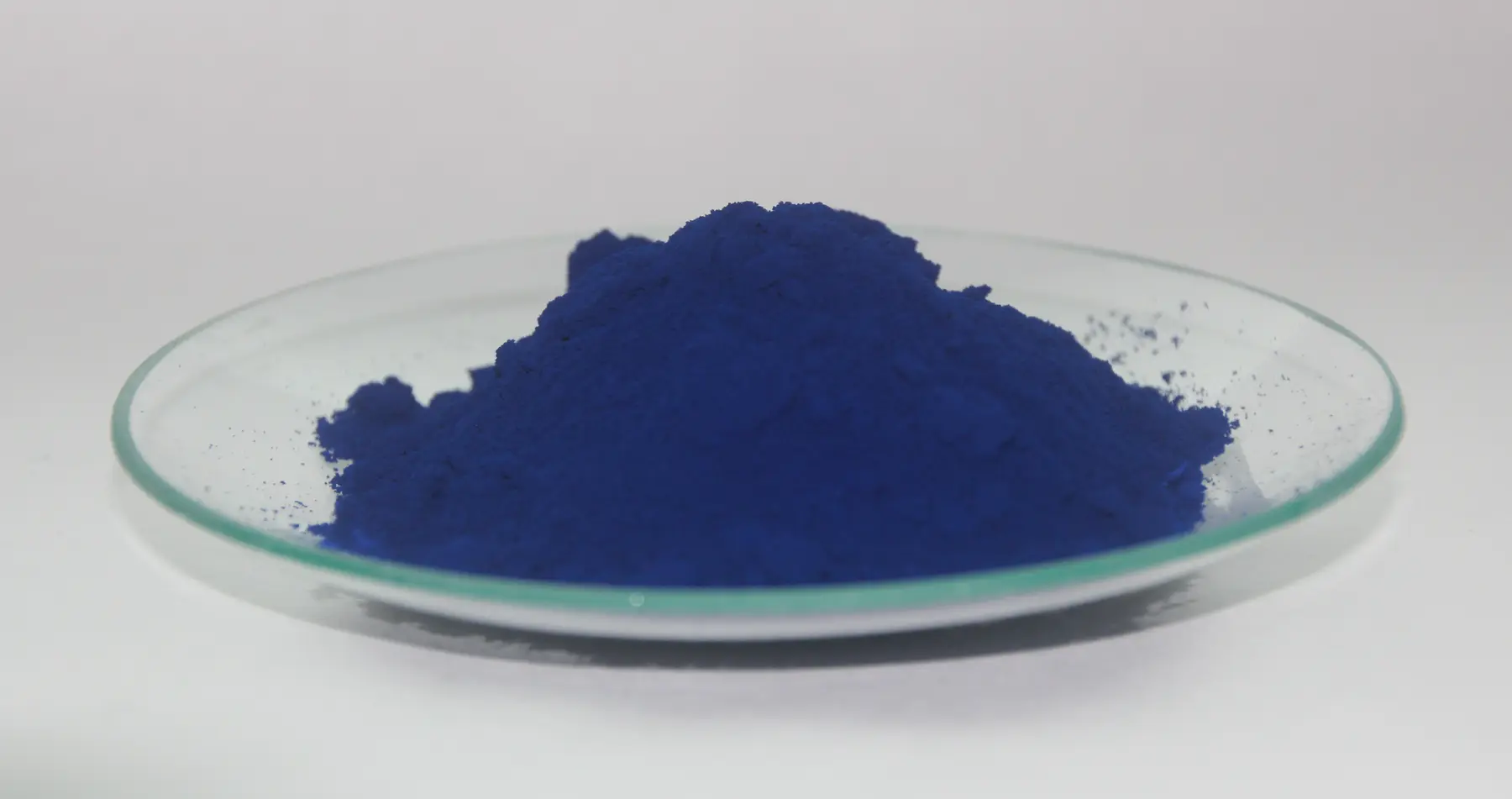
Prussian Blue: The Accident Story Rests on a 1731 Account
Color & Pigment
Prussian blue was announced in Berlin in 1710 and a recipe printed in 1724. The tale of a red that turned blue comes from Stahl's 1731 book, as Kraft traces it.
Image credit
"Pigment Berliner Blau" by Saalebaer — https://commons.wikimedia.org/wiki/File:Pigment_Berliner_Blau.JPG — CC0 1.0 (https://creativecommons.org/publicdomain/zero/1.0/)
Cite this page
Tricks of Ear and Eye. "Egyptian Blue: Under Red Light, It Glows in Infrared." Tricks of Ear and Eye. Published 2026-10-30. https://tricksofearandeye.com/color/egyptian-blue/. Accessed on the date you read it.