Pigeon Vision: Most of What It Sees, It Sees With One Eye
Tricks of Ear and Eye Published
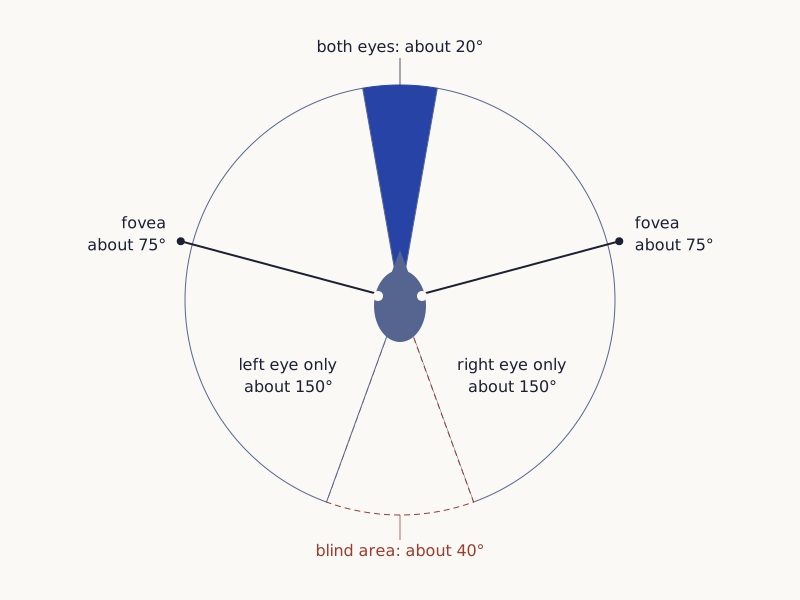
Figure 1 below draws a pigeon's view from above: about 20° in front is covered by both eyes. A blind area of about 40° lies behind the head, and most of the rest reaches one eye only (Delacoux and Kano, 2024, summing up earlier studies; reported values differ) [1] [2]. The pigeon's shortest-wave cone pigment absorbs best near 409 nanometers [3]. A 1997 survey found no evidence of a cone tuned to ultraviolet (UV) light in pigeons, according to its abstract [3].
Wide drawing on a small screen: swipe sideways, or open it full size.
Figure 1. A pigeon's horizontal field of view from above, drawn with rounded values from one 2024 summary; reported values differ between studies, and the head is not to scale.
Diagram: Tricks of Ear and Eye, CC BY 4.0
Full credit line to copy
"Pigeon field of view from above" by Tricks of Ear and Eye, https://tricksofearandeye.com/animal-senses/pigeon-vision/, licensed under CC BY 4.0, https://creativecommons.org/licenses/by/4.0/
Data: Field-of-view values from Delacoux, M., & Kano, F. (2024), eLife 13: RP95549, https://doi.org/10.7554/eLife.95549, CC BY 4.0, and Kano, F., Naik, H., Keskin, G., Couzin, I. D., & Nagy, M. (2022), Sci. Rep. 12: 19113, https://doi.org/10.1038/s41598-022-21931-9, CC BY 4.0
How much of the view do both eyes share?
Put a fingertip on the dark wedge at the top of Figure 1. It spans 20°, the zone both eyes cover. Delacoux and Kano (2024) give the overlap as about 20° and the blind area as about 40°, citing earlier work [1]. They add that pigeons use the overlap mostly for pecking, perching and watching slow-moving objects [1].
These numbers are not fixed. Kano and colleagues (2022) note that reported overlap values differ between studies [2]. In their own analysis they counted 20° on each side of the beak as two-eye vision, wide enough to cover every earlier value [2].
Take the two rounded values from a full circle and about 300° is left for one eye only, about 150° on each side (computed for this page: 360 − 20 − 40 = 300). The table repeats Figure 1 as text. The geometry check (CSV) (where the data come from and its license, JSON) re-measures the figure's angles from the saved file.
| Region in Figure 1 | Angle | Basis |
|---|---|---|
| Both eyes, in front | about 20° | Delacoux & Kano 2024, summarizing earlier studies [1] |
| Blind area, behind the head | about 40° | Delacoux & Kano 2024, summarizing earlier studies [1] |
| One eye only, both sides together | about 300° | computed for this page: 360 − 20 − 40 |
| Fovea of each eye | about 75° from the beak, to each side | Delacoux & Kano 2024 [1]; Kano et al. 2022 [2] |
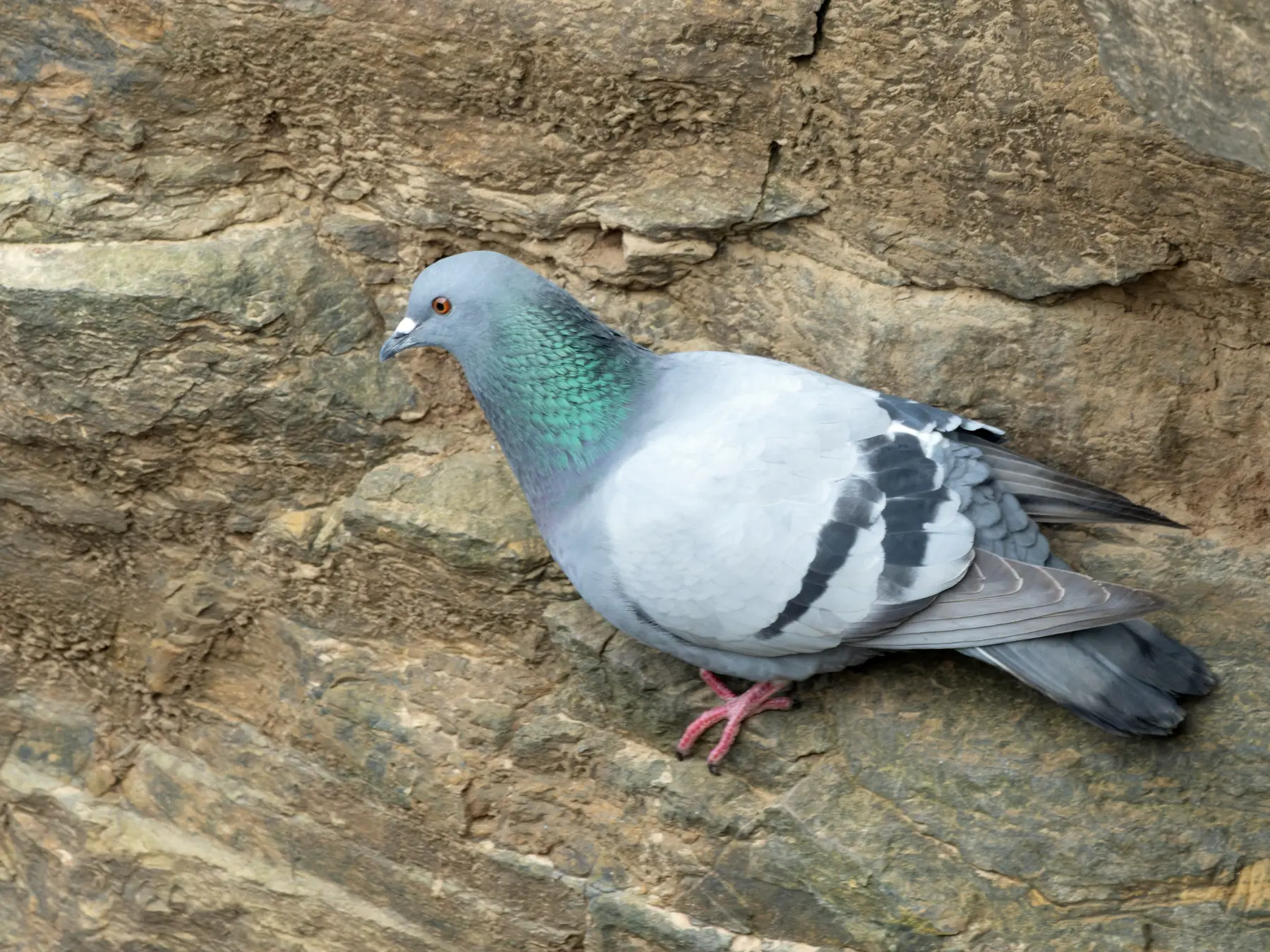
Figure 2. A wild rock dove, Columba livia, at Duncansby Head, Caithness, Scotland, on 25 April 2022.
"Columba livia (Rock Dove, wild), Duncansby Head, Caithness, Scotland" by william_stephens — https://commons.wikimedia.org/wiki/File:Columba_livia_(Rock_Dove,_wild),_Duncansby_Head,_Caithness,_Scotland_1.jpg — CC BY 4.0 (https://creativecommons.org/licenses/by/4.0/)
Each eye has one fovea, the patch of retina with the finest detail, and it aims about 75° to the side, at the horizon [1] [2]. Kano and colleagues (2022) tracked the heads of freely moving pigeons. The birds viewed distant objects with their foveas, and objects on the ground closer than 50 centimeters with the lower front of the view [2]. Pigeons feeding in a flock also used the fovea to check a simulated predator cue (Delacoux and Kano, 2024) [1].
What cones does a pigeon have?
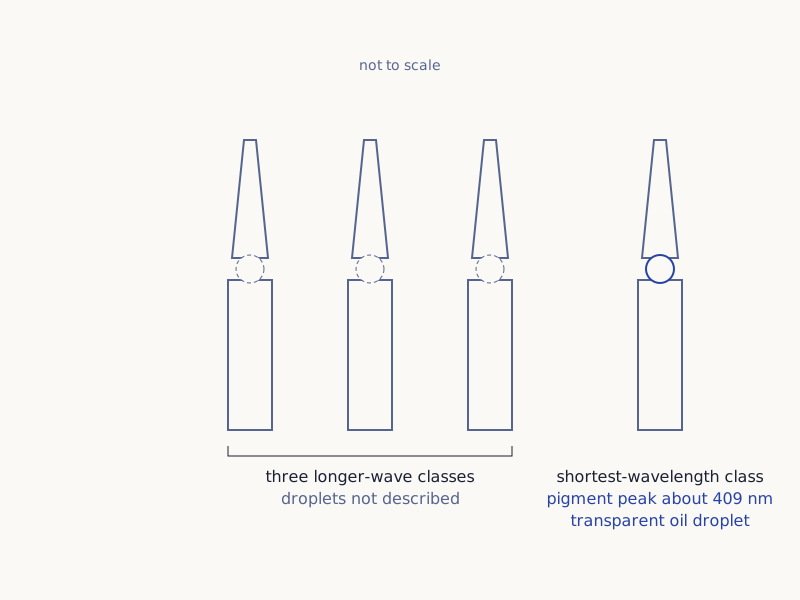
Count the cones in Figure 3: four kinds, and only one carries a number. Bowmaker and colleagues (1997) measured how single light-sensing cells in four bird species absorb light [3]. According to the abstract, pigeons have the same three longer-wave cone classes as budgerigars and zebra finches [3]. A fourth class has a pigment that absorbs best at about 409 nanometers, with a transparent oil droplet [3].
Wide drawing on a small screen: swipe sideways, or open it full size.
Figure 3. Schematic of the four single-cone classes the 1997 abstract reports in pigeons, not to scale; only the shortest-wavelength class has a stated peak and droplet.
Diagram: Tricks of Ear and Eye, CC BY 4.0
Full credit line to copy
"Single-cone classes of the pigeon, schematic" by Tricks of Ear and Eye, https://tricksofearandeye.com/animal-senses/pigeon-vision/, licensed under CC BY 4.0, https://creativecommons.org/licenses/by/4.0/
The abstract gives peak wavelengths for those three classes only in the budgerigar and zebra finch. In those birds, the cones carry colored oil droplets that act as long-pass filters: they pass only light longer than a cut-off wavelength [3]. Figure 3 leaves both out: the abstract gives neither for pigeons. The abstract's sentence on double cones also names only those two species [3].
Counting receptor types does not measure color vision: some mantis shrimp have 12 photoreceptor types for color, yet they did poorly at telling wavelengths apart in behavior tests, according to the abstract of Thoen and colleagues (2014) [5]. The mantis shrimp eyes entry covers those tests. A pigment survey measures absorbed light. It does not show what colors look like to a pigeon.
Where does the shortest cone peak?
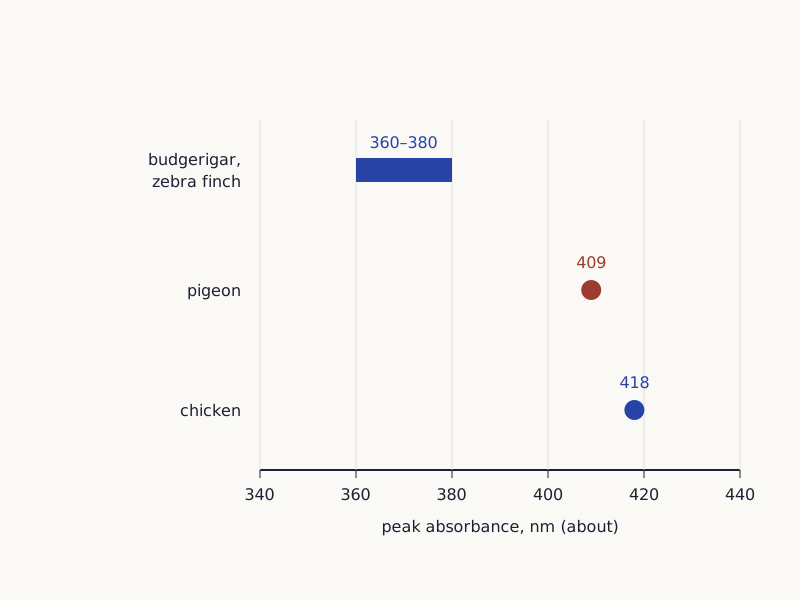
Find 409 in Figure 4, then the bar above and to its left. That bar marks the peaks, about 360–380 nm, of the UV-sensitive cones the abstract reports in budgerigars and zebra finches [3]. The pigeon's peak sits about 29 nm above that range (computed for this page), and the authors found "no evidence" of a UV-sensitive fifth class in pigeons [3]. The chicken's matching pigment, which the authors call "chicken violet," peaks at about 418 nm [3].
Wide drawing on a small screen: swipe sideways, or open it full size.
Figure 4. Pigment peak absorbance of the shortest-wavelength single cone in four bird species, as reported in one 1997 abstract.
Chart: Tricks of Ear and Eye, CC BY 4.0
Full credit line to copy
"Shortest single-cone peaks in four bird species" by Tricks of Ear and Eye, https://tricksofearandeye.com/animal-senses/pigeon-vision/, licensed under CC BY 4.0, https://creativecommons.org/licenses/by/4.0/
| Species | Shortest single cone, peak absorbance | How the abstract classes it |
|---|---|---|
| Budgerigar, zebra finch | about 360–380 nm | ultraviolet-sensitive |
| Pigeon | about 409 nm | no ultraviolet-sensitive class found |
| Chicken | about 418 nm | "chicken violet" |
An older title points the other way. A 1978 paper by Kreithen and Eisner in Nature is titled "Ultraviolet light detection by the homing pigeon" [4]. This site has read only its bibliographic record, so it cannot say what was tested or found, or how that fits with the 1997 survey. The fact table (CSV) (where the data come from and its license, JSON) Data: Field-of-view rows from Delacoux & Kano 2024 (eLife, CC BY 4.0) and Kano et al. 2022 (Sci. Rep., CC BY 4.0); cone rows are single values from the abstract of Bowmaker, Heath, Wilkie & Hunt 1997 (Vision Research), cited row by row lists every bird value above, one claim per row; the percept card (CSV) (where the data come from and its license, JSON) is also a download.
Do pigeons see the Müller-Lyer illusion?
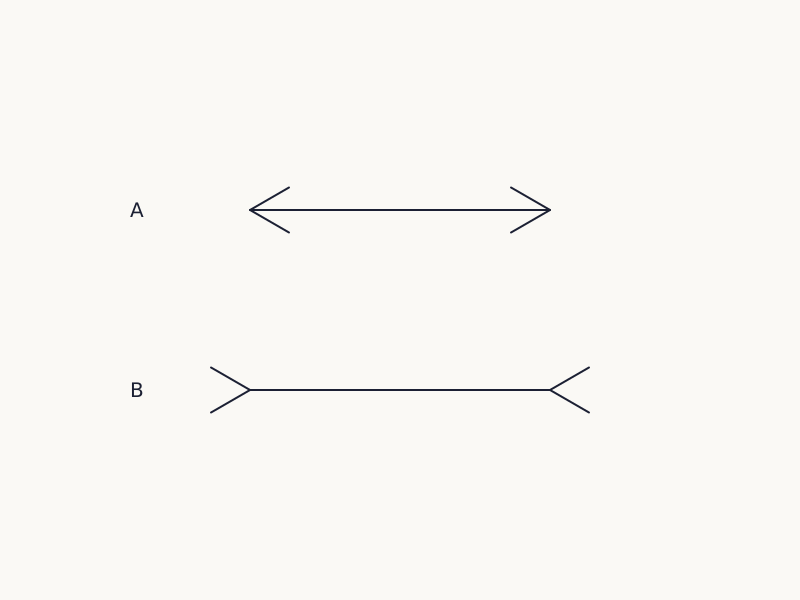
Wide drawing on a small screen: swipe sideways, or open it full size.
Figure 5. The Müller-Lyer drawing from this site's entry on the illusion, two shafts of 300 units each; it was not used in the pigeon studies.
Diagram: Tricks of Ear and Eye, CC BY 4.0
Full credit line to copy
"Müller-Lyer stimulus, independent design" by Tricks of Ear and Eye, https://tricksofearandeye.com/animal-senses/pigeon-vision/, licensed under CC BY 4.0, https://creativecommons.org/licenses/by/4.0/
Compare the two shafts in Figure 5: they are equal, as the Müller-Lyer illusion entry checks. Three pigeons chose in line with the standard figure but not with a reversed version that humans do respond to (Nakamura et al., 2006, abstract) [6]. With longer fins, the pigeons' overestimation kept growing while that of humans shrank (Nakamura et al., 2009, abstract) [7].
These were trained choices: the birds first learned to sort lines as "long" or "short" by pecking one of two keys [6]. They show that the fins shift which line a pigeon picks. They do not show what the line looks like to that pigeon. The bat echolocation entry keeps the same split between a recorded response and an experience.
Sources
- Delacoux, M., & Kano, F. (2024). Fine-scale tracking reveals visual field use for predator detection and escape in collective foraging of pigeon flocks. eLife 13: RP95549. Open the sourceRead: full textText license: CC BY 4.0
- Kano, F., Naik, H., Keskin, G., Couzin, I. D., & Nagy, M. (2022). Head-tracking of freely-behaving pigeons in a motion-capture system reveals the selective use of visual field regions. Scientific Reports 12: 19113. Open the sourceRead: full textText license: CC BY 4.0
- Bowmaker, J. K., Heath, L. A., Wilkie, S. E., & Hunt, D. M. (1997). Visual pigments and oil droplets from six classes of photoreceptor in the retinas of birds. Vision Research 37(16): 2183–2194. Open the sourceRead: abstract only
- Kreithen, M. L., & Eisner, T. (1978). Ultraviolet light detection by the homing pigeon. Nature 272(5651): 347–348. Open the sourceRead: bibliographic record only
- Thoen, H. H., How, M. J., Chiou, T.-H., & Marshall, J. (2014). A different form of color vision in mantis shrimp. Science 343(6169): 411–413. Open the sourceRead: abstract only
- Nakamura, N., Fujita, K., Ushitani, T., & Miyata, H. (2006). Perception of the standard and the reversed Müller-Lyer figures in pigeons (Columba livia) and humans (Homo sapiens). Journal of Comparative Psychology 120(3): 252–261. Open the sourceRead: abstract only
- Nakamura, N., Watanabe, S., & Fujita, K. (2009). Further analysis of perception of the standard Müller-Lyer figures in pigeons (Columba livia) and humans (Homo sapiens): effects of length of brackets. Journal of Comparative Psychology 123(3): 287–294. Open the sourceRead: abstract only
Sense check:
One step, under a minute
Close your right eye, hold a finger at arm's length straight ahead, and slowly sweep it to the right until it disappears. Then open both eyes, still looking ahead, and notice which eye brings the finger back. Next: Mantis shrimp eyes · Müller-Lyer illusion
Related entries
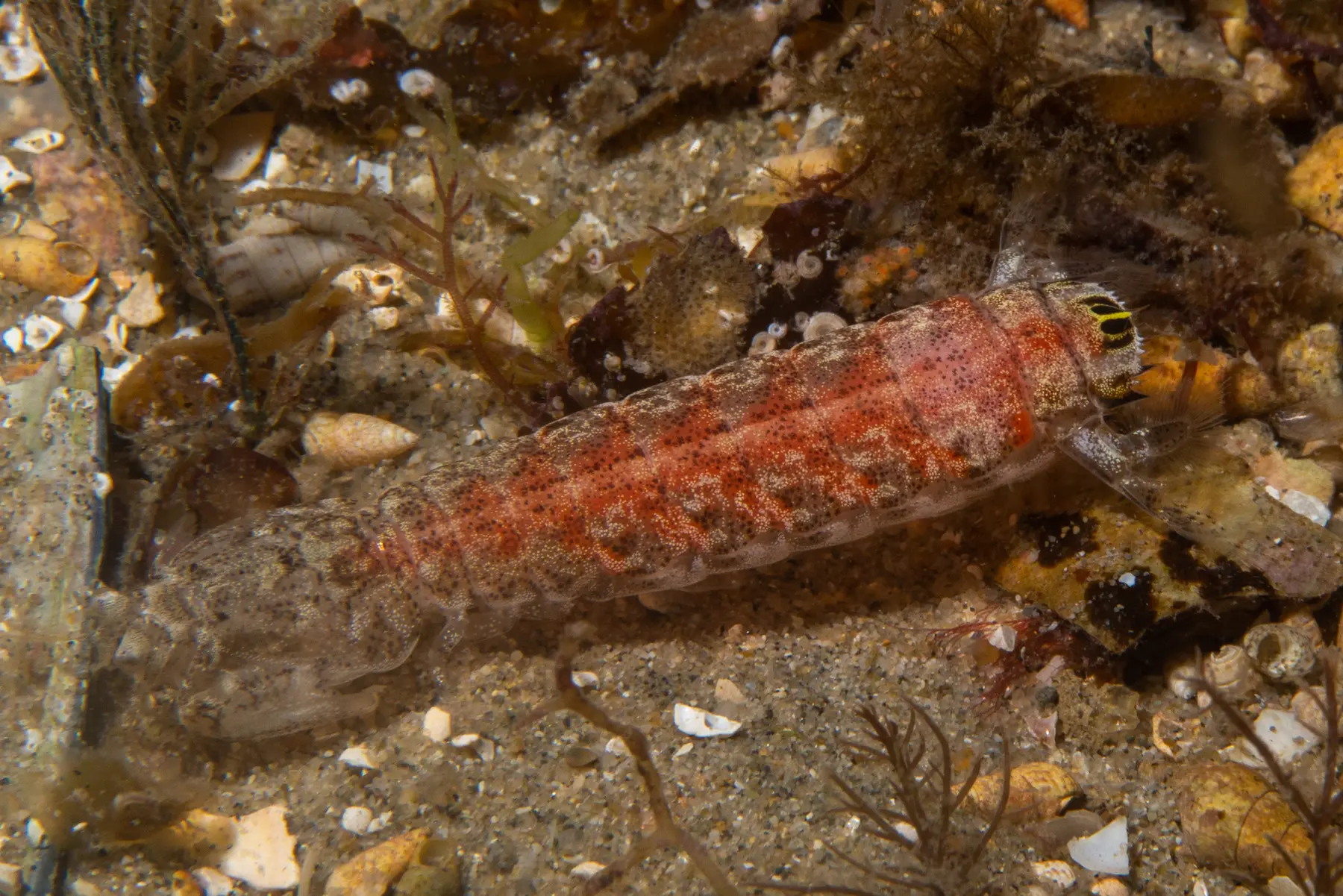
Mantis Shrimp Eyes: A Tested Species Told Hues Apart Poorly
Animal Senses
Some mantis shrimp have 12 kinds of color receptor, yet in tests they needed wavelengths 15–25 nm apart to tell them apart. Humans manage 1–8 nm.
Image credit
"Slender Mantis Shrimp (Austrosquilla osculans)" by Christopher Mark — https://commons.wikimedia.org/wiki/File:Austrosquilla_osculans_61399682.jpg — CC BY 4.0 (https://creativecommons.org/licenses/by/4.0/)
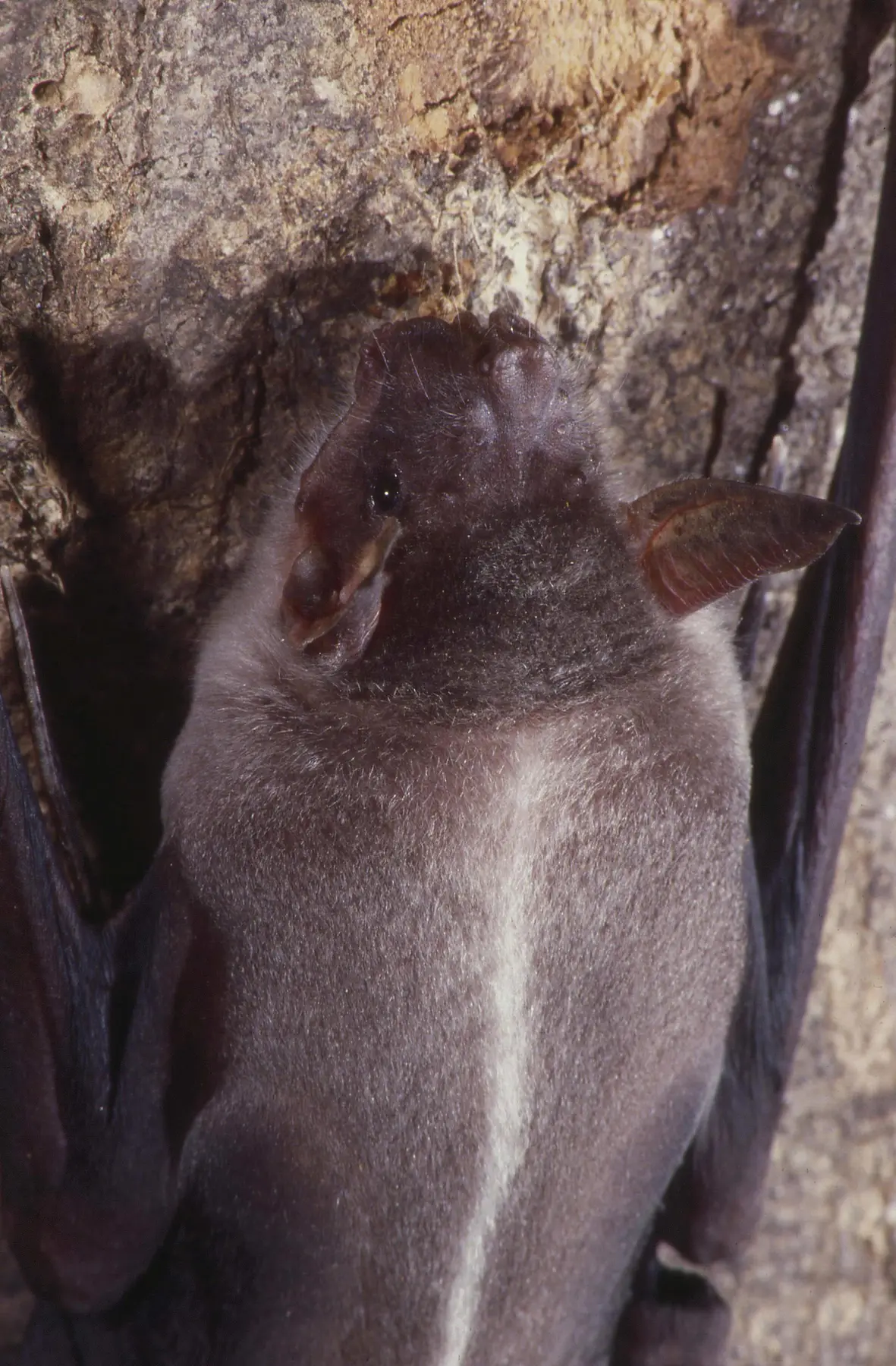
Bat Echolocation: In a Study, Search Calls Peaked at 25+ kHz
Animal Senses
In field recordings of 11 bat species in Panama, the strongest call frequency was above 20 kHz in every one. How loud the calls were, and how echoes give range.
Image credit
"Greater Bulldog Bat, Noctilio leporinus" by Susan Ellis, Bugwood.org — https://commons.wikimedia.org/wiki/File:Captive_Noctilio_leporinus.jpg — CC BY 3.0 (https://creativecommons.org/licenses/by/3.0/us/)
Cite this page
Tricks of Ear and Eye. "Pigeon Vision: Most of What It Sees, It Sees With One Eye." Tricks of Ear and Eye. Published 2026-10-30. https://tricksofearandeye.com/animal-senses/pigeon-vision/. Accessed on the date you read it.