Bat Echolocation: In a Study, Search Calls Peaked at 25+ kHz
Tricks of Ear and Eye Published
At 56 kilohertz, the strongest frequency in greater bulldog bat search calls, one wavelength is about 6 millimeters. In Surlykke and Kalko's 2008 field recordings of 11 bat species in Panama, the frequency carrying the most energy was above 20 kilohertz in every species [1]. That is about the upper limit Hunter and colleagues (2020) give for young, healthy ears [2]. Echolocating bats judge distance by timing the echoes of their calls [3], and each meter to an object adds about 5.8 milliseconds.
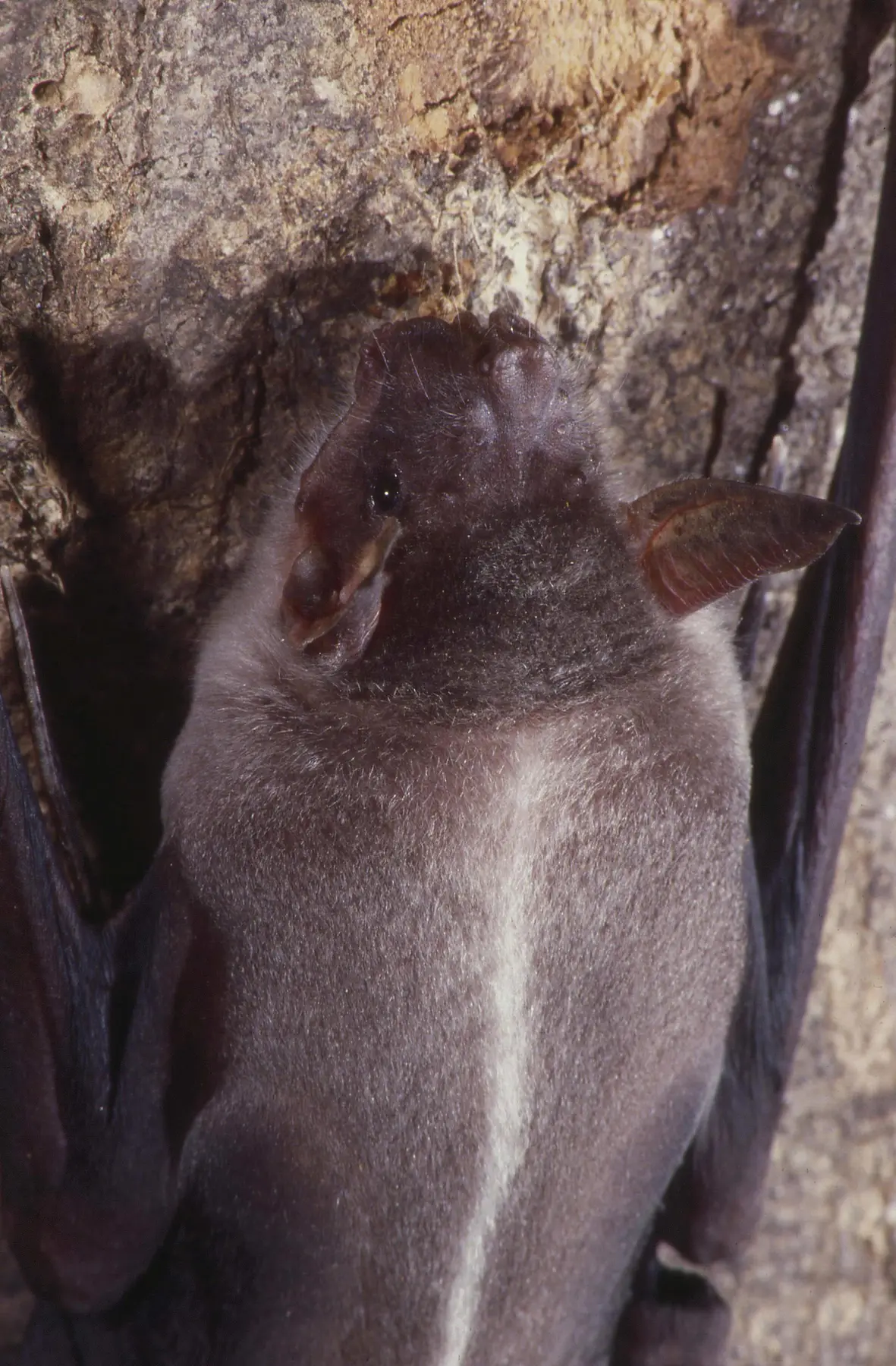
Figure 1. A greater bulldog bat (Noctilio leporinus), an adult kept in captivity, originally caught in Puerto Rico and photographed in the United States.
"Greater Bulldog Bat, Noctilio leporinus" by Susan Ellis, Bugwood.org — https://commons.wikimedia.org/wiki/File:Captive_Noctilio_leporinus.jpg — CC BY 3.0 (https://creativecommons.org/licenses/by/3.0/us/)
Which frequencies do bats call at?
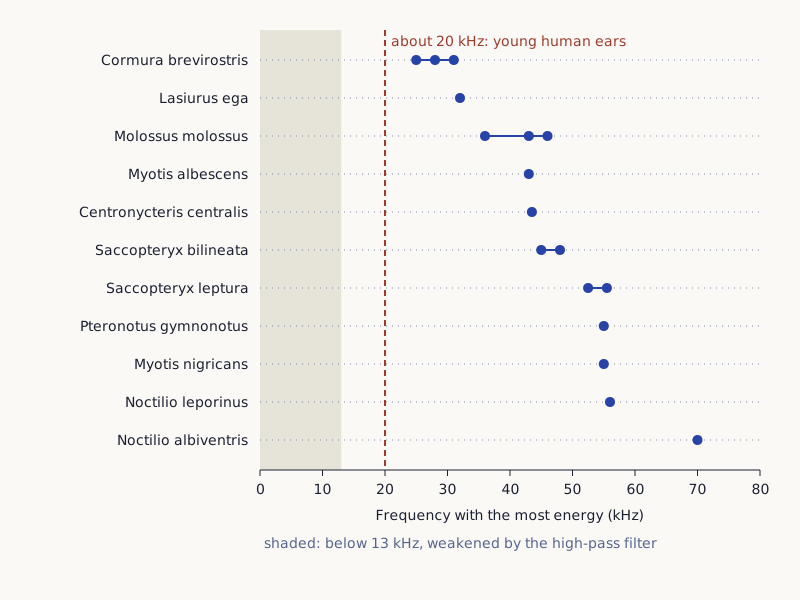
Look at Figure 2. Each dot is the frequency with the most energy in the search calls of one species, from Table 1 of Surlykke and Kalko (2008) [1]. Search calls are those a bat makes while it looks for prey, before it closes in [4]. All 11 species sit to the right of the dashed line at 20 kilohertz.
Wide drawing on a small screen: swipe sideways, or open it full size.
Figure 2. Frequency with the most energy in the search calls of 11 bat species recorded in Panama, from Surlykke and Kalko (2008), against a line at 20 kilohertz.
Chart: Tricks of Ear and Eye, CC BY 4.0
Full credit line to copy
"Peak-energy frequency of 11 bat species against 20 kHz" by Tricks of Ear and Eye, https://tricksofearandeye.com/animal-senses/bat-echolocation/, licensed under CC BY 4.0, https://creativecommons.org/licenses/by/4.0/
Data: Surlykke, A., & Kalko, E. K. V. (2008). Echolocating bats cry out loud to detect their prey. PLoS ONE 3(4): e2036, https://doi.org/10.1371/journal.pone.0002036, licensed under CC BY 4.0
The lowest values belong to Cormura brevirostris, at 25 to 31 kilohertz [1]. The highest is 70 kilohertz, for the lesser bulldog bat, Noctilio albiventris. The greater bulldog bat, N. leporinus, sits at 56 [1]. Where Table 1 lists more than one value for a species, Figure 2 joins them with a line.
| Species | Frequency with the most energy in search calls (kHz) | Average source level at 10 cm, from calls 5–10 m away (dB SPL) |
|---|---|---|
| Cormura brevirostris | 25; 28; 31 | 120.5 |
| Lasiurus ega | 32 | 117.5 |
| Molossus molossus | 36; 43; 46 | 118.0 |
| Myotis albescens | 43 | not given (recorded only at 1.5–2 m) |
| Centronycteris centralis | 43.5 | 123.7 |
| Saccopteryx bilineata | 45; 48 | 121.8 |
| Saccopteryx leptura | 52.5; 55.5 | 126.8 |
| Pteronotus gymnonotus | 55 | 123.9 |
| Myotis nigricans | 55 | 114.3 |
| Noctilio leporinus | 56 | 132.6 |
| Noctilio albiventris | 70 | 133.7 |
Two limits keep this from being a claim about every bat sound. The table gives the frequency with the most energy, not the lowest in each call. The recording chain's 13-kilohertz high-pass filter weakened anything lower, so it was not measured accurately [1]. The bat call facts table (CSV) (where the data come from and its license, JSON) Data: Surlykke, A., & Kalko, E. K. V. (2008). Echolocating bats cry out loud to detect their prey. PLoS ONE 3(4): e2036, https://doi.org/10.1371/journal.pone.0002036, licensed under CC BY 4.0; One value (about 20 kHz, young, healthy people) paraphrased from Hunter et al. (2020), Hearing Research 397: 107922 keeps both limits on the same rows as the numbers.
Both sides of the comparison
On the human side, Hunter and colleagues (2020) put the usual upper limit for pure tones in young, healthy people at around 20 kilohertz [2]. The greater bulldog bat's 56 kilohertz [1] is about 2.8 times that, in the same unit. This site calls such a comparison the sensory exchange rate, its label (not a scientific term) for a conversion that writes out both numbers, their units and their sources. Put plainly, it divides one frequency by another and says nothing about what either listener experiences.
A frequency in a recording is a measured signal. It does not tell you what the call is like for the bat. The mantis shrimp entry draws the same line for color. The pigeon vision entry keeps that line for birds.
How loud is a bat call, and how was it measured?
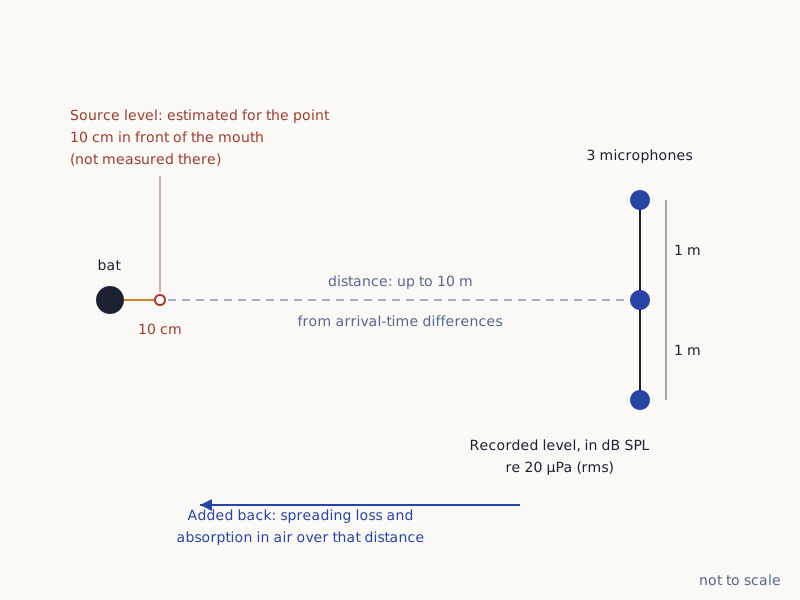
Figure 3 shows how the loudness numbers were made. Surlykke and Kalko recorded bats in flight with three microphones set 1 meter apart in a line [1]. Small differences in arrival time told them how far away each bat was. They took the level recorded at the microphones, in decibels of sound pressure (dB SPL, rms, referenced to 20 micropascals), and added back what spreading and the air had removed on the way [1].
Wide drawing on a small screen: swipe sideways, or open it full size.
Figure 3. How the source levels were estimated: the level recorded at the microphones, worked back to 10 centimeters from the mouth (not to scale).
Diagram: Tricks of Ear and Eye, CC BY 4.0
Full credit line to copy
"How bat call source levels were estimated" by Tricks of Ear and Eye, https://tricksofearandeye.com/animal-senses/bat-echolocation/, licensed under CC BY 4.0, https://creativecommons.org/licenses/by/4.0/
Data: Method described in Surlykke, A., & Kalko, E. K. V. (2008). Echolocating bats cry out loud to detect their prey. PLoS ONE 3(4): e2036, https://doi.org/10.1371/journal.pone.0002036, licensed under CC BY 4.0
The result is called the source level. It is an estimate for a point 10 centimeters in front of the mouth, not a measurement made there [1]. By that measure, the two bulldog bats, which hunt low over water, were the loudest. The authors sum up their average source levels as about 137 dB SPL, with maximum levels above 140, the loudest the authors knew of for any bat [1].
In Table 1, that figure matches the average of the loudest call in each approach flight, 136.4 dB SPL for N. leporinus and 136.6 for N. albiventris, while the all-call averages in the table above are lower [1]. The highest single estimates were 142.7 and 143.5 [1]. Sound reflected off the water probably raised both bulldog bats' figures by about 6 decibels, the authors caution [1].
These numbers belong to these 11 species, these recordings and this reference point. A decibel figure taken at another distance, or against another reference pressure, cannot be lined up against them. So this page does not set them beside everyday noises.
Louder did not mean farther. High frequencies fade fast in air, and the loudest bats also called at the highest frequencies [1]. The authors used a simple sonar equation with an assumed detection threshold to estimate how far away bats of nine species could pick up a large moth. Their answer was 9 meters for N. albiventris and 11 meters for N. leporinus, but 17 meters for the quieter, lower-frequency Cormura brevirostris [1].
How do bats measure distance?
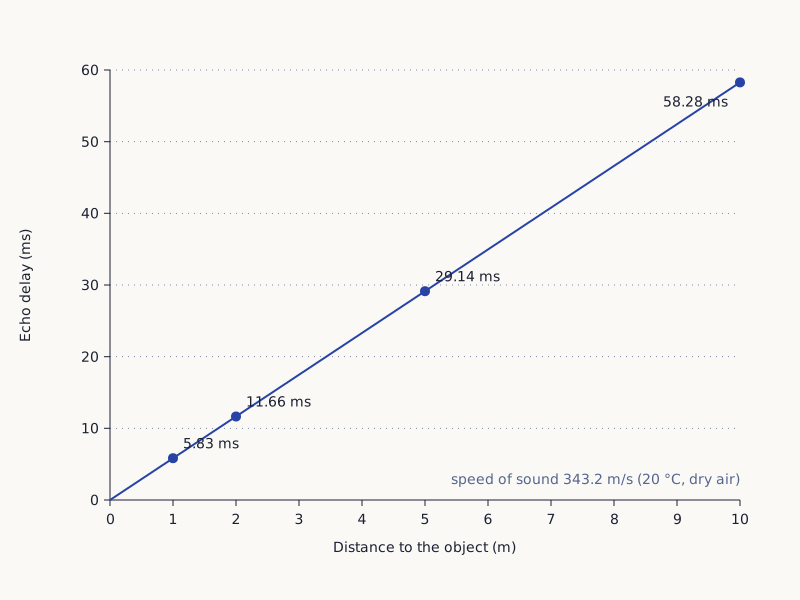
Pick any point on Figure 4. A call travels out to an object and its echo travels back, so the delay is twice the distance divided by the speed of sound. This page computes that speed as 343.2 meters per second, from the ideal-gas formula for dry air at 20 °C. At that speed, an object 1 meter away returns its echo after about 5.83 milliseconds, and one 10 meters away after about 58.28 (echo delay table (CSV) (where the data come from and its license, JSON)).
Wide drawing on a small screen: swipe sideways, or open it full size.
Figure 4. Echo delay against distance to the object, at a speed of sound of 343.2 meters per second (20 °C, dry air).
Chart: Tricks of Ear and Eye, CC BY 4.0
Full credit line to copy
"Echo delay against distance" by Tricks of Ear and Eye, https://tricksofearandeye.com/animal-senses/bat-echolocation/, licensed under CC BY 4.0, https://creativecommons.org/licenses/by/4.0/
The figure check (CSV) (where the data come from and its license, JSON) compares every plotted value in Figures 2 and 4 with its data row; it checks the drawings, not the sources.
In a 2022 review, Beetz and Hechavarría describe how bats time the gap between a call and its echo to judge distance [3]. The delay grows by 1 millisecond for every 17 centimeters [3]. When an object is only a few centimeters away, call and echo overlap, and bats are thought to use spectral cues instead [3].
The same speed sets the wavelength. A 56-kilohertz wave is about 6.1 millimeters long, and a 20-kilohertz wave about 17.2 millimeters (computed for this page). This matters for small prey. Denzinger and Schnitzler (2013) note that echoes weaken once an insect's wing is about as long as the wavelength or shorter: below about 34 millimeters at 10 kilohertz, and 3.4 millimeters at 100 kilohertz [4].
Neurons tuned to a delay
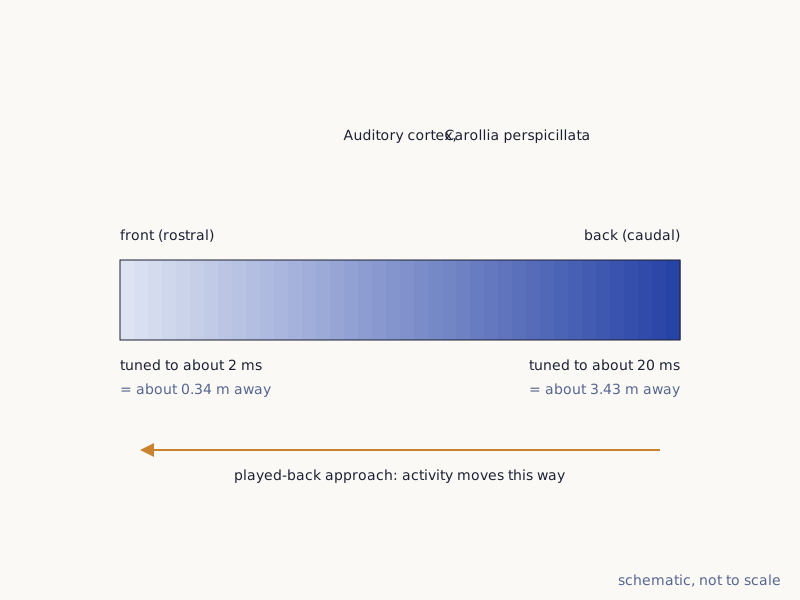
One of the best-described cell types in bat research is the delay-tuned neuron. Each one responds most strongly to a particular gap between a call and its echo [3]. In the auditory cortex of many bat species, these neurons are laid out as a map, with long delays in one region and short delays in another [3]. In Carollia perspicillata, cells tuned to about 20 milliseconds cluster toward the back, and cells tuned to about 2 milliseconds toward the front [3].
Wide drawing on a small screen: swipe sideways, or open it full size.
Figure 5. Delay map in the auditory cortex of Carollia perspicillata as described by Beetz and Hechavarría (2022), drawn as a schematic, not to scale.
Diagram: Tricks of Ear and Eye, CC BY 4.0
Full credit line to copy
"Delay map in the bat auditory cortex, schematic" by Tricks of Ear and Eye, https://tricksofearandeye.com/animal-senses/bat-echolocation/, licensed under CC BY 4.0, https://creativecommons.org/licenses/by/4.0/
Data: Described in Beetz, M. J., & Hechavarría, J. C. (2022). Neural processing of naturalistic echolocation signals in bats. Frontiers in Neural Circuits 16: 899370, https://doi.org/10.3389/fncir.2022.899370, licensed under CC BY 4.0
At 343.2 meters per second, those two delays stand for objects about 3.43 and 0.34 meters away (computed for this page). In one study, anesthetized bats of this species heard the calls and echoes of an approach flight played back. As the delays shortened, activity moved across the map from the long-delay end to the short-delay end (Beetz and Hechavarría, 2022, describing Beetz and colleagues, 2016) [3]. The wave did not appear when the same call-echo pairs were played in random order [3].
These are recordings from bats listening to played-back sounds in a lab. They show which neurons respond to which delay. They do not show what an echo is like for the bat.
The speed of sound is not fixed. Goerlitz (2018) calculated that it rises by about 0.6 meters per second for each degree Celsius [5]. Between 5 and 40 °C, it ran from about 335 meters per second at the cold end to about 355 to 360 at the warm end [5]. The Doppler effect entry uses the same 343.2 meters per second to show what motion does to a frequency.
Do bats change their calls when hunting?
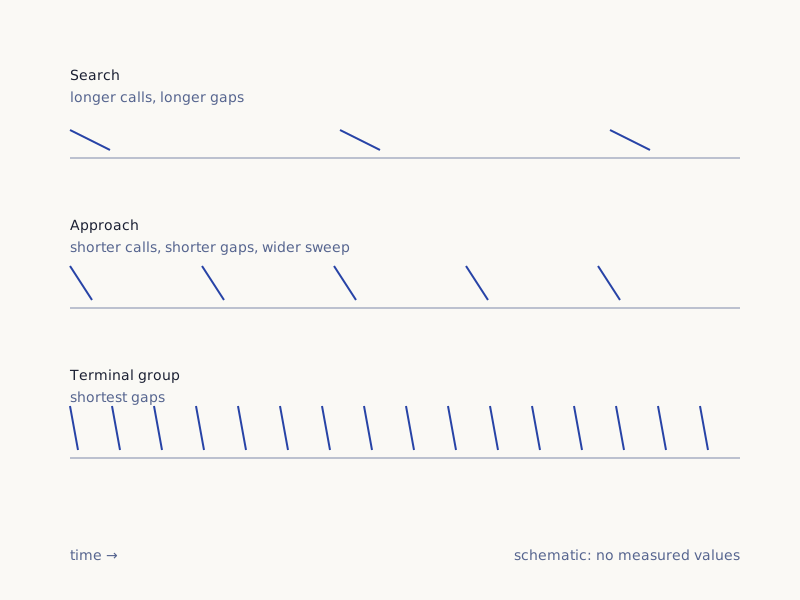
Read Figure 6 from top to bottom. It sketches a pattern that Denzinger and Schnitzler (2013) describe for bats that catch flying insects in open space [4]. Once such a bat detects prey, it shortens its calls and the gaps between them, and widens each frequency sweep [4]. The sequence ends in a terminal group of two buzz phases, and in the second phase the gaps stay at about 6 milliseconds [4].
Wide drawing on a small screen: swipe sideways, or open it full size.
Figure 6. How calls change from search to approach to the terminal group, drawn as a schematic with no measured values.
Diagram: Tricks of Ear and Eye, CC BY 4.0
Full credit line to copy
"Search, approach and terminal calls, schematic" by Tricks of Ear and Eye, https://tricksofearandeye.com/animal-senses/bat-echolocation/, licensed under CC BY 4.0, https://creativecommons.org/licenses/by/4.0/
Data: Pattern described in Denzinger, A., & Schnitzler, H.-U. (2013). Bat guilds, a concept to classify the highly diverse foraging and echolocation behaviors of microchiropteran bats. Frontiers in Physiology 4: 164, https://doi.org/10.3389/fphys.2013.00164, licensed under CC BY 3.0
Bats that hunt near vegetation also end their approach with a terminal group [4]. Shorter calls help with timing. Denzinger and Schnitzler explain that a call can mask an echo that overlaps it or arrives soon after it, and that bats tend to avoid this overlap [4]. For a 5-millisecond call, echoes from anything closer than about 0.86 meters would arrive before the call ends (computed for this page).
Loudness changes too. In the Panama study, bats closing in on the background cut their output by 4 to 7 decibels per halving of distance; Table 1 gives that slope for 6 of the 11 species [1].
The bulldog bats also switch call types. Noctilio species sometimes use search calls that start at a constant frequency and end in a sweep, but they switch to pure sweeps when approaching prey [4]. Rhinolophid bats and other "flutter detecting" hunters keep a long constant-frequency part, correct it for the Doppler shift of their own flight, and so hold the echo inside a band of very sharply tuned neurons that the review calls an auditory fovea [4]. According to the same review, Noctilio has no such fovea [4].
What happens when a call is slowed down tenfold?
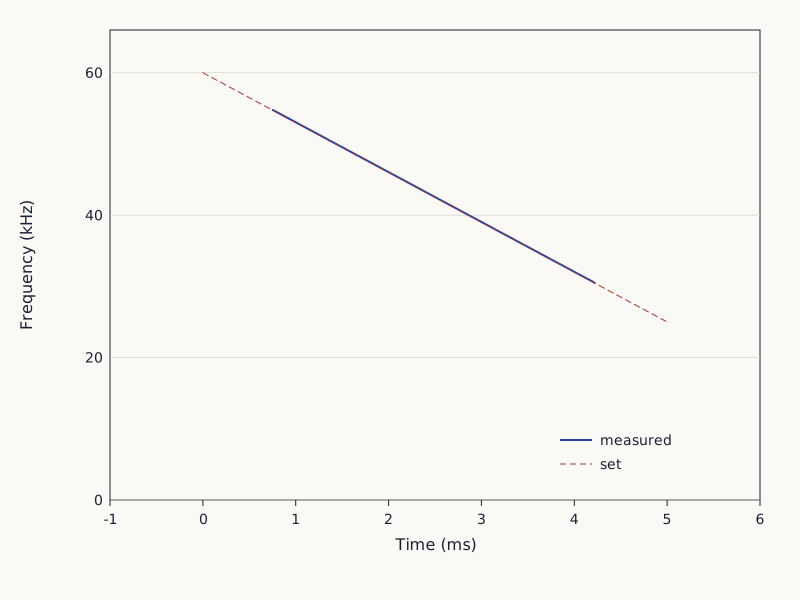
Figure 7 shows a synthetic call made for this page. It is not a recording and not a model of any species. It is a sweep from 60 to 25 kilohertz lasting 5 milliseconds, repeated five times, 100 milliseconds apart. Its sample rate of 192,000 per second is more than an MP3 file can carry, so it is published only as its parameter file (CSV) (where the data come from and its license, JSON), its spectrum check (CSV) (where the data come from and its license, JSON) and this picture.
Wide drawing on a small screen: swipe sideways, or open it full size.
Figure 7. Spectrogram of the first of five synthetic calls, sweeping from 60 to 25 kilohertz in 5 milliseconds; solid line measured from the file, dashed line as set.
Chart: Tricks of Ear and Eye, CC BY 4.0
Full credit line to copy
"Spectrogram of the synthetic call" by Tricks of Ear and Eye, https://tricksofearandeye.com/animal-senses/bat-echolocation/, licensed under CC BY 4.0, https://creativecommons.org/licenses/by/4.0/
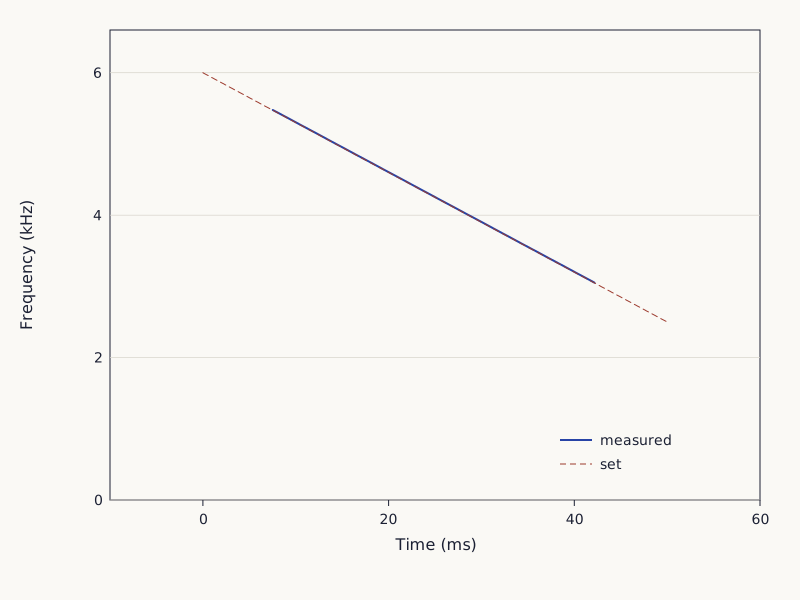
The slowed version below uses the same samples, written at one tenth of the sample rate: every frequency is divided by 10 and every duration multiplied by 10. The sweeps now run from 6 to 2.5 kilohertz over 50 milliseconds, one per second. That range sits well inside the pure-tone range Hunter and colleagues describe for young, healthy listeners [2].
Turn your volume down before you press play.
Clip 1. Slowed 10x, not a real bat call: the synthetic sweep played at one tenth of its speed, from 6 to 2.5 kilohertz in 50 milliseconds.
Slowed 10x, not a real bat call: five synthetic sweeps from 6 to 2.5 kHz, 50 ms each, one per second, 6 s in all
Length · MP3, starts only when you press play
- Download this clip (MP3)
- Synthesis parameters (JSON, bat-echolocation-audio-call-slowed-10x.json) (where it comes from and its license, JSON)
- Spectrum check output (CSV, bat-echolocation-audio-call-slowed-10x-verify.csv) (where it comes from and its license, JSON)
The spectrum check shows that the clip was synthesized with the parameters above. It does not show that any listener will hear the effect.
Sound: Tricks of Ear and Eye, CC BY 4.0
Full credit line to copy
"Synthetic bat-like call, slowed 10x" by Tricks of Ear and Eye, https://tricksofearandeye.com/animal-senses/bat-echolocation/, licensed under CC BY 4.0, https://creativecommons.org/licenses/by/4.0/
Wide drawing on a small screen: swipe sideways, or open it full size.
Figure 8. Spectrogram of the first slowed call, sweeping from 6 to 2.5 kilohertz in 50 milliseconds; solid line measured from the file, dashed line as set.
Chart: Tricks of Ear and Eye, CC BY 4.0
Full credit line to copy
"Spectrogram of the slowed synthetic call" by Tricks of Ear and Eye, https://tricksofearandeye.com/animal-senses/bat-echolocation/, licensed under CC BY 4.0, https://creativecommons.org/licenses/by/4.0/
| Version | Sweep | Sweep length | Calls and spacing | Total length | Sample rate |
|---|---|---|---|---|---|
| Original (no audio file) | 60 to 25 kHz | 5 ms | 5 calls, 100 ms apart | 0.6 s | 192 kHz |
| Slowed 10x | 6 to 2.5 kHz | 50 ms | 5 calls, 1 s apart | 6 s | 19.2 kHz (MP3 at 48 kHz) |
The spectrum checks show that both files match their parameters, within the tolerances listed in each check file. They do not show what any listener hears, and the slowed clip is a listening aid, not a bat call.
Sources
- Surlykke, A., & Kalko, E. K. V. (2008). Echolocating bats cry out loud to detect their prey. PLoS ONE 3(4): e2036. Open the sourceRead: full textText license: CC BY 4.0
- Hunter, L. L., Monson, B. B., Moore, D. R., Dhar, S., Wright, B. A., Munro, K. J., Zadeh, L. M., Blankenship, C. M., Stiepan, S. M., & Siegel, J. H. (2020). Extended high frequency hearing and speech perception implications in adults and children. Hearing Research 397: 107922. Open the sourceRead: author manuscript; paraphrased
- Beetz, M. J., & Hechavarría, J. C. (2022). Neural processing of naturalistic echolocation signals in bats. Frontiers in Neural Circuits 16: 899370. Open the sourceRead: full textText license: CC BY 4.0
- Denzinger, A., & Schnitzler, H.-U. (2013). Bat guilds, a concept to classify the highly diverse foraging and echolocation behaviors of microchiropteran bats. Frontiers in Physiology 4: 164. Open the sourceRead: full textText license: CC BY 3.0
- Goerlitz, H. R. (2018). Weather conditions determine attenuation and speed of sound: Environmental limitations for monitoring and analyzing bat echolocation. Ecology and Evolution 8: 5090–5100. Open the sourceRead: full textText license: CC BY 4.0
Sense check:
One step, under a minute
Work out 2 × 1 m ÷ 343.2 m/s, turn the answer into milliseconds, and find that value on Figure 4. That is how long an echo takes to come back from something 1 meter away. Next: Mantis shrimp eyes · Doppler effect
Related entries

Mantis Shrimp Eyes: A Tested Species Told Hues Apart Poorly
Animal Senses
Some mantis shrimp have 12 kinds of color receptor, yet in tests they needed wavelengths 15–25 nm apart to tell them apart. Humans manage 1–8 nm.
Image credit
"Slender Mantis Shrimp (Austrosquilla osculans)" by Christopher Mark — https://commons.wikimedia.org/wiki/File:Austrosquilla_osculans_61399682.jpg — CC BY 4.0 (https://creativecommons.org/licenses/by/4.0/)
Pigeon Vision: Most of What It Sees, It Sees With One Eye
Animal Senses
Pigeon vision: both eyes share about 20° in front; about 40° at the back is blind (2024 summary; values differ). Shortest cone: about 409 nm (1997 abstract).
Image credit
"Columba livia (Rock Dove, wild), Duncansby Head, Caithness, Scotland" by william_stephens — https://commons.wikimedia.org/wiki/File:Columba_livia_(Rock_Dove,_wild),_Duncansby_Head,_Caithness,_Scotland_1.jpg — CC BY 4.0 (https://creativecommons.org/licenses/by/4.0/)
Cite this page
Tricks of Ear and Eye. "Bat Echolocation: In a Study, Search Calls Peaked at 25+ kHz." Tricks of Ear and Eye. Published 2026-10-30. https://tricksofearandeye.com/animal-senses/bat-echolocation/. Accessed on the date you read it.